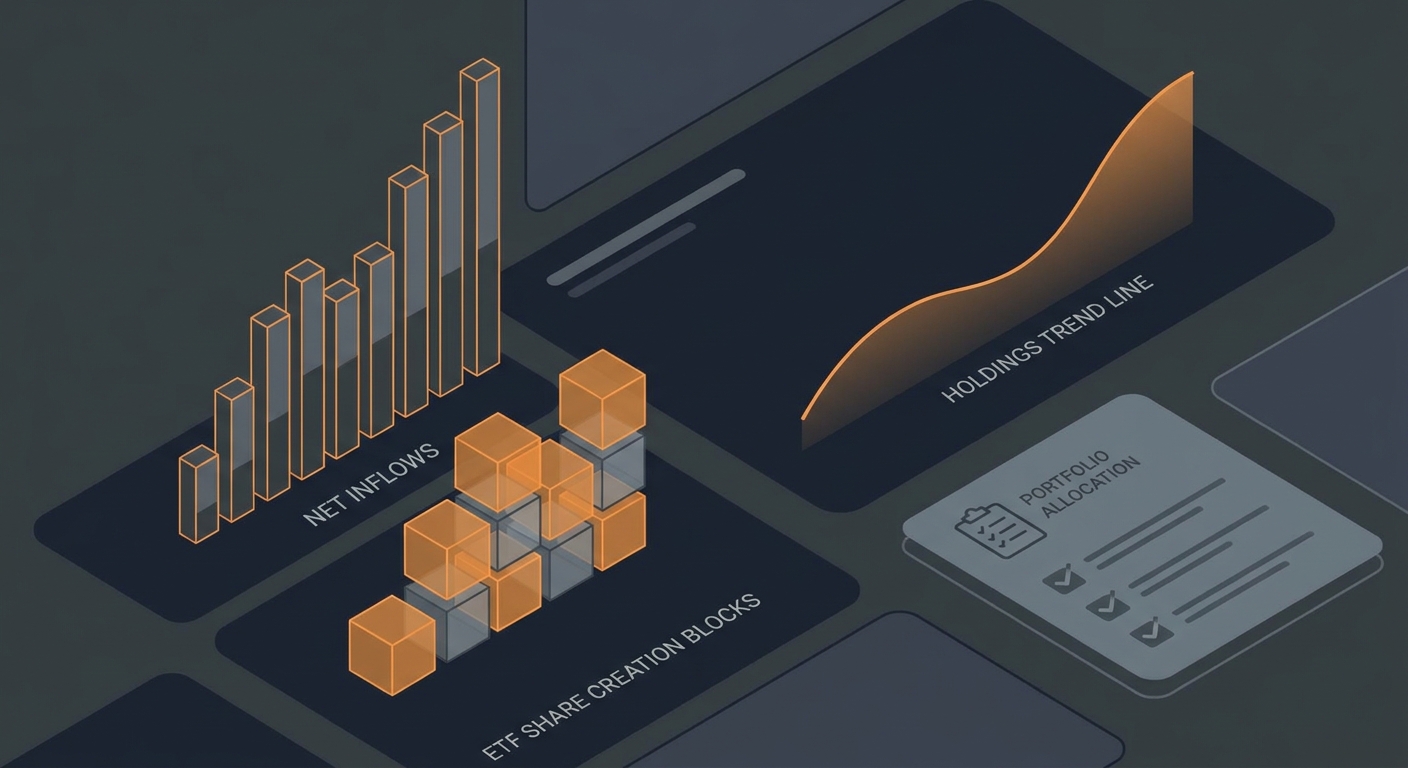
Bitcoin ETF Inflows Explained for Long-Term Investors
Bitcoin ETF inflows get treated like a scoreboard. One day of strong demand is called bullish. One day of outflows is called a warning. That framing is too shallow for anyone investing with a multi-year horizon.
For long-term investors, Bitcoin ETF inflows are useful because they show whether money is entering or leaving the ETF wrapper. They are not useful because they can predict the next candle with precision. A flow table can tell you something about demand. It cannot tell you, by itself, whether your allocation size, time horizon, or risk discipline still make sense.
The better question is not, "Were flows up today?" The better question is, "What do Bitcoin ETF inflows actually measure, and how much weight should a long-term investor give them?"
Risk note: This article is educational only. It is not investment advice. Bitcoin remains a highly volatile asset, and an ETF wrapper does not remove market, liquidity, or allocation risk.
What Bitcoin ETF inflows actually mean
At the simplest level, Bitcoin ETF inflows refer to net money moving into a Bitcoin exchange-traded fund over a given period. If new shares are created because demand is rising, that is an inflow. If shares are redeemed because money is leaving, that is an outflow.
For long-term investors, the key point is that Bitcoin ETF inflows measure investor demand for the fund structure, not just social-media sentiment. They tell you whether investors are allocating capital through a regulated exchange-traded product rather than holding nothing, selling, or using a different vehicle.
That matters because a Bitcoin ETF is not just a chart symbol. It is a fund structure with:
- Shares that trade on an exchange
- A net asset value tied to the fund's bitcoin holdings
- Authorized participants that create or redeem shares
- Custody, fee, and tracking mechanics that affect investor experience
When you read a flow table, you are reading activity inside that structure.
How ETF creation and redemption make inflows possible
Investor.gov explains that ETF shares are generally created and redeemed in large blocks through authorized participants rather than directly by ordinary investors. That creation and redemption process is the backbone behind daily flow numbers.
For Bitcoin ETF inflows, the sequence usually looks like this:
- Investor demand for the ETF rises.
- Authorized participants create new shares.
- The fund receives assets or cash through its creation process.
- The fund's asset base grows.
For U.S. spot Bitcoin products, the details of the process matter. The iShares Bitcoin Trust ETF prospectus states that the trust processes creations and redemptions in exchange for cash, with the trust then handling the related bitcoin transactions through designated counterparties. That means Bitcoin ETF inflows typically reflect real growth in the fund's asset base even though the operational path runs through cash creation and redemption.
This is the first reason flows matter: they are tied to actual fund growth, not just headline excitement.
Why Bitcoin ETF inflows get so much market attention
There are three practical reasons Bitcoin ETF inflows receive outsized attention.
1. They offer a visible demand signal
Flow data is one of the easiest public signals to read. Price action can be noisy. Social sentiment can be manipulated. But a fund taking in or losing assets is a cleaner sign that capital is moving.
That does not make Bitcoin ETF inflows perfect. It makes them legible.
2. They help explain the scale of allocation demand
A spot Bitcoin ETF turns a complex asset into a familiar wrapper for advisers, retirement accounts, family offices, and self-directed brokerage investors. When Bitcoin ETF inflows rise over weeks or months, they can show that a broader investor base is becoming willing to hold Bitcoin exposure inside a standard portfolio account.
For long-term investors, that is often more relevant than one-day price noise.
3. They can affect narrative and liquidity conditions
Persistent Bitcoin ETF inflows can strengthen the market narrative around adoption, access, and institutional comfort. Even when flows do not dictate same-day price direction, they can shape how investors interpret the market's underlying demand profile.
What Bitcoin ETF inflows do not tell you
This is where many articles fail. Bitcoin ETF inflows matter, but they do not answer every question a long-term investor cares about.
They do not tell you:
- Whether Bitcoin is cheap or expensive relative to your own plan
- Whether your allocation is too large for your risk tolerance
- Whether leverage in the broader market is overheating
- Whether the ETF is trading at a persistent premium or discount
- Whether a short-term move is sustainable
The iShares Bitcoin Trust ETF prospectus also notes that shares can trade at prices above or below net asset value. That means the ETF wrapper has its own market-trading behavior in addition to Bitcoin price behavior. Strong Bitcoin ETF inflows do not cancel out that reality.
For long-term investors, the main takeaway is simple: flows are a thermometer, not a complete diagnosis.
Why a single day of flows can mislead you
Many investors overreact to one daily number. A single session of large Bitcoin ETF inflows can be driven by timing, portfolio rebalancing, a block trade, or a short-lived sentiment shift. A single day of outflows can happen during profit-taking, tactical derisking, or broader market stress without changing the long-term ownership story.
That is why long-term investors should interpret Bitcoin ETF inflows in layers:
- Daily flows show short-term direction
- Weekly flows show whether momentum is broadening or fading
- Monthly and quarterly flows give better context for longer-horizon allocation behavior
The longer your investment horizon, the less useful it is to anchor your thinking to a one-day flow print.
How long-term investors should read Bitcoin ETF inflows
The most practical way to use Bitcoin ETF inflows is as one input inside a wider portfolio framework.
1. Ask whether flows are persistent, not just positive
One green day is not a thesis. A multi-week pattern is more informative. Long-term investors should care more about consistency than spectacle.
Questions worth asking:
- Are inflows broad across the category or concentrated in one fund?
- Are inflows holding up during market stress?
- Are outflows shallow and temporary or prolonged and accelerating?
Persistent Bitcoin ETF inflows can tell you more about steady adoption than any isolated headline can.
2. Compare flows with your intended allocation
The most common mistake is to treat strong Bitcoin ETF inflows as a reason to increase risk automatically. For a long-term investor, the right comparison is not flows versus price. It is flows versus plan.
If your investment policy says Bitcoin should remain a small satellite allocation, a week of strong ETF demand does not rewrite that policy. It may confirm broader interest in the asset class, but it does not decide your sizing for you.
3. Pair flows with custody, fees, and product structure
BlackRock's product materials emphasize that the ETF wrapper can simplify access by reducing the operational burden of direct crypto custody. That convenience matters, but long-term investors still need to review the structure they are using.
Alongside Bitcoin ETF inflows, ask:
- What exactly does the fund hold?
- How does the creation and redemption process work?
- What fees reduce long-term compounding?
- How is custody handled?
- Can shares trade away from NAV during stress?
Flows tell you demand. Structure tells you what you are actually buying.
The five things to watch besides Bitcoin ETF inflows
If you invest with a multi-year horizon, Bitcoin ETF inflows should sit beside five other checks.
1. Position size
No flow trend removes the need for disciplined sizing. Bitcoin can still experience large drawdowns inside a long-term uptrend.
2. Portfolio role
Is Bitcoin meant to be a small diversifying sleeve, a high-conviction growth asset, or a tactical trade? The answer should be set before you react to flows.
3. Rebalancing rules
Large price moves can make a modest Bitcoin allocation become a much larger portfolio weight. Strong Bitcoin ETF inflows do not remove the need to rebalance if your allocation drifts beyond plan.
4. Market structure
ETF demand is only one part of the picture. Spot liquidity, derivatives leverage, and broader risk sentiment can all matter.
5. Time horizon discipline
Long-term investors should use Bitcoin ETF inflows to understand adoption and demand conditions, not to chase every short-term swing.
A simple framework for using Bitcoin ETF inflows well
Use this checklist when you see a large flow headline:
- Confirm whether the number reflects one fund or the category.
- Check whether the trend has lasted more than one session.
- Separate demand evidence from price-chasing emotion.
- Revisit your target allocation before changing any exposure.
- Review product structure, fees, and tracking behavior if you use the ETF wrapper.
This turns Bitcoin ETF inflows into a decision aid rather than a trigger.
Where BTCMind fits
BTCMind is useful when you want to put one market signal in context instead of treating it like the whole story. The app's research workflow weighs multiple evidence streams in parallel, including market structure, derivatives, and risk framing, before a final conclusion is made. That is the right mindset for Bitcoin ETF inflows too. Flows can strengthen or weaken a case, but they should not replace an allocation plan or a risk process.
If you are evaluating Bitcoin through a long-term lens, the goal is not to react faster than everyone else. The goal is to read demand correctly, size exposure rationally, and stay consistent when headlines get loud.
Final take
Bitcoin ETF inflows matter because they show how much capital is moving into or out of the ETF structure. They can signal adoption, investor access, and shifts in demand. But for long-term investors, they work best as context, not as a command.
Use Bitcoin ETF inflows to answer a narrow question: is money entering the wrapper in a sustained way? Then answer the bigger questions separately:
- Does Bitcoin still fit your plan?
- Is the allocation size still appropriate?
- Does the ETF structure match your needs?
- Are you reacting to evidence or to excitement?
That is how long-term investors turn a noisy headline metric into something genuinely useful.
If you want a mobile workflow that treats crypto decisions as an evidence problem instead of a headline problem, review BTCMind's feature overview, see how the AI agents structure competing views, and use the download page to evaluate whether the app fits your process.
FAQ
What are Bitcoin ETF inflows?
Bitcoin ETF inflows are net new money entering a Bitcoin ETF over a given period, usually through the share-creation process that expands the fund's asset base.
Do Bitcoin ETF inflows guarantee a higher Bitcoin price?
No. Bitcoin ETF inflows can signal demand, but they do not guarantee short-term price direction. Other factors such as liquidity, leverage, sentiment, and portfolio rebalancing still matter.
Why do long-term investors care about Bitcoin ETF inflows?
Long-term investors care about Bitcoin ETF inflows because they help show whether the ETF wrapper is attracting sustained capital, which can be a useful adoption and demand signal.
What should I watch besides Bitcoin ETF inflows?
Watch allocation size, portfolio role, rebalancing rules, ETF structure, fees, custody design, and broader market conditions alongside Bitcoin ETF inflows.