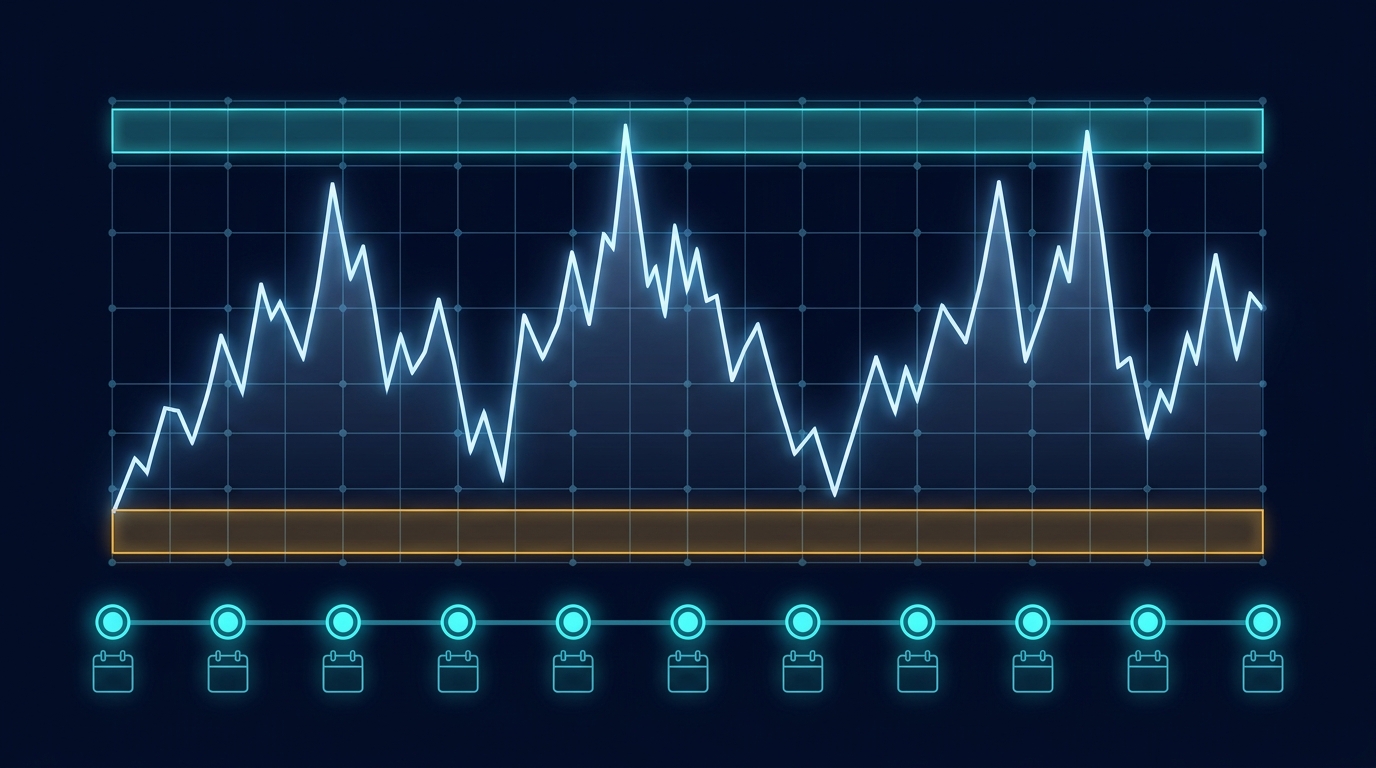
Crypto volatility creates two opposite pressures: chase a fast rally before it gets away, or freeze during a drawdown because the next drop feels inevitable. A crypto dollar-cost averaging strategy replaces those repeated timing decisions with a written purchasing policy.
The useful version of DCA is not “buy forever.” It is a controlled process with a funding budget, allocation cap, approved assets, fixed cadence, cost limit, review schedule, and explicit pause conditions. Those rules matter because a recurring order can automate a good decision or quietly compound a bad one.
This guide builds a practical DCA policy for volatile markets. It includes a contribution formula, a three-lane funding model, a volatility stress test, a one-page rule sheet, a worked example, and a monthly review workflow.
Risk note: This article is educational and is not investment, tax, or legal advice. Crypto assets can lose substantial or all value. Dollar-cost averaging does not guarantee profit, reduce the underlying asset's risk, or protect against loss.
What is a crypto dollar-cost averaging strategy?
Investor.gov defines dollar-cost averaging as investing equal portions at regular intervals regardless of market movement. In crypto, that might mean purchasing the same dollar amount every week, every two weeks, or every month.
When the price is lower, a fixed contribution buys more units. When the price is higher, it buys fewer. The schedule changes the path into the position; it does not determine whether the asset is suitable, whether the final return will be positive, or whether the portfolio can absorb a severe loss.
A complete crypto DCA strategy answers seven questions before the first automated order:
- Which assets are eligible?
- What is the maximum crypto allocation?
- How much new cash can be committed without weakening essential reserves?
- How often will purchases occur?
- What all-in cost is acceptable?
- When will the policy be reviewed or rebalanced?
- What conditions pause or terminate new purchases?
If the plan cannot answer those questions, it is a recurring-buy setting—not yet a risk-controlled strategy.
What DCA can and cannot solve
DCA is strongest as a behavioral and operational tool. It can reduce the number of discretionary decisions an investor makes while prices move quickly.
It may help prevent:
- breakout chasing, where contribution size increases after a rally;
- drawdown paralysis, where a planned contribution is canceled solely because recent returns are negative;
- perfect-bottom waiting, where cash remains unallocated indefinitely;
- headline sizing, where every news cycle changes the amount invested;
- unreconciled improvisation, where purchases happen across several venues without consistent records.
But DCA does not solve:
- asset quality or protocol failure;
- excessive portfolio concentration;
- exchange, wallet, or custody risk;
- spreads, fees, withdrawal costs, or slippage;
- tax-lot and transfer recordkeeping;
- loss of income or near-term liquidity needs;
- a permanently impaired investment thesis.
That boundary is important. The schedule should control execution, while separate portfolio rules control exposure and continued eligibility.
Start with a DCA budget, not a calendar
Many recurring-buy guides begin by debating weekly versus monthly purchases. The more important question is how much capital is actually available for a volatile asset.
Use a simple budget sequence:
eligible annual DCA budget
= annual investable surplus
- higher-priority savings commitments
- planned near-term capital needs
- required reserve replenishment

maximum crypto DCA budget
= the lower of:
   eligible annual DCA budget × crypto funding share
   or the cash needed to reach the portfolio allocation cap
This is a policy formula, not a universal recommendation. The inputs depend on the investor's cash flow, liabilities, time horizon, existing portfolio, and ability to tolerate loss.
The second line prevents a common mistake: choosing a comfortable monthly amount without checking where it could take the total allocation. A small recurring order can become a large portfolio exposure when repeated for years or combined with a strong price increase.
For a portfolio-level sizing worksheet, use BTCMind's crypto portfolio risk budget framework before setting the recurring amount.
The three-lane DCA policy
A useful way to separate decisions is to divide available capital into three lanes.
| Lane | Purpose | Rule |
|---|---|---|
| Core DCA lane | Funds fixed recurring purchases | Same pre-approved amount on each scheduled date |
| Reserve lane | Holds uncommitted investment cash | Does not automatically increase after price declines |
| Safety lane | Protects emergency and near-term needs | Never used for crypto purchases |
The core DCA lane is the only lane connected to automation. Its contribution stays fixed until a scheduled policy review.
The reserve lane gives the investor flexibility without turning every drawdown into an order. It can be reassigned only under a separately written rule—for example, during a quarterly rebalance—not because social media calls a price “cheap.”
The safety lane remains outside the strategy. Separating it visually and operationally helps prevent a volatile market from competing with essential liquidity.
This three-lane model is deliberately different from martingale-style averaging. It does not double the next contribution after a loss, borrow money, or assume that a lower price means lower risk.
Build the one-page crypto DCA rule sheet
Write the policy before enabling recurring orders. Keep it short enough to read during a stressful market week.
| Policy field | Decision to document | Control objective |
|---|---|---|
| Portfolio objective | Why crypto is included | Prevents ownership without a defined role |
| Eligible assets | Exact assets permitted | Blocks impulsive expansion into new tokens |
| Allocation cap | Maximum portfolio weight | Limits concentration before volatility arrives |
| Annual budget | Maximum new cash for the period | Connects purchases to real cash flow |
| Core contribution | Fixed amount per order | Removes emotional sizing |
| Cadence | Weekly, biweekly, or monthly | Makes execution repeatable |
| Reserve rule | When reserve cash may be reassigned | Prevents automatic averaging down |
| Cost ceiling | Maximum all-in cost per purchase | Controls fee and spread drag |
| Venue and custody | Where orders execute and assets are held | Surfaces counterparty and operational risk |
| Review date | Monthly operational check and quarterly policy review | Separates monitoring from market reaction |
| Rebalance trigger | Weight or risk threshold | Controls drift after rallies or declines |
| Pause conditions | Cash-flow, custody, compliance, or thesis failures | Stops automation when circumstances change |
| Records | Required transaction and transfer fields | Supports reconciliation and tax preparation |
The policy should be specific enough that two people reading it would take the same action. “Buy more when fear is high” is not specific. “Review the reserve lane at quarter-end only if the crypto allocation is below its cap and all eligibility checks still pass” is operational.
How often should you DCA crypto?
There is no universally best day or cadence. A useful schedule balances cash flow, costs, operational burden, and the ability to follow the rule consistently.
Weekly
Weekly purchases create more entry points and may feel smoother during fast markets. They also create more transactions, tax lots, and opportunities for minimum fees or spreads to consume a meaningful percentage of each order.
Biweekly
Biweekly purchases can align with payroll while reducing transaction count. This is often a practical middle ground when the venue's recurring-buy costs are reasonable.
Monthly
Monthly purchases are simpler to reconcile and may reduce fixed-fee drag. The tradeoff is fewer entry points and a larger amount exposed to the execution price on one date.
Choose cadence by measuring friction, not by backtesting a favorite weekday. Calculate:
all-in purchase cost percentage
= (trading fee + estimated spread + funding fee + allocated withdrawal cost)
   ÷ gross purchase amount
If a $25 order carries $1 of combined friction, 4% of the contribution is lost before market movement. Increasing order frequency would make the operational schedule look smoother while making the economics worse.
BTCMind's crypto exchange due-diligence guide includes a repeatable method for comparing spread, order-book quality, fees, withdrawals, and custody evidence.
Stress-test the policy before automating it
A DCA plan should be tested against uncomfortable conditions, not only a normal month. The purpose is not to predict the next market path. It is to check whether the rules remain affordable and understandable when conditions change.
Run at least these scenarios:
| Scenario | What changes | Question the policy must answer |
|---|---|---|
| 50% asset drawdown | Position value falls sharply | Does the fixed contribution remain affordable without touching the safety lane? |
| 100% asset rally | Portfolio weight may expand | Does the allocation cap trigger a pause or rebalance review? |
| Income interruption | Investable surplus falls | Which rule pauses future orders, and how quickly? |
| Fee increase | Recurring order becomes less efficient | At what all-in cost does cadence or venue require review? |
| Withdrawal delay | Venue access deteriorates | Are new purchases paused until custody access is verified? |
| Thesis break | Asset fundamentals materially change | Who or what evidence determines that the asset is no longer eligible? |
The plan passes only if each scenario produces a predefined action. “Decide later” leaves the hardest decisions to the most emotional moment.
A volatility-aware DCA strategy without market timing
Volatility can inform a review without changing every order. The distinction is between monitoring conditions and using those conditions to resize purchases.
A conservative workflow is:
- Keep the core contribution fixed during the policy period.
- Monitor portfolio weight, all-in cost, custody access, and asset eligibility.
- Review market-cycle and sentiment data only on scheduled dates.
- Use that evidence to reassess thesis risk, not to predict the next day's price.
- Apply only the pause, rebalance, or reserve rules already written.
For example, the Bitcoin market cycle indicator dashboard can help organize valuation, holder behavior, liquidity, miner conditions, and derivatives evidence. The Crypto Fear and Greed Index workflow can document sentiment extremes. Neither should automatically double or cancel the next contribution.
This keeps DCA rules-based. Market evidence can challenge the thesis or highlight concentration, but it does not become a disguised timing system.
Worked example: from budget to recurring order
Assume a hypothetical investor has already determined that a limited crypto allocation fits a long-term portfolio. The numbers below illustrate the method; they are not suggested allocations.
| Input | Hypothetical value |
|---|---|
| Investable portfolio | $80,000 |
| Maximum crypto allocation | 5% |
| Current crypto value | $2,400 |
| Allocation-cap value | $4,000 |
| Remaining room before cap | $1,600 |
| Eligible annual investable surplus | $6,000 |
| Maximum crypto funding share | 20% of surplus |
| Cash-flow-based annual limit | $1,200 |
The annual DCA budget is the lower of $1,600 in allocation room and $1,200 from the cash-flow policy. The result is $1,200.
The investor chooses:
- $100 on the first business day of each month;
- a quarterly policy review;
- no automatic increase after drawdowns;
- a pause if the crypto allocation reaches 5%;
- a pause if the safety reserve falls below its target;
- a cost review if all-in purchase friction exceeds 1%;
- a custody review if withdrawals are delayed or access controls change.
Now stress-test the rule.
If crypto rallies and the portfolio weight reaches 5.4%, the next purchase pauses pending the scheduled allocation review. If crypto falls 50% but income, safety reserves, custody, and the asset thesis remain unchanged, the $100 core contribution continues. The reserve lane does not automatically enter the market.
If income is interrupted, the cash-flow pause rule overrides the calendar. If the exchange blocks withdrawals, the custody rule pauses new orders even if the allocation is below its cap.
The strategy is durable because the action comes from the policy—not from whether the price chart looks exciting or frightening.
Fees, custody, and records are part of performance
Recurring purchases can hide small operational losses because they happen automatically. Track every order as if it will need to be independently reconstructed later.
At minimum, record:
- order date and time;
- gross cash contribution;
- execution price and units received;
- explicit fee;
- observable spread or markup;
- funding, withdrawal, and network fees;
- venue and account;
- destination wallet;
- transaction or withdrawal identifier;
- transfer links between internal records;
- current custody location.
FINRA's investor guidance on crypto assets emphasizes that these assets and service providers can involve substantial volatility, theft, fraud, and limited protections. A recurring plan should therefore include access tests, withdrawal checks, and a documented response to venue deterioration.
For U.S. readers, the IRS digital-assets guidance explains that digital-asset activity can create tax reporting requirements. Repeated purchases also create repeated basis records. BTCMind's crypto tax recordkeeping control system provides a fuller ledger and reconciliation workflow.
When to pause or stop a crypto DCA plan
Price movement alone should not be the only stop rule. A written policy can pause new purchases when:
- the crypto allocation reaches its cap;
- essential reserves fall below policy;
- income or liabilities materially change;
- the funds may be needed within the near-term horizon;
- the asset no longer passes the eligibility thesis;
- liquidity deteriorates enough to impair execution or exit;
- the venue changes fees, access, terms, or withdrawal reliability;
- wallet access or security cannot be verified;
- legal, tax, or compliance circumstances change;
- records cannot be reconciled;
- leverage or borrowed funds would be required to continue.
A pause is not a prediction that price will fall. It is a control that prevents automation from operating outside its approved conditions.
Common DCA mistakes in volatile markets
Treating DCA as downside protection
Spreading entry dates does not create a price floor. An asset can continue declining after every purchase or lose most of its value permanently.
Increasing size after every loss
Doubling contributions after declines is not fixed DCA. It is a more aggressive exposure rule that can exhaust capital and breach allocation limits quickly.
Ignoring portfolio drift
A fixed contribution does not create a fixed portfolio weight. Rallies, declines in other assets, or years of new purchases can all change concentration.
Automating before measuring cost
A platform's “recurring buy” convenience can include a different spread or fee structure from manual orders. Compare all-in execution before selecting cadence.
Using too many assets
Splitting a small budget across many tokens increases records and operational complexity while potentially creating correlated exposure rather than genuine diversification.
Reviewing the policy every day
Daily rule changes recreate the emotional timing problem DCA was meant to reduce. Monitor operational risks continuously, but revise the funding policy on scheduled dates unless a stop condition fires.
The 15-minute monthly DCA review
Use this short checklist once per month:
- Recalculate crypto as a percentage of the total investable portfolio.
- Confirm the next contribution remains within the annual budget.
- Calculate the latest all-in purchase cost percentage.
- Reconcile cash, units, fees, and transfers.
- Confirm account access, withdrawal status, and custody records.
- Check whether any pause condition has fired.
- Record whether the asset thesis is unchanged, challenged, or broken.
- Leave the contribution unchanged unless the written policy requires action.
At quarter-end, review the allocation cap, asset eligibility, reserve lane, venue, and cadence. Keep the evidence and decision in a dated journal so the strategy can be audited rather than remembered selectively.
Final takeaway
A crypto dollar-cost averaging strategy is most useful when it makes execution boring. The durable version does not promise a better return or a perfect average price. It defines how much can be invested, how often orders occur, how costs are measured, how concentration is controlled, and when automation must stop.
The minimum viable policy is:
- approve the assets;
- cap the allocation;
- calculate the budget;
- separate core, reserve, and safety lanes;
- fix the amount and cadence;
- measure all-in cost;
- document venue, custody, and records;
- stress-test drawdowns, rallies, income loss, and access failures;
- review on scheduled dates;
- pause through written conditions.
In a volatile market, consistency is valuable only when the rules around it remain sound.
FAQ
Is dollar-cost averaging a good strategy for crypto?
It can be a useful execution method for someone who has already approved a limited long-term crypto allocation and can tolerate substantial loss. It does not make an unsuitable asset suitable or guarantee better returns.
Is it better to DCA crypto weekly or monthly?
Neither cadence is universally better. Compare cash-flow timing, all-in costs, order minimums, tax-lot volume, and reconciliation burden. Use the simplest schedule that remains efficient and repeatable.
Should I increase my DCA amount when crypto falls?
Not under a fixed DCA policy. Increasing the amount after losses is a separate variable-contribution strategy. It should have its own funding limit, allocation control, and stress test rather than being improvised during a drawdown.
Does DCA reduce crypto risk?
DCA may reduce entry-timing concentration, but it does not reduce protocol, custody, liquidity, regulatory, fraud, or permanent-loss risk. Portfolio sizing and asset selection remain more important controls.
When should a recurring crypto purchase be paused?
Pause when a written condition fires, such as reaching the allocation cap, losing income stability, needing near-term cash, exceeding a cost ceiling, encountering withdrawal or custody problems, or seeing the asset thesis materially deteriorate.
Can I use a fear and greed indicator to change DCA amounts?
You can include sentiment in a scheduled review, but automatically increasing contributions during “fear” changes fixed DCA into a timing strategy. Define and stress-test any variable rule before using it.
What records should a crypto DCA investor keep?
Keep the date, cash amount, execution price, units, fees, venue, wallet, transaction identifier, transfers, and cost-basis support for every purchase. Requirements depend on jurisdiction and activity, so consult a qualified professional for personal tax guidance.