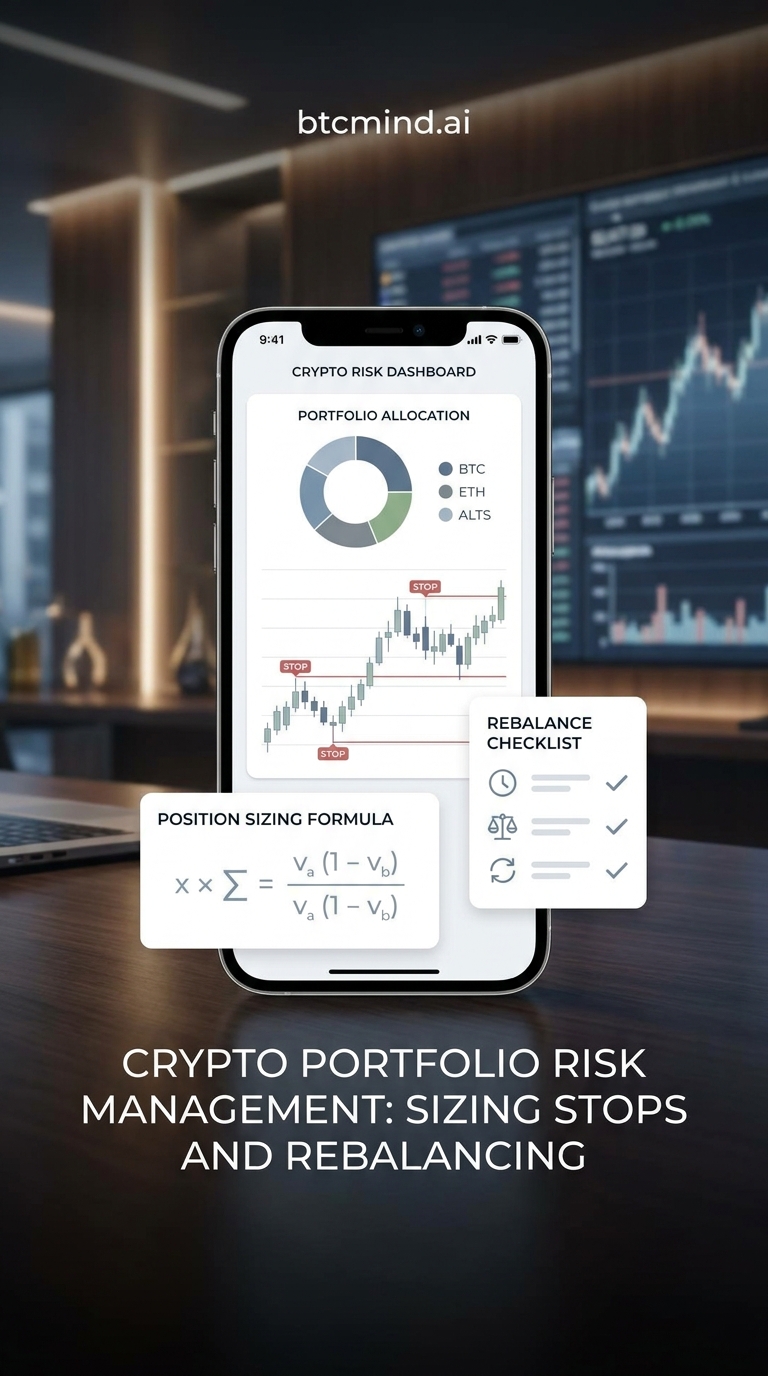
Crypto Portfolio Risk Management: Sizing Stops and Rebalancing
Crypto portfolio risk management matters more than finding one perfect entry. A good thesis can still fail if the position is too large, the stop is placed where normal volatility can shake you out, or the portfolio drifts into a concentration you never intended to hold. In crypto, those errors compound fast because volatility, leverage, and 24/7 trading can turn a manageable drawdown into a portfolio-level problem.
The practical framework is simpler than most traders think:
- Decide how much of your account you are willing to lose if the trade is wrong.
- Size the position from that risk budget and the stop distance.
- Rebalance the portfolio on a schedule or threshold so one winner does not silently become your whole book.
Risk note: This article is educational only. It is not investment advice. Crypto trading carries extreme risk, and any stop or rebalance process can still fail in fast or illiquid markets.
What crypto portfolio risk management actually covers
Crypto portfolio risk management is the discipline of controlling downside before you think about upside. For most self-directed traders and investors, it has three moving parts:
| Lever | Main question | Practical goal |
|---|---|---|
| Position sizing | How big should this trade or allocation be? | Keep a single mistake from damaging the whole portfolio |
| Stop placement | Where is the thesis invalidated? | Exit before a small loss becomes a large one |
| Rebalancing | Has the portfolio drifted away from plan? | Bring risk back to target after winners, losers, or new deposits |
Investor.gov defines rebalancing as bringing a portfolio back to its original asset allocation mix when market moves push weights away from plan. That idea matters even more in crypto because a sharp move in Bitcoin, ETH, or one high-beta alt can change your total risk profile in days instead of quarters.
Start with a portfolio risk budget, not a coin pick
Before you size a crypto position, define the maximum account damage you are willing to tolerate if the idea fails. CME Group's trading education describes the "2% rule" as a simple discipline: risk no more than 2% of account equity on a single trade. Many traders go lower than that in crypto because the asset class is more volatile and can gap through stops.
That does not mean 2% is a magic number. It means you should choose a rule before entering:
- Conservative swing trader: often
0.5%to1%account risk per trade - Active trader with tighter invalidation: often
1%to2% - Leveraged or highly correlated book: usually needs less, not more, risk per position
The key is consistency. If your risk per trade changes with emotion, your portfolio risk management is not a system yet.
The simplest position-sizing formula
For a directional crypto trade, the clean starting formula is:
position size = account risk in dollars / stop distance in percent
Example:
- Portfolio value:
$25,000 - Risk budget:
1% - Maximum loss allowed:
$250 - Entry price:
$100 - Stop price:
$92 - Stop distance:
8%
Position size:
$250 / 0.08 = $3,125
That means the trade size is roughly $3,125, not $25,000, even if you strongly like the setup.
This is the core of crypto portfolio risk management: the stop determines the size, not the other way around. If the proper stop creates a position that feels too small, the answer is usually to accept the smaller size rather than force a tighter stop that does not match market structure.
Why stop placement should come before leverage
One of the fastest ways to break crypto portfolio risk management is to choose leverage first and invalidation later. That reverses the logic. The correct sequence is:
- Identify the level that proves the setup is wrong.
- Measure the distance from entry to that level.
- Size the position so the loss stays inside your risk budget.
- Only then decide whether the trade still deserves capital.
BTCMind's own product language reflects this order: research first, risk constraint second, action third. A stop is not just a line on a chart. It is the price level where your thesis no longer deserves the same capital.
Three stop-loss methods that fit crypto better than guesswork
1. Structure-based stops
A structure-based stop sits beyond a level that would invalidate the setup, such as:
- Below support for a long
- Above resistance for a short
- Beyond the low or high that defines the trade idea
This is usually the cleanest method because the stop is tied to the thesis, not a random percentage.
2. Volatility-adjusted stops
Schwab's education on Average True Range explains ATR as a volatility measure that can help traders place exits with market movement in mind. In crypto, that matters because a fixed 2% stop on a highly volatile asset may get hit by normal noise rather than true invalidation.
A volatility-adjusted stop does not guarantee a better result. It simply reduces the chance that your stop is unrealistically tight for the coin and timeframe you are trading.
3. Time-based stops
Some trades fail because they do nothing. If a breakout never follows through, or if the market drifts sideways while your opportunity cost grows, a time-based stop can be part of sound crypto portfolio risk management. This works best when the setup depended on a catalyst or expected momentum.
The stop-order caveat most crypto traders ignore
FINRA notes that a stop order becomes a market order once the stop price is reached, and the final execution price can differ from the stop price during volatile conditions. That warning matters in crypto because overnight gaps are replaced by round-the-clock liquidation cascades, thin weekend books, and sharp exchange-specific moves.
Practical implication:
- A stop price is a trigger, not a guarantee of exact execution.
- Slippage should be included in your real risk estimate.
- The more illiquid the token, the more conservative your position sizing should be.
That is also why crypto portfolio risk management should assume that real losses can exceed the planned stop loss in disorderly conditions.
Correlation can make "small" positions too large
A portfolio can look diversified while still being one trade in disguise. If BTC, ETH, SOL, and a basket of altcoins all sell off together, four small positions may behave like one large risk bet.
Before you add a new position, ask:
- Is this exposure meaningfully different from what I already own?
- Am I adding a new thesis or doubling down on the same one?
- If Bitcoin drops hard, will all of these positions likely move together?
Crypto portfolio risk management fails when traders size each position in isolation but ignore correlation at the portfolio level.
How rebalancing keeps winners from becoming your whole portfolio
Fidelity describes rebalancing as buying and selling investments to bring a portfolio back to the asset mix aligned with your strategy. In crypto, rebalancing is the discipline that prevents one strong performer from quietly taking over the portfolio.
Say your target allocation is:
50%Bitcoin25%ETH15%large-cap alts10%stablecoins
After a strong alt rally, that 15% sleeve may become 28% or more. If you do nothing, you are no longer holding the portfolio you originally designed. You are holding a higher-risk version created by market drift.
Rebalancing is how you take that drift seriously.
Two rebalancing approaches that work in practice
1. Calendar rebalancing
You review the portfolio on a fixed cadence, such as:
- Monthly
- Every six weeks
- Quarterly
This approach is simple and reduces decision fatigue. It is often the best starting point for investors who want crypto portfolio risk management without constant screen time.
2. Threshold rebalancing
You rebalance only when an asset moves a set amount away from target, such as:
5percentage points from target weight20%relative drift from the intended allocation
This approach is more responsive to fast-moving markets and usually fits crypto better than long static review windows.
Many traders combine both: a monthly review plus an override if any major sleeve drifts beyond a preset threshold.
How often should you rebalance a crypto portfolio?
There is no universal answer, but there are clear tradeoffs:
| Frequency | Benefit | Main cost |
|---|---|---|
| Weekly | Fast control of drift | High trading friction and over-management risk |
| Monthly | Good balance for many active investors | Can still miss very fast concentration changes |
| Quarterly | Lower friction | Drift can become large in volatile markets |
| Threshold-only | Reacts to actual portfolio change | Requires clear rules and discipline |
For most non-institutional crypto investors, monthly or threshold-based reviews are a more durable default than constant adjustment. The best rebalancing system is the one you can follow when markets are both euphoric and ugly.
A simple crypto portfolio risk management workflow
Use this checklist before adding or resizing any position:
- Define the thesis in one sentence.
- Mark the price level that invalidates the thesis.
- Set account risk for the trade, such as
0.5%or1%. - Calculate position size from the stop distance.
- Check correlation with the rest of the portfolio.
- Confirm whether the portfolio would still fit your allocation plan after entry.
- Schedule the next rebalance review before placing the trade.
This is not glamorous, but it is the difference between having a process and improvising.
Common mistakes with sizing, stops, and rebalancing
Most crypto portfolio risk management problems repeat the same patterns:
- Sizing the trade first and forcing the stop to fit
- Using the same stop distance on Bitcoin and a thin altcoin
- Ignoring slippage and assuming the stop price is the exit price
- Running multiple correlated positions as if they were independent
- Refusing to trim winners because "the trend is strong"
- Rebalancing emotionally instead of by schedule or threshold
- Using leverage to compensate for a weak setup
If you remove those seven mistakes, your downside process will already look more professional than most retail crypto behavior.
Where BTCMind fits into the workflow
BTCMind is useful when you want research and invalidation logic before you commit risk. The app's multi-agent process is built around evidence, debate, and explicit risk-aware conclusions rather than vague market commentary. That does not replace your portfolio rules. It helps you apply them with a cleaner thesis, clearer levels, and less emotional sizing.
If your process improves after the signal, not just before it, your crypto portfolio risk management is moving in the right direction.
Final take
Crypto portfolio risk management is not one tool. It is the combination of:
- A fixed risk budget per trade
- Position sizes derived from stop distance
- Stops tied to structure or volatility, not hope
- A rebalancing rule that keeps allocation drift under control
- A portfolio view that respects correlation
Do that consistently and you will not eliminate losses, but you will make them survivable. In crypto, survivability is the foundation that lets good research matter.
If you want a mobile workflow that turns market research into concrete invalidation logic, review BTCMind's feature overview, see how the AI agents structure competing views, and use the download page to evaluate whether the app fits your process.
FAQ
What is a good risk percentage per crypto trade?
Many traders use roughly 0.5% to 2% of account equity as a maximum risk budget for a single trade, with lower risk often making more sense in crypto because volatility and slippage can be severe.
Should crypto stop losses be fixed percentages?
Not by default. Fixed-percentage stops can ignore market structure and volatility. Structure-based or volatility-adjusted stops are usually more defensible than an arbitrary number.
How often should I rebalance a crypto portfolio?
Monthly reviews or threshold-based rebalancing are common practical defaults. The right cadence depends on volatility, fees, taxes, and how concentrated the portfolio can become between reviews.
Can rebalancing reduce crypto portfolio risk?
Yes. Rebalancing reduces drift, trims concentration, and brings the portfolio back toward the allocation you intended to hold.
Sources
- CFTC, "Customer Advisory: Understand the Risks of Virtual Currency Trading"
- CME Group Education, "The 2% Rule"
- FINRA, "Stop Orders: Factors to Consider During Volatile Markets"
- Investor.gov glossary, "Rebalancing"
- Fidelity Viewpoints, portfolio rebalancing education
- Charles Schwab education, "Average True Range indicator and volatility"