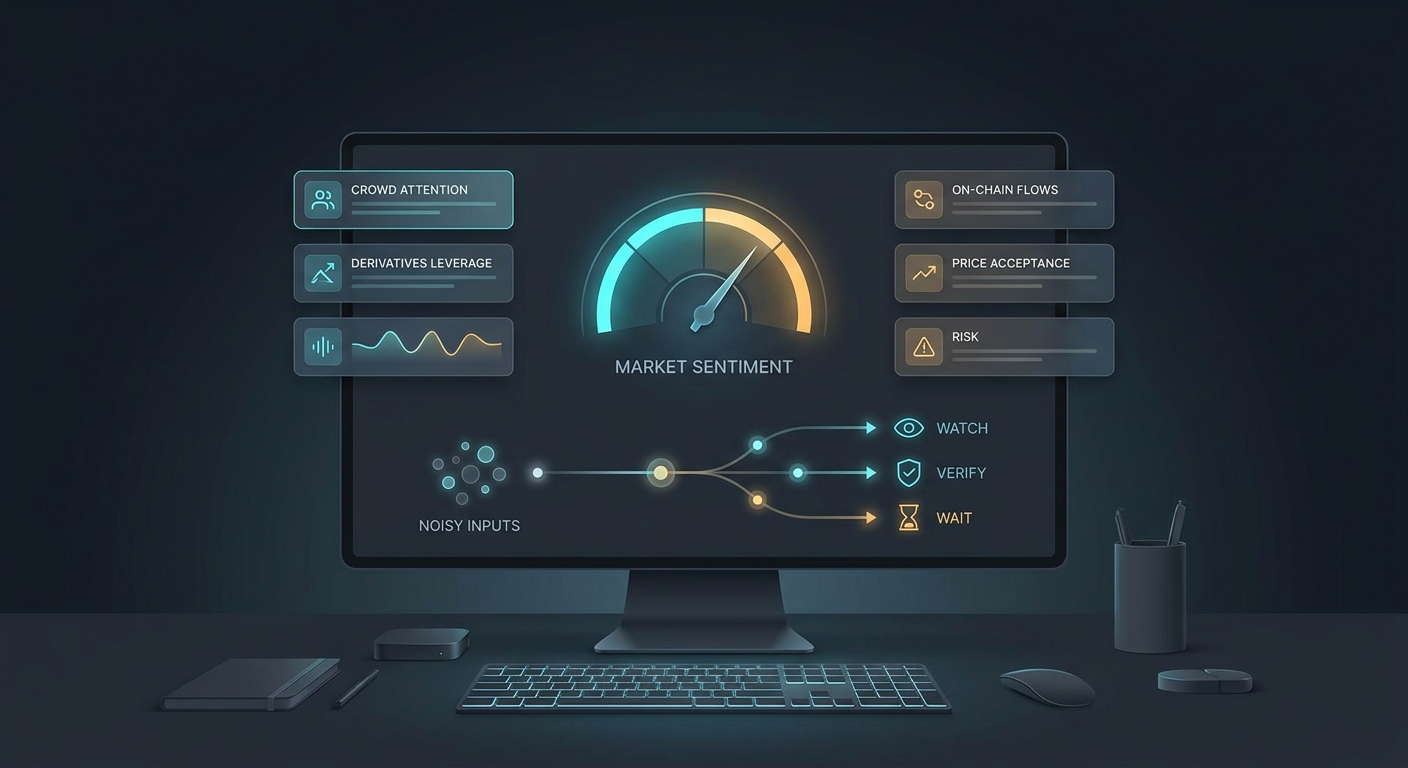
Market sentiment bitcoin is the market's emotional and positioning bias around BTC: what traders believe, how aggressively they are positioned, how attention is changing, and whether price behavior confirms or rejects the crowd's story.
That sounds simple. It is not.
A green sentiment gauge can hide crowded leverage. A bearish social feed can arrive after price has already flushed. A funding spike can matter for a 4-hour trader but mean little for a long-term holder. The useful question is not "is Bitcoin sentiment bullish or bearish?" The useful question is "when does sentiment change the decision?"
This guide explains what market sentiment bitcoin means, when it matters, when to ignore it, and how to turn sentiment into a decision note instead of another emotional input. It is educational research, not financial advice.
Updated August 24, 2026: BTCMind product evidence, Alternative.me's Crypto Fear & Greed Index page, Google Trends help documentation, CFTC Commitments of Traders pages, CoinGlass public derivatives pages, and Glassnode public pages were checked before drafting. This article avoids Bitcoin price forecasts and uses sentiment as a decision workflow, not investment advice.
The Short Answer
Market sentiment bitcoin is a practical read on whether Bitcoin market participants are calm, fearful, greedy, crowded, skeptical, or undecided. It combines signals from price behavior, derivatives positioning, on-chain flows, search and social attention, news, and source freshness.
Sentiment matters most when it changes one of five decisions:
| Decision | Sentiment can help answer | Bad use |
|---|---|---|
| Watch | Is the market state changing enough to monitor? | Treating every sentiment shift as urgent |
| Verify | Which second signal should confirm or reject the read? | Acting from one score or social post |
| Reduce risk | Is leverage or narrative crowding making the move fragile? | Assuming bullish sentiment always means upside |
| Add evidence | Which missing layer would make the read useful? | Averaging unrelated indicators into one number |
| Wait | Is the signal stale, late, or contradicted? | Forcing a trade because the crowd feels emotional |
If a sentiment read cannot change watch, verify, reduce risk, add evidence, or wait, it is probably market color. Market color can be useful, but it should not drive the plan.
If you already understand the concept and want metric selection, read the market sentiment bitcoin metrics guide. If you are comparing vendors, use the market sentiment bitcoin comparison checklist. This article is the definition and timing layer.
What Market Sentiment Bitcoin Includes
A useful Bitcoin sentiment read has six layers.
| Layer | What it shows | Example question |
|---|---|---|
| Price acceptance | Whether BTC holds, rejects, or ranges after a move | Did price accept the level, or was it one fast reaction? |
| Spot participation | Whether buying or selling looks broad enough to matter | Is the move supported across liquid venues and time windows? |
| Derivatives positioning | Whether leverage is confirming or crowding the move | Are funding, open interest, and liquidations creating fragility? |
| On-chain context | Whether flows or holder behavior support or contradict the story | Are coins moving in a way that matches the sentiment narrative? |
| Crowd attention | Whether fear, greed, search interest, and social narratives are extreme | Is the crowd early, confirming, or late? |
| Source health | Whether the data is fresh, defined, and usable for the horizon | Is the source current enough for this decision? |
The trap is treating these layers as equal. They are not.
For example, Google Trends can help you understand relative search interest, but Google explains that Trends data is normalized by time and location and scaled from 0 to 100. That makes it useful for attention, not proof of buying demand. Alternative.me's Crypto Fear & Greed Index can compress multiple emotion inputs into one reading, but a composite score still needs component checks before it becomes a decision. CFTC Commitments of Traders reports can add positioning context, but their release cadence is not intraday.
Good market sentiment bitcoin analysis keeps each layer in its lane.
When Bitcoin Sentiment Matters
Sentiment matters when the market is deciding whether a move is real, fragile, late, or crowded.
Use a sentiment review in these seven situations.
1. After A Breakout Or Failed Breakout
Breakouts attract emotion. A Bitcoin move above a visible level can create excitement, social confirmation, and late leverage in the same window.
Sentiment matters because the first reaction may not be acceptance.
Use this quick test:
| Signal | Healthy read | Fragile read |
|---|---|---|
| Price | Holds above the level after the first reaction | Spikes through the level and falls back |
| Participation | Volume and liquidity support the move | One venue or one candle drives the move |
| Derivatives | Open interest expands without obvious stress | Funding jumps and open interest crowds into resistance |
| Crowd | Attention rises after confirmation | Attention spikes before evidence catches up |
| Action | Watch or verify according to plan | Wait or reduce urgency |
A breakout does not become stronger because the crowd is excited. It becomes stronger when price acceptance, participation, and risk evidence improve together.
2. During Sharp Drawdowns
Fear can be useful information. It can also arrive too late.
During a drawdown, market sentiment bitcoin matters because you need to separate three states:
| State | What it means | Better response |
|---|---|---|
| Panic narrative | Headlines and social posts are fearful, but market evidence is mixed | Verify, do not chase |
| Forced selling | Liquidations, leverage, and weak liquidity are driving the move | Reduce risk and wait for cleanup |
| Structural change | Price, participation, flows, and risk evidence shift together | Reassess the thesis |
This is where source health matters. If the derivatives feed, on-chain label, or news source is stale, the right answer may be "blocked" rather than bullish or bearish.
3. When Funding And Open Interest Are Crowded
Bitcoin sentiment often becomes dangerous when leverage agrees too loudly.
CoinGlass maintains public pages for Bitcoin funding rates, open interest, and liquidation views. Those data types can help show whether traders are leaning heavily in one direction. The key is not whether funding is positive or negative. The key is whether leverage is making the move more fragile.
Use this wording:
Price is strong, but open interest expanded into resistance and funding is elevated.
Sentiment label: bullish but crowded.
Decision: verify participation; cap confidence until the move holds.
That is stronger than "bullish" because it names the risk.
4. When Social Attention Moves Faster Than Evidence
Bitcoin is narrative-sensitive. Search interest, social posts, community questions, and headlines can change quickly.
Crowd attention matters when it tells you:
- fear or greed is becoming extreme,
- beginners are entering the conversation,
- "should I buy" or "is Bitcoin dead" questions are rising,
- a story is spreading faster than the underlying evidence,
- or your content, support, and product teams need calmer routing.
Crowd attention is weaker when it is detached from price acceptance, participation, and risk evidence. Treat it as an attention layer, not a trading system.
5. When On-Chain Evidence Disagrees With The Crowd
On-chain data can add context when headlines are emotional. Glassnode positions its platform around digital asset and on-chain market intelligence, and on-chain tools generally help analysts review flows, holder behavior, exchange activity, and market structure.
This layer matters most when it disagrees with crowd emotion.
Example:
Crowd attention is fearful after a drawdown, but exchange-flow context does not show broad panic transfer behavior.
Sentiment label: narrative-heavy fear.
Decision: wait for price and flow confirmation before changing the plan.
On-chain data should rarely be used as a one-minute trigger. Use it as context, contradiction, and thesis review. If this layer is new to you, start with the on chain data workflow.
6. Before A Risk Review Or Position Change
Sentiment matters before a risk decision because emotion often hides as confidence.
Before changing exposure, ask:
- What sentiment layer changed?
- Is the source fresh?
- What confirms it?
- What contradicts it?
- Does the read match the time horizon?
- What risk gets worse if the read is wrong?
- What action is allowed: watch, verify, reduce risk, add evidence, or wait?
This keeps market sentiment bitcoin analysis connected to your plan instead of your mood. For the broader control layer, use crypto risk management metrics to define exposure, invalidation, liquidity, and decision-audit rules.
7. When A Tool Or AI Brief Gives A Confident Answer
Sentiment matters when a dashboard or AI tool gives you a confident answer, because confidence is not the same as evidence.
The minimum check is:
| Check | Question |
|---|---|
| Evidence separation | Can you see price, derivatives, on-chain, crowd, and risk separately? |
| Counter-case | Does the brief name the strongest opposing evidence? |
| Source trail | Can you inspect timestamps, definitions, and sources? |
| Action boundary | Is there a no-action path? |
| Risk boundary | Does the output include invalidation or confidence limits? |
BTCMind fits this synthesis problem. BTCMind's current homepage positions the product as an AI crypto research desk where six AI specialists run bull/bear debate, technicals, derivatives, and tail-risk analysis in parallel before a portfolio manager call. That is useful when the user already has enough signals and needs a structured brief, not another tab.
When Bitcoin Sentiment Does Not Matter
Sentiment is not always useful. Sometimes it is just noise with a good interface.
Discount a market sentiment bitcoin read when any of these are true.
| Situation | Why to discount it | Better response |
|---|---|---|
| No decision changes | The read cannot affect watch, verify, reduce risk, add evidence, or wait | Log it as context only |
| Source is stale | Old data can look like conviction | Mark the layer red and stop |
| Horizon mismatch | Intraday sentiment is being used for long-term allocation, or the reverse | Match evidence to the decision window |
| One layer dominates | Social heat or one gauge is treated as the whole market | Require independent confirmation |
| Components overlap | Price, volatility, social, and search are reacting to the same event | Avoid double-counting |
| Risk state is unclear | You do not know what gets worse if the read is wrong | Run the risk gate first |
| You are trying to predict instead of decide | The workflow becomes a price forecast machine | Return to decision notes |
The goal is not to have an opinion about every Bitcoin mood swing. The goal is to know when mood changes the operating plan.
The Market Sentiment Bitcoin Timing Matrix
Use this matrix to decide how much weight to give sentiment.
| Market condition | Sentiment weight | Why |
|---|---|---|
| Quiet range | Low | Sentiment may be background noise until price or participation changes |
| Visible breakout | Medium to high | Crowd reaction can confirm or crowd the move |
| Failed breakout | High | Sentiment often flips fast and reveals trapped positioning |
| Sharp drawdown | High | Fear, liquidations, and source freshness become decision-critical |
| News shock | Medium | Attention matters, but confirmation and source quality matter more |
| Leverage build-up | High | Funding and open interest can reveal squeeze risk |
| Long-term allocation review | Low to medium | Sentiment is context, not the main thesis |
| Tool evaluation | High | You need to know whether the tool improves real decisions |
This is the missing piece in many generic sentiment articles: sentiment is not one constant input. Its weight changes by market state and decision horizon.
A 10-Minute Market Sentiment Bitcoin Workflow
Use this workflow when Bitcoin moves enough to deserve a sentiment review.
| Minute | Step | Output |
|---|---|---|
| 0-1 | Name the decision horizon | Intraday, swing, allocation, content, support, or risk |
| 1-2 | Mark source health | Green, amber, red, or gray |
| 2-3 | Check price acceptance | Accepted, rejected, ranging, or unresolved |
| 3-4 | Grade participation | Strong, mixed, weak, or unavailable |
| 4-5 | Check derivatives crowding | Clean, crowded, squeeze-risk, or stale |
| 5-6 | Add on-chain context | Confirming, contradicting, irrelevant, or stale |
| 6-7 | Add crowd attention | Quiet, rising, extreme fear, extreme greed, or noisy |
| 7-8 | Write the strongest contradiction | One sentence |
| 8-9 | Choose the action lane | Watch, verify, reduce risk, add evidence, or wait |
| 9-10 | Set next review trigger | Price level, time, source refresh, or brief update |
The output should be a card, not a screenshot.
market_sentiment_bitcoin_timing_card
timestamp:
decision_horizon:
market_state:
source_health:
price_acceptance:
participation:
derivatives_crowding:
on_chain_context:
crowd_attention:
strongest_contradiction:
allowed_action:
invalidation:
next_review_trigger:
If this card looks too heavy, that is the point. Acting from a one-number sentiment gauge is easy. Making it decision-grade requires evidence, contradiction, and risk.
Examples: When Sentiment Changes The Decision
Example 1: Bullish But Crowded
Bitcoin breaks a visible level. Social feeds turn euphoric. Funding rises. Open interest expands. Price holds for one review window but not long enough to confirm the higher-timeframe thesis.
Better sentiment note:
Market sentiment bitcoin read: bullish but crowded.
Allowed action: verify.
Contradiction: leverage expanded before durable price acceptance.
Next review: wait for level retest or funding cooldown.
Example 2: Fearful But Not Confirmed
Bitcoin drops quickly after a headline. Search interest rises. Fear posts spread. Price is below the prior range, but on-chain context and derivatives cleanup are not yet clear.
Better sentiment note:
Market sentiment bitcoin read: fear rising, evidence incomplete.
Allowed action: add evidence.
Contradiction: crowd fear is ahead of confirmed structural change.
Next review: derivatives update and price acceptance check.
Example 3: Neutral But Source-Blocked
The sentiment gauge is neutral. The dashboard looks calm. But the derivatives feed has not refreshed after a fast move, and the on-chain provider changed a label.
Better sentiment note:
Market sentiment bitcoin read: blocked, not neutral.
Allowed action: wait.
Contradiction: key sources are stale or changed.
Next review: source refresh or analyst brief.
Neutral is not always a market state. Sometimes neutral is a data-quality problem.
How BTCMind Fits The Sentiment Workflow
BTCMind is useful after sentiment signals start to conflict.
The public product page describes BTCMind as a mobile AI crypto research desk. Six AI specialists run deep research: bull/bear debate, technicals, derivatives, tail-risk, and historical reflection before a portfolio manager produces a structured call. The product also emphasizes source-traced briefs, price alerts, voice chat, and optional OKX-connected execution controlled by the user.
For a market sentiment bitcoin workflow, that makes BTCMind a synthesis layer:
- It can turn a sentiment shift into a structured brief.
- It can force bull and bear evidence into the same review.
- It can separate technicals, derivatives, and tail-risk instead of flattening them into one mood.
- It can help a mobile user read the conclusion without watching dashboards all day.
- It can preserve a clearer evidence trail than a social feed or one-number gauge.
BTCMind does not remove risk, replace personal judgment, or guarantee performance. Its practical role is to help users move from noisy signals to a traceable decision workflow.
Final Checklist
Before you let Bitcoin sentiment affect a decision, answer these questions:
- What decision could this sentiment read change?
- Which layer changed: price, participation, derivatives, on-chain, crowd, or source health?
- Is the data fresh enough for the decision horizon?
- What confirms the read?
- What contradicts the read?
- Is the move early, confirming, late, or crowded?
- What risk gets worse if the read is wrong?
- Is the allowed action watch, verify, reduce risk, add evidence, or wait?
- What is the next review trigger?
- Can you save the decision note for later review?
The strongest market sentiment bitcoin workflow is not the one with the most indicators. It is the one that tells you when sentiment matters, when it does not, and what responsible action is allowed next.
Ready to add a research-synthesis layer beside your sentiment dashboard? Get the BTCMind app and turn Bitcoin sentiment signals into source-backed briefs on mobile.