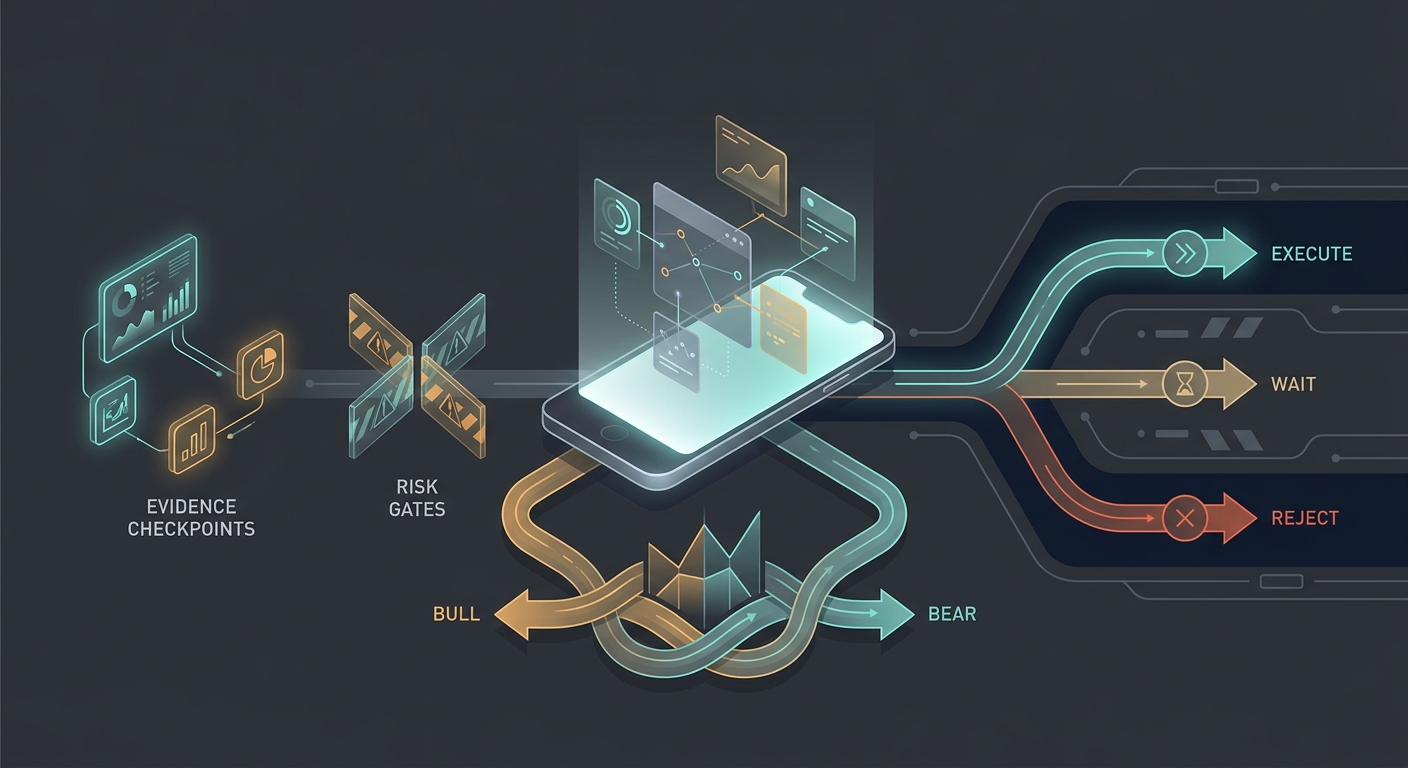
The best crypto trading signals are not the loudest alerts, the most precise-looking entry prices, or the channels posting the biggest win-rate screenshots. They are signals that can survive a repeatable workflow: source check, evidence check, invalidation check, risk check, execution check, and post-trade review.
That distinction matters because a crypto trading signal is easy to produce and hard to trust. Anyone can post "long BTC at 118,400, stop 116,900, target 121,800." The useful question is what must be true before that alert deserves capital, what would prove it wrong, and whether the trade still works after fees, slippage, spread, funding, and position size.
This guide gives you a practical operating system for crypto trading signals. Use it to evaluate signal providers, AI crypto research tools, Telegram or Discord alerts, TradingView-style technical alerts, on-chain alerts, derivatives signals, and internal desk workflows.
Not investment advice. Crypto trading carries extreme risk. Use this as a research and workflow framework, not as a recommendation to buy, sell, or use leverage.
What counts as a crypto trading signal?
A crypto trading signal is a decision prompt. It tells you that a market condition may justify action.
Good signals usually contain five fields:
| Field | What it should answer | Weak version |
|---|---|---|
| Setup | What condition triggered the signal? | "BTC looks bullish" |
| Evidence | Which data supports it? | "Whales are buying" |
| Action | Long, short, reduce, hedge, wait, or no trade? | "Send it" |
| Invalidation | What would prove the signal wrong? | No stop, no level, no time limit |
| Risk rule | How much capital is allowed? | "High confidence" with no sizing |
The best crypto trading signals are not just entries. They are complete decision cards.
A 7-step workflow for crypto trading signals
Use this workflow before trusting any crypto trading signals guide, provider, bot, or AI research tool.
1. Separate alert, signal, and trade
Most traders mix three different objects:
| Object | Purpose | Example |
|---|---|---|
| Alert | Something changed | BTC crossed a prior high |
| Signal | The change may matter | Breakout is confirmed only if spot volume and funding are not overheated |
| Trade | Capital is committed | Buy spot BTC with a defined invalidation level |
An alert is not a signal. A signal is not a trade. The gap between them is where most losses happen.
Create three routing labels:
- Watch: condition is interesting but incomplete.
- Prepare: evidence is strong enough to plan, but execution is not triggered.
- Act or reject: the setup has a defined entry, invalidation, size rule, and review time.
BTCMind is built around this distinction. Its six-agent research council runs technicals, derivatives, tail-risk, historical reflection, and bull/bear debate before the portfolio manager issues a final BUY / SELL / HOLD style conclusion with confidence. That is different from treating a single alert as a trade.
2. Require a complete signal record
Do not evaluate a signal from the screenshot alone. Require the full record.
| Required field | Why it matters |
|---|---|
| Timestamp | Proves whether the signal existed before the move |
| Asset and venue | BTC spot, ETH perp, SOL spot, and exchange venue have different liquidity and fee assumptions |
| Direction | Long, short, reduce exposure, hedge, or no trade |
| Entry condition | Market order, limit level, candle close, breakout confirmation, or pullback |
| Invalidation | Price level, time stop, data trigger, or thesis failure |
| Risk budget | Maximum loss if invalidation hits |
| Evidence sources | Technical, on-chain, derivatives, news, macro, sentiment, or portfolio context |
| Counter-case | What the signal may be missing |
| Post-trade result | Filled price, exit, slippage, fees, funding, and review notes |
If a crypto trading signals tool cannot export or preserve this record, it is hard to audit. Treat it as entertainment until proven otherwise.
3. Score the evidence stack
One signal source is fragile. A useful crypto trading signals workflow checks whether independent evidence points in the same direction or whether the signal is only repeating one noisy indicator.
Use a simple evidence score:
| Evidence lane | Positive sign | Warning sign |
|---|---|---|
| Price structure | Breakout, reclaim, compression break, support hold, or failed breakdown | Chasing a stretched candle with no retest |
| Volume and liquidity | Move occurs with real participation and enough depth | Thin books, weekend liquidity, wide spread |
| Derivatives | Funding, open interest, and liquidations support the setup without overcrowding it | Funding is extreme, OI is crowded, liquidation risk is one-sided |
| On-chain | Exchange flows, holder behavior, or wallet activity support the thesis | Wallet labels are unclear or metric definitions are vague |
| News and catalyst | Catalyst is verified and material | Rumor, recycled headline, fake screenshot, or "insider" claim |
| Risk context | Setup fits the portfolio's current exposure and loss budget | Trade increases an already concentrated risk |
Give each lane one of three labels: supports, neutral, or contradicts. A signal with one supporting lane and three contradicting lanes should usually be rejected or downgraded to watch-only.
4. Add a contradiction gate
Most crypto trading signals fail because the signal is allowed to ignore conflicting data. Build a contradiction gate before execution.
Reject or pause the signal when any of these are true:
- The signal is long but funding is overheated and rising into resistance.
- The signal is short but spot demand is absorbing every selloff.
- The entry requires a market order into a candle that already moved several ATRs.
- The stop is so wide that the loss budget is broken.
- The provider shows win rate but not average loss, slippage, or maximum drawdown.
- The signal depends on a screenshot, private group rumor, or unverified wallet label.
- The trade would add to a position that already exceeds portfolio risk limits.
This is where adversarial research helps. A bull case and bear case should both be forced to cite evidence before any crypto trading signal becomes actionable.
5. Convert the signal into a risk card
A signal with no loss math is incomplete.
Use this risk-card template:
| Risk field | Formula or rule |
|---|---|
| Account risk limit | Example: no more than 0.25% to 1.00% of account equity per idea |
| Distance to invalidation | Entry price minus stop level for longs; stop level minus entry for shorts |
| Position size | Risk budget divided by distance to invalidation |
| Liquidity check | Position should be small enough to enter and exit without meaningful market impact |
| Fee and funding check | Expected edge must survive fees, spread, slippage, and funding |
| Time stop | If the thesis does not work by a defined time, close or re-score |
For leveraged crypto trading signals, add liquidation distance before position sizing. If the liquidation price is closer than the signal's invalidation logic, the setup is structurally broken.
BTCMind's product messaging includes risk constraints such as take-profit / stop-loss handling and position caps for OKX execution. That matters because a signal workflow should define risk before execution, not after the trade starts moving against you.
6. Paper-test before allocating real capital
Before paying for a signal provider or automating execution, paper-test at least 30 signals from the same source.
Track:
| Metric | Why it matters |
|---|---|
| Signal completion rate | How often signals include entry, invalidation, evidence, and size logic |
| Forward expectancy | Average win multiplied by win rate minus average loss multiplied by loss rate |
| Max drawdown | Whether losing streaks are tolerable |
| Slippage gap | Difference between posted entry and realistic fill |
| Alert-to-action rate | How many alerts become valid trades |
| Reject rate | Whether the workflow prevents bad trades |
| Time-to-invalidation | How quickly bad signals fail |
| Review compliance | Whether every signal gets a post-mortem |
Do not accept backtests alone. A signal can look excellent historically and fail in forward use because the provider cherry-picked data, ignored fees, adjusted the rule after the fact, or posted after the move.
7. Review the signal system weekly
Every Friday or Sunday, review the signal system rather than arguing with one trade.
Ask:
- Which signal sources produced complete decision cards?
- Which sources generated noise but no adopted decisions?
- Which signals were rejected, and did rejection prevent losses?
- Did any signal violate the loss budget?
- Did the trader override invalidation?
- Did execution quality change because of spread, slippage, or funding?
- Should any provider, alert, or model be paused?
The best crypto trading signals improve the decision process even when a trade loses. Weak signals create emotion, urgency, and unreviewable screenshots.
Five crypto trading signal examples
These examples are hypothetical. They show how to route signals, not what to trade.
Example 1: BTC breakout signal
Raw alert: BTC breaks above a prior resistance level.
Weak workflow: Buy immediately because the candle is green.
Better workflow:
| Check | Requirement |
|---|---|
| Price | Breakout holds above the level for a defined close |
| Volume | Participation is above recent baseline |
| Derivatives | Funding is not already extreme |
| Risk | Stop sits below invalidation without breaking account risk limit |
| Counter-case | If breakout fails back into the range, reject |
Decision: Prepare, then act only if the close and liquidity check pass.
Example 2: ETH funding squeeze signal
Raw alert: Funding turns sharply negative while price stops falling.
Weak workflow: Long because shorts are crowded.
Better workflow:
| Check | Requirement |
|---|---|
| Derivatives | Negative funding plus elevated short interest |
| Price | Failed breakdown or reclaim of intraday structure |
| Liquidity | Enough depth to exit if squeeze fails |
| Invalidation | New low with rising spot sell pressure |
| Time stop | If squeeze does not begin within the defined window, close |
Decision: Watch until price confirms. Do not treat negative funding alone as a trade.
Example 3: On-chain exchange-flow signal
Raw alert: A large amount of BTC leaves exchanges.
Weak workflow: Assume whales are accumulating.
Better workflow:
| Check | Requirement |
|---|---|
| Metric definition | Confirm whether the data measures exchange wallets, labeled entities, or estimated clusters |
| Context | Compare with recent inflow/outflow baseline |
| Price | Confirm whether market structure reacts |
| Counter-case | Wallet relabeling, internal transfer, custody movement |
| Decision | Use as supporting evidence, not a standalone entry |
Decision: Add to evidence score. Do not execute unless price, liquidity, and risk checks align.
For deeper tool evaluation, use an on chain data tools scorecard before relying on wallet labels or exchange-flow alerts.
Example 4: News-catalyst signal
Raw alert: A token pumps after a social-media rumor.
Weak workflow: Buy before "news spreads."
Better workflow:
| Check | Requirement |
|---|---|
| Source | Official announcement, exchange filing, protocol post, or verified primary source |
| Timing | Confirm whether price already moved before the signal |
| Liquidity | Avoid thin books and wide spreads |
| Risk | Reduce size because headline risk can reverse quickly |
| Rejection rule | Reject screenshots, anonymous "insider" claims, and recycled headlines |
Decision: Usually watch or reject unless the catalyst is primary-sourced and the trade still has defined invalidation.
CFTC learning resources repeatedly warn that bad actors use social media, messaging apps, crypto assets, and AI-generated material in investment scams. A signal workflow should therefore treat anonymous urgency as a risk factor, not as edge.
Example 5: Portfolio risk signal
Raw alert: BTC, ETH, and high-beta alts all trigger long signals on the same day.
Weak workflow: Take every signal because each looks independent.
Better workflow:
| Check | Requirement |
|---|---|
| Correlation | Treat the trades as one market-direction bet |
| Exposure | Calculate combined downside if BTC fails |
| Priority | Keep only the highest-quality setup |
| Hedge | Consider reduce-only or wait decisions |
| Review | Log why rejected signals were skipped |
Decision: Do not stack correlated crypto trading signals without a portfolio-level risk budget.
Use crypto risk management metrics to convert signal ideas into exposure, invalidation, and drawdown limits.
How to evaluate crypto trading signals tools
When comparing crypto trading signals tools, score workflow quality before feature volume.
| Evaluation question | What strong tools provide |
|---|---|
| Can it preserve a full signal record? | Timestamp, source, evidence, action, invalidation, size, result |
| Can it separate alerts from trades? | Watch / prepare / act / reject routing |
| Does it show counter-evidence? | Bull and bear case, not one-direction confidence |
| Can it handle multiple signal types? | Technical, derivatives, on-chain, news, sentiment, and portfolio context |
| Does it support paper testing? | Forward-test ledger, realistic fill assumptions, post-trade review |
| Does it include risk controls? | Position caps, invalidation, time stops, loss budget, permission boundaries |
| Is the output explainable? | Every call traces back to source signals |
| Does it fit your workflow? | Mobile alerts, export, team review, or execution handoff depending on your needs |
TradingView-style alerts can be useful for price or indicator conditions. On-chain platforms can be useful for flows and wallet activity. News-monitoring tools can be useful for catalyst detection. Execution tools can help route orders. But none of those categories automatically gives you a complete decision workflow.
BTCMind's angle is the synthesis layer: six AI specialists run parallel analysis, bull/bear debate, technicals, derivatives, and tail-risk review, then a portfolio manager turns the debate into a traceable conclusion. That makes it closer to an AI crypto research desk than a raw alert feed.
A practical checklist before using any signal
Run this checklist before acting on crypto trading signals:
- Source known: Is the signal from a tool, analyst, model, or anonymous channel?
- Timestamp clear: Was it posted before the move?
- Evidence visible: Which data supports the setup?
- Counter-case included: What would make the signal wrong?
- Invalidation defined: What level, condition, or time limit kills the idea?
- Risk sized: What is the maximum acceptable loss?
- Execution realistic: Can you enter near the stated price after spread, fees, and slippage?
- Portfolio fit checked: Does this add unwanted concentration?
- Scam filter passed: No guaranteed returns, urgency, secret insider claim, or pressure to move funds.
- Review scheduled: Will the result be logged after exit?
If any answer is missing, downgrade the signal to watch-only.
Common mistakes with crypto trading signals
Mistake 1: Buying win-rate screenshots
Win rate alone is not edge. A provider can win often and still lose money if average losses are larger than average wins.
Ask for expectancy, drawdown, sample size, timestamps, realistic fills, and all losing signals.
Mistake 2: Ignoring rejected signals
A good workflow rejects many alerts. If a provider only shows winners and never shows rejected setups, you cannot tell whether the process filters risk or simply markets outcomes.
Mistake 3: Letting signals override portfolio risk
Five small trades can become one large correlated bet. Every signal should pass through portfolio exposure before execution.
Mistake 4: Treating AI confidence as truth
AI crypto trading signals need the same evidence checks as human signals. Confidence scores are useful only when they are calibrated, forward-tested, and tied to source evidence. Use the AI crypto trading signals evidence ladder before trusting model output.
Mistake 5: Automating before auditing
Automation should come last. First prove that the signal source creates complete records, survives forward testing, respects risk limits, and can be paused quickly.
For a deeper audit, use this AI crypto trading signals trust audit.
The best crypto trading signals workflow in one table
| Stage | Goal | Output |
|---|---|---|
| Alert intake | Detect a market condition | Raw alert |
| Source check | Verify origin and timestamp | Trusted / untrusted |
| Evidence score | Compare technical, derivatives, on-chain, news, and risk context | Support / neutral / contradict |
| Contradiction gate | Force the bear case | Act / wait / reject |
| Risk card | Convert thesis into loss math | Size, invalidation, time stop |
| Execution check | Confirm realistic fill and permissions | Manual, automated, or no trade |
| Post-trade review | Learn from the outcome | Decision log and provider score |
If you want one rule: never act on a signal that cannot be written as a decision card.
FAQ
Are crypto trading signals worth it?
Crypto trading signals can be useful when they save research time and improve discipline. They are not useful when they replace judgment, hide losses, omit invalidation, or create urgency without evidence.
What are the best crypto trading signals for beginners?
Beginners should avoid leverage-heavy signals and start with watch-only alerts, spot-market decision cards, and paper testing. The best beginner workflow is one that teaches why a setup matters and why it should be rejected.
How many crypto trading signals should I follow?
Follow fewer sources than you think. One technical alert source, one market-intelligence source, one risk dashboard, and one decision journal are usually more useful than ten noisy channels.
Can AI generate reliable crypto trading signals?
AI can help synthesize evidence, route contradictions, and summarize research. It still needs source traceability, forward testing, risk limits, and human oversight. Treat AI output as a research workflow until it proves itself in a paper-test ledger.
Should crypto trading signals be automated?
Only after the source survives forward testing, realistic execution checks, and portfolio risk limits. Automation without audit turns a weak signal into a faster mistake.
Turn crypto trading signals into a research desk workflow
The best crypto trading signals do not ask you to trust a screenshot. They give you a repeatable way to decide: what changed, why it matters, what contradicts it, how much risk is allowed, and when the idea is dead.
BTCMind is designed for traders who want that discipline without building a full research desk themselves. Six AI specialists run the technical, derivatives, tail-risk, historical, bull, and bear work; the portfolio manager turns it into a traceable conclusion on mobile.
Use crypto trading signals as inputs. Let the workflow decide what deserves capital.