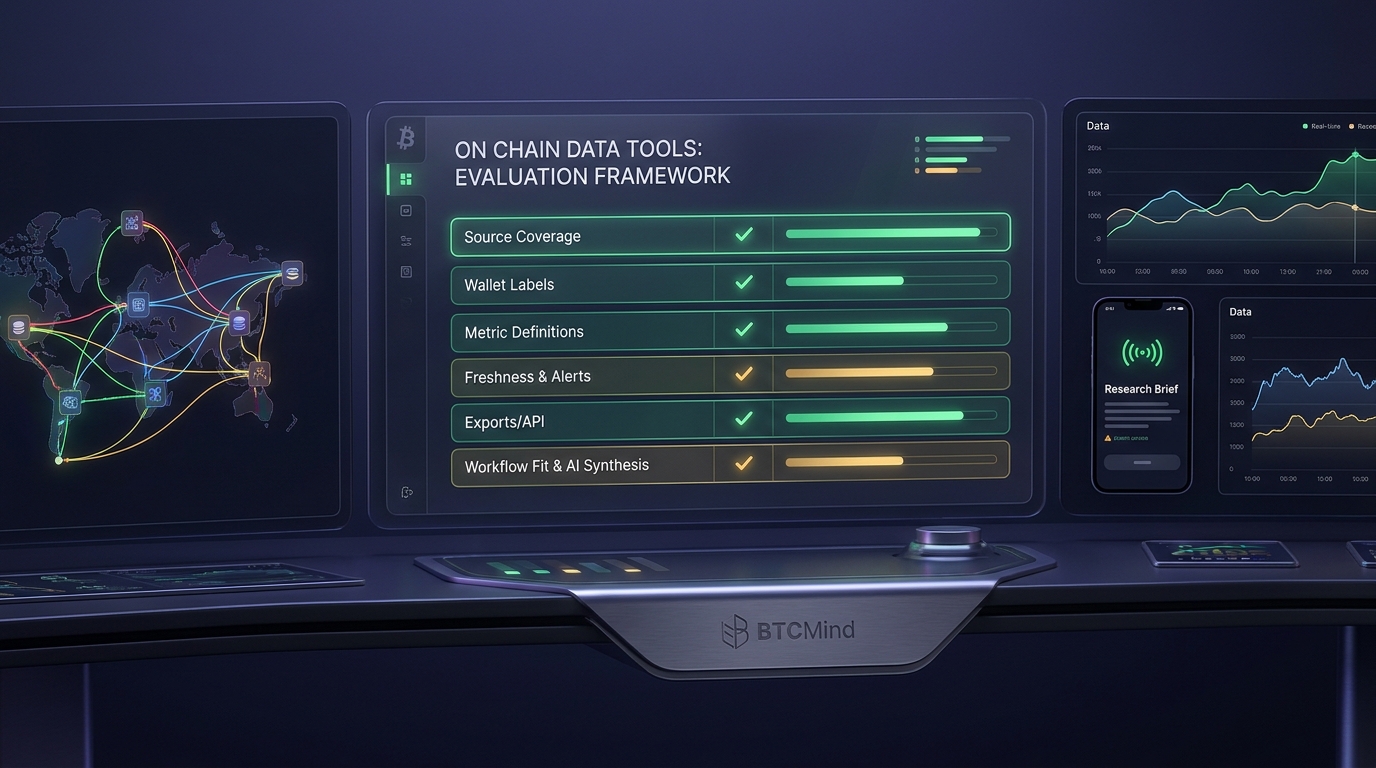
On chain data tools should help you answer one question: does blockchain activity change the next research decision?
That sounds simple, but most tool comparisons drift into feature lists. One platform has more dashboards. Another has better wallet labels. Another has a query engine, alerts, smart-money screens, exchange-flow charts, or portfolio tracking. Those features matter only if they improve a decision you actually make.
This evaluation framework turns on chain data from a vague buying category into a testable workflow. Use it before you choose a paid analytics platform, renew a plan, add another dashboard to the research stack, or trust an AI-generated crypto brief that cites on-chain evidence.
Educational note: This guide is for research workflow design. It is not investment advice, a recommendation, or a live trading signal. Crypto assets can be volatile, and leverage can amplify losses.
The Short Answer
Good on chain data tools do five jobs well:
- They show where the data came from.
- They explain how labels and metrics are built.
- They make freshness and revision risk visible.
- They connect alerts to decisions, not just notifications.
- They let you export, audit, or summarize the evidence later.
If a tool cannot do those five things, it may still be useful for exploration. It is not yet decision-grade.
The evaluation mistake is starting with "which tool has the most data?" Start with:
- What decision do we need to improve?
- Which chain, asset, wallet, exchange, or protocol matters?
- What on chain data would change action, confidence, or timing?
- What non-chain evidence must confirm or challenge the read?
- How will we know after 14 days whether the tool helped?
That is the difference between buying a dashboard and building a research workflow.
Start With the Job, Not the Vendor
On chain data tools are not interchangeable. A wallet investigation tool, an on-chain analytics terminal, a SQL-style query layer, a portfolio tracker, and an AI research desk solve different problems.
Before comparing vendors, write a one-line job statement:
When [event happens], we need on chain data to decide [action] within [time window], using [evidence standard].Examples:
| Situation | Weak job statement | Strong job statement |
|---|---|---|
| Exchange flow alert | "Track exchange reserves" | "When BTC exchange inflows spike, decide whether this is a sell-risk warning, custody reshuffle, or false positive within one daily review." |
| Wallet monitoring | "Watch smart money" | "When a watched wallet moves size, identify whether the move is accumulation, distribution, bridge activity, or label noise before changing watchlist priority." |
| Tool renewal | "We need better on-chain charts" | "Before renewal, prove that at least 10 on-chain signals changed decisions, reduced false alerts, or improved research speed in the last 30 days." |
| AI brief review | "Use AI to summarize the market" | "When an AI brief cites on chain data, verify source freshness, metric definition, counter-case, and action relevance before using the conclusion." |
For a definition-first primer, read BTCMind's on chain data workflow. This article assumes you already know what on chain data is and now need to evaluate tools.
The 12-Point On Chain Data Tools Scorecard
Score each tool from 0 to 2 on every criterion:
- 0 = missing, unclear, or unusable for the job.
- 1 = present but limited, manual, stale, or hard to audit.
- 2 = usable, clear, repeatable, and decision-ready.
| # | Criterion | What to Check | Passing Standard |
|---|---|---|---|
| 1 | Chain and asset coverage | Supported chains, assets, exchanges, protocols, and history | Covers the exact assets and venues in your workflow, not just the broad market |
| 2 | Source traceability | Links to addresses, transactions, contracts, blocks, or source docs | A reviewer can trace the claim back to inspectable evidence |
| 3 | Label methodology | Wallet labels, entity clusters, confidence levels, and update policy | Labels are explainable enough to avoid treating guesses as facts |
| 4 | Metric definitions | Formulas, windows, exclusions, and known limitations | The same metric means the same thing across reviews |
| 5 | Freshness | Update frequency, timestamp visibility, lag, and downtime history | Fresh enough for the decision horizon |
| 6 | Revision handling | Label changes, backfills, metric revisions, and changelogs | The tool makes material revisions visible |
| 7 | Alert quality | Thresholds, routing, deduplication, false-positive controls | Alerts map to decisions, owners, and expiration rules |
| 8 | Cross-signal context | Price, volume, derivatives, news, portfolio, or custody context | On-chain evidence is not interpreted in isolation |
| 9 | Export and API | CSV, API, dashboards, webhook, notebook, or query access | Evidence can leave the UI and enter the team's decision log |
| 10 | Audit trail | Saved views, notes, timestamps, screenshots, or versioned outputs | A past decision can be reviewed without reconstructing it from memory |
| 11 | Workflow fit | Mobile, desktop, team seats, permissions, speed, and learning curve | The tool fits the people and cadence that will use it |
| 12 | Cost discipline | Plan limits, credit model, overage risk, renewal proof | Cost is tied to adopted decisions, not dashboard enthusiasm |
Interpret the score this way:
| Total Score | Decision |
|---|---|
| 20-24 | Use or renew if the tool also passes the 14-day acceptance test |
| 15-19 | Pilot with narrow scope and explicit repair items |
| 9-14 | Use only for exploration or a single specialized job |
| 0-8 | Do not rely on it for decision-grade research |
The score is not a universal ranking. It is a fit test. A query layer can score high for custom research and low for mobile alerts. A wallet-intelligence product can score high for entity investigation and low for broad portfolio monitoring. A portfolio tracker can score high for holdings visibility and low for on-chain methodology.
Match Tool Class to the Research Job
Use this map before you build a shortlist.
| Tool Class | What It Usually Does Best | Where It Can Fail | Evaluation Question |
|---|---|---|---|
| Blockchain explorer | Raw transaction, address, block, and contract inspection | Too manual for recurring decision workflows | Can we verify the underlying evidence quickly? |
| Wallet intelligence platform | Entity labels, wallet clusters, network maps, watched addresses | Label confidence and attribution risk | Can we separate evidence from inference? |
| On-chain analytics terminal | Market metrics, exchange flows, supply bands, alerts, dashboards | Metric overload and unclear action rules | Which metrics change decisions, and which are decoration? |
| Query/data layer | Custom datasets, SQL-style workflows, API access, reproducible research | Requires data skill and maintenance | Can we build the exact view our workflow needs? |
| Portfolio tracker | Holdings, wallets, exchanges, balances, tax or performance context | May not explain on-chain signal methodology | Does it improve portfolio decisions or just show balances? |
| AI research desk | Synthesis, contradiction checks, briefing, decision cards | Can hide weak inputs behind confident language | Does the brief cite source signals, counter-cases, and invalidation rules? |
Current public positioning shows why this matters. Glassnode describes digital asset market intelligence with market and on-chain data, analytics, and research. Nansen emphasizes onchain AI with hundreds of millions of labeled addresses, smart-money tracking, and token analysis. Arkham positions itself around deanonymizing blockchain activity and mapping addresses, entities, and assets. Dune's docs position the product around blockchain data, a query engine, and API access. CoinStats positions itself as a crypto tracker for many coins, exchanges, wallets, and blockchains.
Those are different jobs. Comparing them as if they are all "on chain data tools" creates false precision.
What Decision-Grade On Chain Data Requires
A decision-grade on chain data workflow has six layers.
| Layer | Required Output | Failure Mode |
|---|---|---|
| Source | Address, transaction, block, contract, dataset, or vendor metric | The claim cannot be traced |
| Label | Entity attribution and confidence | A wallet movement is treated as known intent |
| Metric | Definition, window, denominator, and update time | Teams compare charts without knowing what changed |
| Context | Price, volume, derivatives, news, portfolio, and custody checks | On-chain evidence is over-weighted |
| Decision | Add, reduce, wait, investigate, hedge, archive, or no action | The tool produces insight with no owner |
| Memory | Decision log, screenshot, export, source URL, and invalidation rule | Nobody can audit whether the tool helped |
This is where many on chain data tools lose practical value. They may have excellent charts, but the chart is not the decision. The decision is the documented move from evidence to action, including what would make the view wrong.
For cost and operating discipline, see BTCMind's on-chain signal workflows cost and ROI guide.
A 14-Day Acceptance Test for On Chain Data Tools
Do not evaluate on chain data tools from a demo alone. Run a short acceptance test.
Day 0: Write the Test Contract
Create a one-page contract:
| Field | Example |
|---|---|
| Decision | Classify exchange-flow risk after major BTC moves |
| Horizon | Daily review, not intraday execution |
| Assets | BTC and major stablecoins |
| Evidence | Exchange reserves, netflows, label notes, price/volume context |
| Required output | Decision card: act, wait, investigate, or ignore |
| Success metric | 10 reviewed events, at least 4 adopted decisions, fewer duplicate alerts |
| Hard stop | Cannot export evidence, unclear label definitions, or more than 30 percent false alerts |
Days 1-3: Recreate Old Decisions
Take five prior market events or portfolio reviews. Ask whether the tool can reconstruct what the team would have needed at the time:
- Was the data available with timestamps?
- Were labels clear enough?
- Did the metric definition match the decision?
- Could the evidence be exported?
- Would it have changed the decision or only added commentary?
This prevents recency bias. A tool that looks good on today's chart may be weak when you ask it to explain a past decision.
Days 4-10: Shadow Live Events
Use the tool in parallel with your current process. Do not let it control action yet.
For each event, fill this card:
Event:
On-chain signal:
Source and timestamp:
Label confidence:
Non-chain confirmation:
Counter-case:
Decision impact:
Owner:
Follow-up trigger:
If the tool cannot produce this evidence card, it is not ready for decision-grade use.
Days 11-14: Score and Decide
Review the scorecard and the shadow cards.
| Result | Action |
|---|---|
| High score, clear adopted decisions | Adopt or renew |
| High score, low usage | Repair workflow before expanding |
| Medium score, one strong use case | Keep only for that use case |
| Low score, no adopted decisions | Reject, downgrade, or archive |
| Strong data, weak synthesis | Pair with a research-brief workflow |
The acceptance test should end with a tool decision: buy, renew, downgrade, replace, repair, or remove.
Red Flags When Comparing On Chain Data Tools
Watch for these problems during demos, trials, and renewals.
1. The Tool Hides Metric Definitions
If a metric is important enough to change a decision, it needs a definition. Ask for:
- calculation window;
- included and excluded entities;
- label source;
- update frequency;
- revision policy;
- known failure cases.
Without that, the on chain data may be visually persuasive but operationally weak.
2. Wallet Labels Look Certain When They Are Not
Entity labels are useful, but they are not permanent facts. A deposit wallet, exchange wallet, market-maker wallet, bridge contract, or fund address can be mislabeled, reclassified, or incomplete.
Good tools expose enough context to keep label risk visible. Weak tools turn inference into certainty.
3. Alerts Have No Action Contract
An alert should say who acts, what they check, when it expires, and what action is allowed.
Bad alert:
Large exchange inflow detected.Better alert:
BTC exchange inflow above threshold. Owner reviews source, label confidence, price/volume confirmation, and derivatives context. Allowed outputs: investigate, wait, reduce risk, or archive.For alert structure, use BTCMind's Bitcoin alert routing lanes.
4. The Tool Cannot Export Evidence
If evidence cannot be exported, screenshotted, linked, or logged, your team cannot learn from it. That matters for paid renewals, post-mortems, compliance review, and AI brief verification.
The minimum export should include:
- source URL or dataset reference;
- timestamp;
- metric name and definition;
- value;
- label note;
- screenshot or CSV;
- decision impact;
- reviewer.
5. The UI Rewards Watching Instead of Deciding
On chain data tools can create a false sense of productivity. More dashboards can mean more ambiguity.
The fix is a decision limit. For each dashboard, define the only decisions it is allowed to support. If a dashboard does not map to a decision, archive it or label it as background research.
How BTCMind Fits Into the Stack
BTCMind is not positioned as a raw blockchain explorer or a generic market dashboard. The current BTCMind site describes a mobile AI crypto research desk where six AI specialists run deep research in parallel: technicals, derivatives, tail-risk, bull/bear debate, and portfolio-manager synthesis. The product emphasizes investment-grade briefs, source-signal traceability, price alerts, voice chat, and a mobile workflow.
That makes BTCMind useful after source evidence is checked.
A strong stack looks like this:
Source on-chain tool -> label and metric check -> non-chain confirmation -> BTCMind synthesis -> decision cardUse BTCMind when you want a smaller, adversarial brief from mixed evidence. Do not use BTCMind, or any AI crypto research tool, as a substitute for checking sources, understanding label risk, or managing position size.
For adjacent research design, see the Bitcoin market intelligence beginner guide and the Bitcoin analytics strategy for growth teams.
On Chain Data Tools Evaluation Template
Copy this into your research doc before a trial or renewal.
Tool:
Tool class:
Primary job:
Assets/chains:
Decision horizon:
Owner:

Must-have evidence:
1.
2.
3.

Scorecard total:
Weakest criteria:
Repair items:

14-day test events:
1.
2.
3.
4.
5.

Adopted decisions:
False alerts:
Unclear labels:
Export gaps:
Cost or plan constraints:

Decision:
Buy / renew / downgrade / replace / repair / remove

Reason:
Next review date:
Final Takeaway
The best on chain data tools are not the ones with the most charts. They are the ones that make evidence traceable, labels honest, metrics explainable, alerts actionable, and decisions reviewable.
If your workflow cannot say how on chain data changes action, you are not ready to compare tools. Start with the decision, run the 12-point scorecard, complete a 14-day acceptance test, and keep only the tools that improve real research decisions.
BTCMind can help turn verified on-chain evidence into a compact research brief, but the source standard still comes first: check the data, challenge the interpretation, write the counter-case, then decide.
Sources and Methodology
Public pages checked on August 19, 2026:
- BTCMind homepage and product crawl: https://btcmind.ai
- Glassnode homepage: https://glassnode.com/
- CryptoQuant pricing page: https://cryptoquant.com/pricing
- Dune documentation: https://docs.dune.com/
- Nansen homepage: https://www.nansen.ai/
- Arkham homepage: https://www.arkhamintelligence.com/
- CoinStats homepage: https://coinstats.app/
Search and research tool notes:
- Ahrefs keyword research was attempted for "on chain data", "on chain data guide", and "on chain data tools", but the API returned a Cloudflare/429 response. No search volume, keyword difficulty, DR, traffic, or ranking metric claims are used in this article.
- Apodex deep research was attempted once and returned a 504 timeout. The article relies on project knowledge, current public page checks, and adjacent BTCMind content instead.
FAQ
What are on chain data tools?
On chain data tools are products that help users inspect, organize, query, visualize, alert on, or summarize blockchain activity. They can include explorers, wallet-intelligence platforms, analytics terminals, query layers, portfolio trackers, and AI research desks.
How should I choose an on chain data tool?
Choose an on chain data tool by job fit. Define the decision, asset coverage, source traceability, label methodology, metric definitions, freshness, alerts, exports, audit trail, workflow fit, and cost discipline before comparing vendors.
Are on chain data tools enough for trading decisions?
No. On chain data tools provide evidence, not certainty. A sound workflow also checks price, volume, derivatives, news, portfolio exposure, custody risk, invalidation rules, and position-size discipline.
What is the biggest mistake in using on chain data?
The biggest mistake is treating wallet labels or metric movements as intent. A transfer can have many explanations. Decision-grade research keeps label risk, metric definitions, and counter-cases visible.
Where does AI fit with on chain data tools?
AI is most useful as a synthesis layer after the source evidence has been checked. It can help summarize conflicts, generate counter-cases, and create a decision card, but it should not replace source inspection.