Bitcoin market intelligence is not a larger dashboard. It is a way to decide which Bitcoin signals deserve action, which deserve monitoring, and which should be ignored.
This Bitcoin market intelligence: beginner guide gives you a signal triage system: a practical process for sorting price moves, volume changes, derivatives pressure, on-chain notes, news, and AI briefs into one of four lanes: act, watch, research, or discard.
That distinction matters because beginners usually do not suffer from too little data. They suffer from too many inputs with no priority rule. A chart looks bullish, a headline sounds bearish, a funding screen looks crowded, a social post sounds urgent, and the final decision becomes emotional. Market intelligence turns that pile of inputs into a written evidence packet.
This article is educational only. It is not investment advice, a recommendation, or a live Bitcoin trading signal. Bitcoin and crypto assets can be volatile, leverage can amplify losses, and no research process removes market risk.
Bitcoin market intelligence: beginner guide in one sentence
Bitcoin market intelligence is the process of converting noisy Bitcoin data into a traceable decision: what changed, why it matters, what would prove the read wrong, and whether the evidence is strong enough to affect risk.
For beginners, the key question is not "Is this signal bullish or bearish?" The better question is:
Is this signal decision-grade for my timeframe?
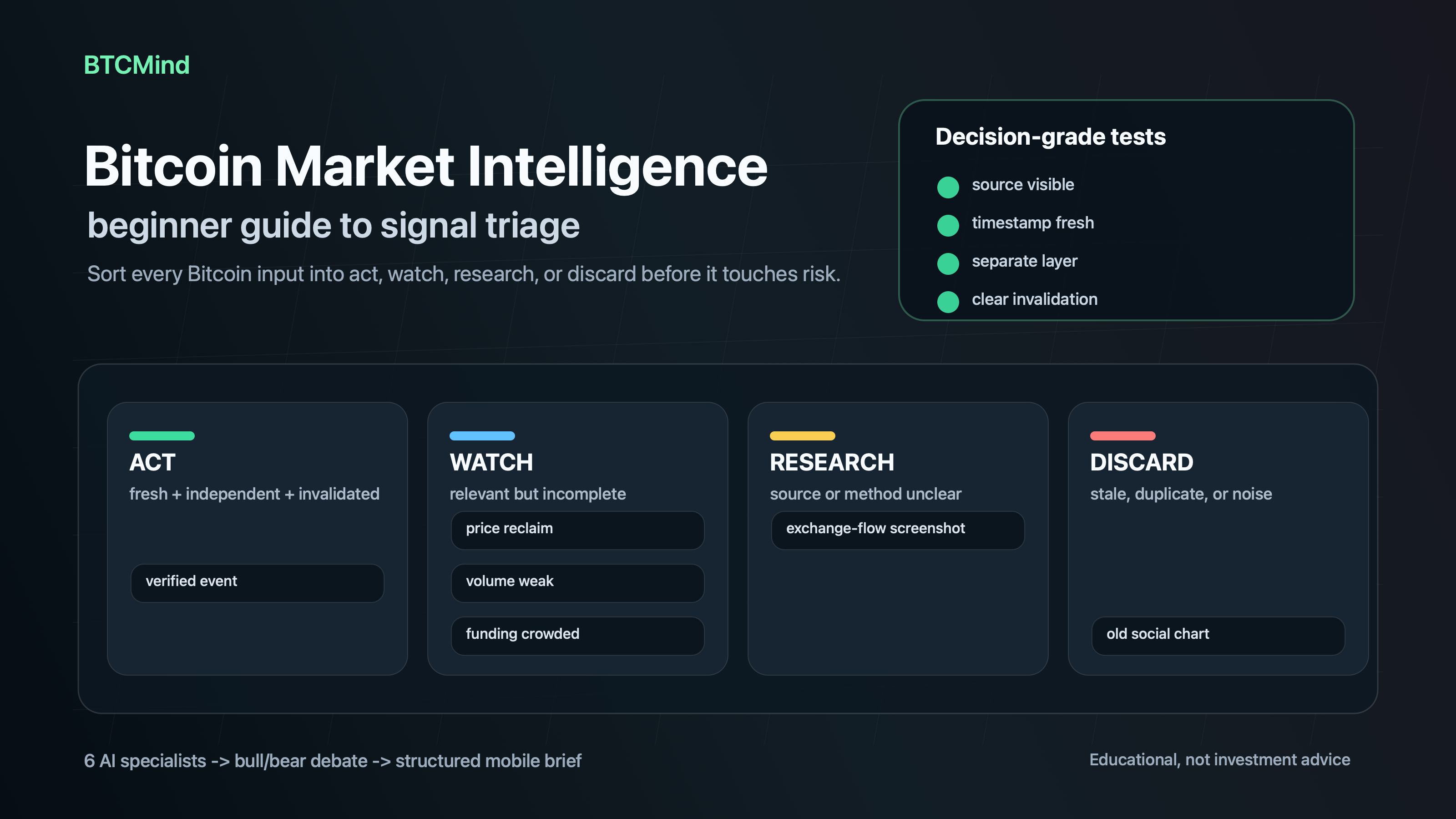
A signal is decision-grade only when it passes four tests:
| Test | Beginner question | If the answer is no |
|---|---|---|
| Source | Do I know where the claim or data came from? | Treat it as unverified commentary |
| Freshness | Is it current enough for my decision horizon? | Mark it stale before judging direction |
| Independence | Is it a separate evidence layer or just the same price move restated? | Do not count it twice |
| Invalidation | Do I know what would make the signal wrong? | Do not let it change position size |
This Bitcoin market intelligence: beginner guide is built around those four tests. You are not trying to catch every move. You are trying to stop weak signals from becoming oversized decisions.
The four-lane signal triage system
Every Bitcoin input should go into one of four lanes.
| Lane | Meaning | Beginner action |
|---|---|---|
| Act | Evidence is fresh, relevant, independent, and tied to an invalidation rule | Take the preplanned action or update the decision card |
| Watch | Evidence is relevant but incomplete, conflicted, or not yet confirmed | Set an alert or review time |
| Research | Evidence may matter, but the source, definition, or timeframe is unclear | Verify before it reaches the decision card |
| Discard | Evidence is stale, duplicated, unverifiable, or outside your timeframe | Remove it from the decision |
The default lane should be watch, not act. Most Bitcoin signals are interesting before they are actionable. A funding spike, a sharp wick, a whale-transfer screenshot, or a macro headline can all matter. They do not automatically justify a new trade, a larger position, or a panic exit.
In this Bitcoin market intelligence: beginner guide, the lane is the control surface. Direction tells you what the signal implies. The lane tells you whether it is strong enough to affect behavior.
Use this operating rule:
A signal can move from watch to act only after it names the source, timeframe, opposing evidence, and invalidation.
That rule sounds slow, but it is faster than rebuilding your thesis after every chart or post.
Start with the decision, not the data
Beginners often open tools first and define the decision later. Reverse the order.
Before checking any market input, write one line:
The decision I am supporting is: add / hold / reduce / hedge / set alert / do nothing.
The decision horizon is: intraday / swing / multi-week / long-term allocation.
This one line stops a common error: using an intraday signal to justify a long-term allocation decision, or using a long-term on-chain model to override short-term liquidation risk.
Then use the same triage table every time:
| Signal | Source | Timestamp | Layer | Direction | Lane | Invalidation |
|---|---|---|---|---|---|---|
| Daily close above key zone | Exchange chart | Last completed daily candle | Price | Constructive | Watch or act | Daily close back below zone |
| Funding elevated while open interest rises | Derivatives data source | Current session | Leverage | Crowded long risk | Watch | Funding normalizes or OI falls |
| Large exchange inflow screenshot | Social post | Unclear | On-chain | Possible supply risk | Research | Primary source confirms venue and amount |
| ETF or regulatory headline | Official filing, exchange, regulator, or credible wire | Publication time | News | Event risk | Watch or act | Primary source contradicts headline |
| AI brief says "buy" without source timestamps | Analyst or AI tool | Unknown | Synthesis | Unsupported | Discard or research | Source packet supplied |
The lane matters more than the direction. A bullish signal in the research lane is not bullish enough to act on. A bearish signal in the watch lane is a risk note, not a command. A mixed evidence packet is not a failure. It is the normal state of a 24/7 market.
That is the main practical difference between raw data and this Bitcoin market intelligence: beginner guide approach: you preserve the right to do nothing until the evidence packet is decision-grade.
The five evidence layers beginners should triage
A useful Bitcoin market intelligence workflow separates inputs by job. Do not let one layer dominate the whole decision.
| Layer | Job | Beginner examples | Common mistake |
|---|---|---|---|
| Price structure | Show where Bitcoin is trading relative to obvious zones | Trend, range, support, resistance, failed breakout | Treating one line as exact |
| Participation | Check whether activity supports the move | Spot volume, liquidity, market breadth | Assuming price alone confirms itself |
| Derivatives | Detect leverage pressure and crowding | Funding, open interest, futures basis, liquidations | Treating crowded positioning as a guaranteed reversal |
| On-chain context | Add network, holder, and exchange-flow context | Exchange reserves, transaction activity, realized value metrics | Treating one transfer as proof of intent |
| News and macro risk | Identify events that can change the thesis | Exchange, issuer, ETF, regulator, macro, security events | Acting before primary-source verification |
If three layers agree and two are neutral, the decision may be clean enough to act at a bounded size. If price is constructive but derivatives are crowded and news is unverified, the correct lane may be watch. If an on-chain signal looks important but the metric definition is unclear, it belongs in research.
For deeper adjacent workflows, use BTCMind's Bitcoin support and resistance guide for price zones, the Bitcoin market cycle indicators guide for broader regime context, and the Bitcoin sentiment analysis workflow when social mood starts influencing your decisions.
The 15-minute beginner triage routine
This Bitcoin market intelligence: beginner guide uses a short routine because long routines usually collapse under real market pressure.
Use this once per day or before any meaningful Bitcoin action:
| Minute | Work | Output |
|---|---|---|
| 0-2 | Define the decision and timeframe | One sentence decision line |
| 2-5 | Read price structure on the chosen timeframe | Trend, range, key zone, invalidation |
| 5-7 | Check participation | Confirming, weak, or unclear |
| 7-9 | Check derivatives if leverage risk matters | Balanced, crowded long, crowded short, or unavailable |
| 9-11 | Check one on-chain or exchange-flow source | Useful, stale, unclear, or irrelevant today |
| 11-13 | Check material news or macro events | Verified event, unverified claim, or no material event |
| 13-15 | Assign lanes and write the action | Act, watch, research, or discard |
The output should be a note, not a feeling:
Decision: hold existing BTC, no add yet.
Horizon: multi-day swing.
Price: reclaim attempt is inside the key zone, not cleanly accepted.
Participation: spot volume is unclear.
Derivatives: leverage appears crowded long.
News: no verified thesis-changing event.
Lane: watch.
Invalidation: daily close below the zone keeps the add off the table.
Next review: after daily close.
This is Bitcoin market intelligence in its simplest useful form. It converts uncertainty into an operating choice.
How to handle contradictions
Contradictions are not a reason to ignore the system. They are the reason the system exists.
Use this router:
| Conflict | What it may mean | Beginner route |
|---|---|---|
| Price breaks higher but volume is weak | Move may lack broad participation | Watch for acceptance or pullback confirmation |
| Price looks strong but funding and open interest are stretched | Upside may continue, but leverage risk is elevated | Avoid chasing size; wait for cleaner positioning |
| News sounds bullish but price cannot reclaim the key zone | Market may doubt the impact or have priced it in | Keep headline in watch lane until price confirms |
| On-chain exchange flows look bearish but derivatives are balanced | Supply risk may be slow-moving, not immediate | Separate timeframe; do not force a short-term action |
| AI brief gives a strong verdict but no source timestamps | Synthesis may be useful, but auditability is weak | Ask for sources or keep it in research |
The goal is not to make every layer agree. The goal is to know what disagreement does to behavior. For beginners, disagreement usually means lower size, delayed action, or a tighter review window.
A source-quality rule for market intelligence
Market intelligence gets worse when every source receives equal weight.
Use this hierarchy:
| Source type | Use for | Beginner caution |
|---|---|---|
| Primary source | Event confirmation: regulator, exchange, issuer, protocol, company, court, official data page | Still check timestamp and scope |
| Documented data provider | Market, on-chain, or derivatives data with visible methodology | Provider coverage and definitions can differ |
| Credible secondary source | Fast context when primary documents are slow to parse | Separate reporting from interpretation |
| Analyst or AI synthesis | Compression, scenario framing, contradiction checks | Require source trails for important claims |
| Social screenshot | Lead for research | Never decision-grade alone |
Public data providers such as CoinGecko document market data fields like price, volume, and market capitalization. On-chain analytics providers such as Glassnode document metric definitions and methodology. Official investor education from Investor.gov and CFTC materials is useful for risk framing because crypto assets can carry volatility, fraud, custody, and operational risks. For AI-assisted workflows, NIST's AI Risk Management Framework is a useful reference because it frames AI risk as something to govern, map, measure, and manage rather than something to trust blindly.
None of those sources tells you whether Bitcoin should be bought today. Their job is more basic: make sure the input is real, timestamped, and interpreted within its limits.
This Bitcoin market intelligence: beginner guide uses external sources as verification rails, not as outsourced conviction. A source can prove that an event happened without proving what your account should do next.
When a Bitcoin market intelligence tool is worth using
A Bitcoin market intelligence tool is useful when it improves triage speed without hiding the evidence. It is not useful just because it adds more charts.
Before trusting any Bitcoin market intelligence platform, score it against this 20-point checklist:
| Control | Points |
|---|---|
| Shows source links or data provenance for important claims | 2 |
| Shows timestamps for material inputs | 2 |
| Separates price, derivatives, on-chain, news, and risk layers | 2 |
| Labels confidence instead of only direction | 2 |
| Names invalidation or review conditions | 2 |
| Shows the opposing case | 2 |
| Allows a no-action output | 2 |
| Explains when evidence is stale or unavailable | 2 |
| Helps export or save the decision record | 2 |
| Reduces time spent without increasing blind trust | 2 |
Score 16-20 and the tool may be decision-support quality. Score 10-15 and it may be useful as a research aid. Score below 10 and it is probably still a dashboard or commentary feed.
For the purposes of a Bitcoin market intelligence: beginner guide, a tool earns trust by making the decision card easier to fill, not by producing a stronger-sounding opinion.
BTCMind is designed around this decision-support problem. Its six AI specialists analyze technicals, derivatives, tail risk, historical context, bull arguments, and bear arguments before a portfolio manager produces a structured brief with verdict, key levels, action plan, invalidation, and confidence. The important beginner benefit is not "AI predicts Bitcoin." The benefit is that a mobile brief can compress the research loop while keeping the reasoning inspectable.
BTCMind also fits the triage model because the product positioning is not a black-box bot or KOL signal feed. The workflow is built around adversarial bull/bear debate and traceable calls, with price alerts and structured mobile briefs for users who do not want to watch the market all day.
The beginner decision card
Before any Bitcoin decision changes risk, fill this card:
| Field | Required answer |
|---|---|
| Decision | Add, hold, reduce, hedge, set alert, or do nothing |
| Horizon | Intraday, swing, multi-week, or long-term allocation |
| Price structure | Trend/range and key zone |
| Participation | Confirming, weak, unclear, or unavailable |
| Derivatives | Balanced, crowded long, crowded short, or out of scope |
| On-chain context | Useful, stale, unclear, or irrelevant today |
| News/macro | Verified event, unverified claim, or no material event |
| Evidence against | Strongest opposing case |
| Lane | Act, watch, research, or discard |
| Invalidation | Observable condition that makes the read wrong |
| Review time | Specific time or market condition |
If the invalidation or evidence-against fields are blank, the signal is not decision-grade. Keep it in watch or research.
Final takeaway
This Bitcoin market intelligence: beginner guide gives you a practical filter for a noisy market: define the decision, separate evidence layers, assign every signal to a lane, and act only when the signal is sourced, fresh, independent, and invalidatable.
BTCMind can shorten that workflow with six-agent research, bull/bear debate, tail-risk checks, confidence labels, and mobile briefs. Use it to read the conclusion, inspect the evidence trail, and preserve the no-action state when the evidence is not strong enough.
Not investment advice. Crypto trading carries extreme risk. Past performance is not indicative of future results.