Most “crypto portfolio tools” solve one narrow job. The problem begins when their users assume that tracking, analysis, research, risk management, and execution are interchangeable.
A portfolio tracker can show that Bitcoin is 42% of your holdings. It cannot automatically tell you whether that weight still fits your thesis, whether three altcoin positions share the same liquidity risk, or whether derivatives positioning contradicts an apparently bullish chart. An on-chain dashboard can surface a structural shift, but it may still leave you to decide whether the signal matters for your time horizon. A trading bot can execute a rule precisely while having no independent view on whether the rule remains valid.
For crypto portfolio research: comparison and alternatives, start with the decision layer that is failing, not the vendor category with the most visible marketing.
This comparison separates five crypto portfolio research approaches by the decision they actually support:
- spreadsheets and research journals;
- portfolio trackers;
- on-chain and market-data platforms;
- trading bots and automation tools;
- multi-agent AI research desks.
You will also get a four-layer portfolio research audit, a 15-point comparison scorecard, a portfolio-complexity calculator, buyer-specific decision paths, three practical tool stacks, a switching-versus-stacking matrix, a 30-day trial log, a 14-day acceptance-test plan, a replacement-readiness ladder, a vendor-fit scenario map, an evidence-weighted renewal memo, an RFP-style replacement checklist, and a controlled migration plan for replacing a crypto research tool without losing decision history.
Important: This article is educational, not personalized financial advice. Crypto assets can be extremely volatile and expose users to market, liquidity, custody, operational, fraud, and regulatory risks. No tool, model, signal, or research workflow can guarantee a profitable outcome.
Crypto portfolio research: comparison and alternatives by job
| Approach | Primary job | Strongest output | Main blind spot | Best fit |
|---|---|---|---|---|
| Spreadsheet or research journal | Record and structure judgment | Custom thesis history and decision rules | Continuous data collection | Investors with a concentrated watchlist and disciplined review habit |
| Portfolio tracker | Maintain portfolio state | Holdings, allocation, performance, and wallet/exchange visibility | Explaining why conditions changed | Users with assets spread across accounts, chains, or venues |
| On-chain and market-data platform | Investigate market structure | Deep metrics, dashboards, alerts, and historical context | Portfolio-specific synthesis | Analysts comfortable interpreting specialist data |
| Trading bot or automation platform | Execute defined rules | Repeatable orders, alerts, backtests, and position automation | Independent thesis formation | Traders with a tested rule set and explicit shutdown conditions |
| Multi-agent AI research desk | Compress the research process | Adversarial evidence synthesis and a recurring decision brief | Custody, accounting, and final human responsibility | Time-poor traders who need several evidence types translated into one reviewable plan |
The answer is rarely “pick the tool with the most features.” The better question is:
Which layer of my decision process is currently failing?
If balances are wrong, fix tracking. If evidence is fragmented, fix research synthesis. If risk limits are vague, fix the portfolio policy. If execution is inconsistent, automate only after the first three layers are reliable.
Five-minute shortlist: which alternative should you evaluate first?
Use this table before opening pricing pages or booking demos. It keeps crypto portfolio research: comparison and alternatives anchored to the workflow problem rather than vendor category labels.
| Your current symptom | Likely failed layer | First alternative to test | What a pass looks like | What a fail looks like |
|---|---|---|---|---|
| You cannot reconcile balances across wallets and exchanges | Portfolio truth | Portfolio tracker | Holdings, allocation, and exceptions are visible within one review window | Balances remain stale, duplicated, or unclassified |
| You have charts, metrics, and alerts but no clear conclusion | Research synthesis | Multi-agent AI research desk or structured research journal | Evidence, counter-case, invalidation, and next action appear in one reviewable brief | Output adds another opinion without source trail or decision context |
| You understand the thesis but miss entries, exits, or risk actions | Execution discipline | Trading bot or automation platform | A prewritten rule executes consistently with permissions and shutdown controls | Automation creates trades that were not already defined by the research plan |
| You want deeper evidence behind Bitcoin, ETH, or large-cap positions | Evidence coverage | On-chain and market-data platform | Metrics answer named questions and can be tied to portfolio decisions | More dashboards are opened but decisions do not improve |
| You have too many tools, subscriptions, and alerts | Governance | Spreadsheet ownership map plus remove/renew gate | Every tool owns one job and duplicate outputs are removed | The stack still has no tie-break rule when tools disagree |
The fastest path is often subtractive. A user with ten disconnected alerts may need fewer signals and a clearer decision memo. A user with one tracker and no thesis history may need a written research journal before buying another platform. A user with clear research but inconsistent order entry may need automation, but only after position size, invalidation, and emergency stop conditions are already explicit.
Current product snapshot: what leading alternatives are built to do
Brand comparisons become misleading when every product is scored as if it were trying to solve the same problem. The official product pages checked for this guide on August 11, 2026 describe materially different jobs.
| Product or approach | Current official emphasis | Useful when | Do not assume it replaces |
|---|---|---|---|
| CoinStats | Portfolio aggregation across wallets, exchanges, DeFi, and NFTs; portfolio analytics; profit-and-loss views; exit planning; read-only connections | Your first problem is fragmented holdings and performance visibility | Independent thesis review, adversarial research, or a complete risk policy |
| Glassnode Studio | On-chain, spot, and derivatives data; custom charts; dashboards; backtesting; metric alerts; analyst notes | You need specialist market-structure evidence and can interpret it | Account reconciliation, portfolio-specific judgment, or order execution |
| 3Commas | DCA, grid, signal, and other trading bots; backtesting; exchange connectivity; strategy and execution tooling | You already have a defined rule and need repeatable execution | A verified investment thesis, independent counter-case, or custody controls |
| Spreadsheet or research journal | Custom calculations, assumptions, thesis history, and review logs | Your workflow is small enough to maintain manually and needs complete flexibility | Continuous ingestion, reliable reconciliation, or automated alerts |
| BTCMind | Six-agent parallel research, bull/bear debate, technical, derivatives, and tail-risk analysis, then a structured mobile brief | Your bottleneck is synthesizing several evidence types into a reviewable decision | Custody, tax accounting, guaranteed data accuracy, or personal financial responsibility |
Two implications follow.
First, feature overlap does not mean workflow equivalence. A tracker may include analytics, an analytics platform may include alerts, and a bot may include an AI assistant. The deciding question is still what the product treats as its core output: portfolio state, specialist evidence, execution, or decision synthesis.
Second, evaluate important connection and permission claims against the provider’s current documentation before onboarding. Marketing pages change, supported venues change, and one connection may offer read-only visibility while another can place orders. The name of the integration is not enough; verify the exact permission scope.
Calculate your portfolio research complexity before buying software
A user with Bitcoin in one hardware wallet has a different research problem from a trader with five exchanges, DeFi positions, perpetual futures, and several stablecoins. Score each factor from 0 to 2.
| Factor | 0 points | 1 point | 2 points |
|---|---|---|---|
| Custody locations | One wallet or venue | Two to three locations | Four or more locations |
| Chains and protocols | One chain, no DeFi | Two chains or limited DeFi | Multiple chains and active DeFi positions |
| Position count | One to three positions | Four to ten positions | More than ten positions |
| Leverage | None | Occasional or low leverage | Persistent leverage or perpetual futures |
| Research inputs | Price plus one source | Three to five recurring sources | More than five sources across technical, on-chain, derivatives, news, or sentiment |
| Decision frequency | Monthly or less | Weekly | Daily or intraday |
| Automation | None | Alerts or partial automation | Bots, APIs, or automated order placement |
| Reporting needs | Personal review only | Tax or partner reporting | Team, client, or formal investment-committee records |
Interpret the complexity score
- 0–4: simple portfolio. A spreadsheet or lightweight tracker may be enough. Avoid building a six-tool stack that creates more maintenance than insight.
- 5–9: moderate portfolio. Use a tracker for portfolio truth and add either specialist analytics or a structured research layer for the main decision bottleneck.
- 10–13: complex portfolio. Separate portfolio truth, research synthesis, and execution. Require an ownership map and permission register.
- 14–16: operationally intensive portfolio. Treat the setup like a small investment operation. Add data-quality checks, incident procedures, review logs, and quarterly tool governance.
The score does not measure sophistication or expected returns. It measures how many failure points the workflow can accumulate. A high score is a reason to simplify responsibilities, not automatically to buy more products.
What crypto portfolio research should produce
Useful research changes a decision or confirms that no decision is necessary. A complete workflow should produce seven outputs:
- Portfolio state: assets, weights, cost basis, venues, wallets, leverage, and stablecoin dependencies.
- Thesis state: why each position exists and whether current evidence still supports it.
- Concentration map: correlated exposures, shared ecosystems, liquidity constraints, and counterparty dependencies.
- Market context: technical structure, on-chain activity, derivatives positioning, sentiment, and event risk.
- Counter-case: the strongest evidence against the current view.
- Invalidation: the price, data, event, or time condition that would make the thesis wrong.
- Next action: hold, investigate, reduce, rebalance, hedge, exit, or do nothing—with a reason and review date.
A tool that produces only one or two of these outputs may still be valuable. The mistake is expecting it to cover the missing layers without an explicit process.
The four-layer crypto portfolio research audit
Before comparing brands, audit your existing workflow. Give each layer a score from 0 to 3.
Layer 1: portfolio truth
Can you answer, within five minutes:
- What do I own across every wallet and exchange?
- What percentage is exposed to one chain, stablecoin, custodian, or ecosystem?
- Which positions use leverage?
- Which balances or transactions are stale, duplicated, or unclassified?
Scoring:
- 0: balances are fragmented or materially unreliable.
- 1: most holdings are visible, but reconciliation is manual.
- 2: balances and allocation are current with documented exceptions.
- 3: portfolio state is current, reconciled, and segmented by risk dependency.
This is where a portfolio tracker usually creates the most value.
Layer 2: evidence coverage
Does your workflow examine more than price?
A robust review may include technical structure, spot activity, derivatives positioning, on-chain behavior, liquidity, protocol or issuer events, and tail-risk scenarios. Not every decision needs every input, but missing evidence should be visible.
Scoring:
- 0: decisions depend mainly on headlines, influencers, or price movement.
- 1: one analytical lens is used consistently.
- 2: several evidence types are reviewed, but synthesis is manual.
- 3: evidence coverage is defined by decision type and data gaps are labeled.
This is where specialist analytics platforms and structured research desks compete.
Layer 3: adversarial judgment
Can your process challenge its own conclusion?
Crypto markets punish one-sided narratives. A bullish thesis should include its strongest bearish evidence. A bearish thesis should identify what would prove it too cautious. If conflicting signals are compressed into one unexplained score, the workflow hides the most useful information.
Scoring:
- 0: the process looks mainly for confirmation.
- 1: risks are listed after the conclusion.
- 2: bull and bear evidence are compared before the decision.
- 3: the counter-case can change the action, position size, or invalidation rule.
This layer distinguishes research synthesis from a generic dashboard or chatbot answer.
Layer 4: decision discipline
Does the output specify what happens next?
The result should separate observation, judgment, sizing, execution, and review:
Observe → Challenge → Decide → Size → Execute → Review
Scoring:
- 0: outputs are vague “bullish/bearish” labels.
- 1: an action is suggested without invalidation or sizing context.
- 2: action, no-action, invalidation, and review timing are explicit.
- 3: risk limits and execution controls are defined before the order is placed.
Use the crypto portfolio risk budget worksheet if this is your weakest layer.
How to interpret the audit
| Total score | Interpretation | Priority |
|---|---|---|
| 0–3 | The workflow is mostly reactive | Establish portfolio truth and written rules |
| 4–6 | Useful tools exist, but gaps are hidden | Connect tracking, evidence, and risk review |
| 7–9 | Research is functional but labor-intensive | Improve synthesis, alerts, and repeatability |
| 10–12 | The workflow is mature | Test data quality, failure modes, and decision outcomes |
Do not buy an execution platform to solve a portfolio-truth problem. Do not buy another data feed when the real bottleneck is adversarial judgment.
Alternative 1: spreadsheets and research journals
A spreadsheet is the most adaptable crypto portfolio research tool because it imposes almost no methodology. You can track allocations, thesis statements, catalysts, invalidation levels, scenario losses, review dates, and decision history in one place.
Where spreadsheets are strongest
- Complete control over fields, formulas, and review cadence.
- A durable history of what you believed before the outcome was known.
- Easy separation between observations and decisions.
- Low switching cost and no dependency on one vendor’s taxonomy.
- Strong fit for a small number of high-conviction positions.
Where spreadsheets fail
They become fragile when the portfolio spans many wallets, chains, exchanges, or derivatives positions. Manual prices and transactions go stale. Formulas drift. A spreadsheet also does not create analytical discipline by itself; a beautifully formatted journal can still contain one-sided reasoning.
Choose this alternative when
Choose a spreadsheet when your main need is custom decision memory, not continuous monitoring. It is also a useful control layer beside any paid tool: record the thesis, expected evidence, invalidation, maximum risk, and next review date before acting.
Alternative 2: portfolio trackers such as CoinStats
Portfolio trackers are designed to consolidate state. CoinStats’ official portfolio page, checked on August 11, 2026, describes connections across wallets and exchanges, allocation and profit-and-loss analytics, DeFi tracking, and wallet activity analysis.
That makes a tracker valuable when the hardest question is “What do I own, where is it, and how has it performed?”
Where portfolio trackers are strongest
- Aggregating balances across wallets, exchanges, and protocols.
- Showing allocation, profit and loss, transaction history, and top movers.
- Reducing manual reconciliation.
- Creating alerts tied to assets or portfolio state.
- Supporting mobile monitoring.
The research gap
A portfolio tracker may describe the portfolio accurately without testing the thesis behind it. Allocation analytics do not automatically explain whether an exposure should remain, whether an apparent gain came from excessive concentration, or whether several tokens share one underlying risk factor.
Treat tracker-generated predictions, ratings, or insights as inputs that require the same source and methodology checks as any other signal.
Choose this alternative when
Choose a tracker when your main bottleneck is portfolio truth. Pair it with a research journal or research desk when you need to move from “what changed?” to “what does it mean for my decision?”
Alternative 3: on-chain and market-data platforms such as Glassnode
Specialist data platforms answer deeper questions about network activity and market structure. Glassnode Studio’s official product page, checked on August 11, 2026, says the workspace combines on-chain, spot, and derivatives data, with custom charts, backtesting, alerts, dashboards, notes, and shareable analysis.
Where specialist analytics are strongest
- Investigating investor cohorts, flows, profitability, adoption, and network activity.
- Comparing on-chain behavior with spot and derivatives conditions.
- Building custom dashboards around a defined research framework.
- Testing whether a metric behaved similarly in previous regimes.
- Alerting when a specialist indicator crosses a threshold.
The interpretation burden
More metrics can increase false confidence. Every metric has construction choices, time lags, labeling assumptions, historical limitations, and regime sensitivity. Two analysts can look at the same dashboard and reach opposite conclusions.
The missing function is often not data access but portfolio-specific synthesis: which metrics matter for this holding, this horizon, this risk limit, and this decision?
If you are budgeting for specialist data, use this on-chain signal workflow cost and ROI guide to compare total workflow cost rather than subscription price alone.
Choose this alternative when
Choose an on-chain platform when you already know which research questions you need to answer and have the skill and time to interpret the evidence.
Alternative 4: trading bots and automation platforms such as 3Commas
Automation platforms are strongest downstream of research. On its official features page, checked on August 11, 2026, 3Commas describes SmartTrade controls, DCA and other bots, TradingView signals, backtesting, portfolio functions, notifications, API access, and exchange integrations.
Where automation platforms are strongest
- Executing repeatable entry, exit, take-profit, and stop-loss rules.
- Monitoring markets continuously.
- Reducing manual order-entry errors.
- Backtesting and paper-testing defined strategies.
- Applying the same operational rule across supported venues.
The research gap
Automation scales the quality of the rule it receives. It can make a good process more consistent or a weak process lose money faster. A backtest is not an independent thesis, and historical fit does not guarantee that the market regime will persist.
Connecting an exchange also creates operational questions: API permissions, withdrawal controls, key storage, venue risk, monitoring, and emergency shutdown procedures.
Use an AI crypto trading signals trust audit before allowing generated signals to influence live capital.
Choose this alternative when
Choose automation when you have a defined, tested, risk-bounded execution rule. Do not choose it because you expect the platform to discover a durable strategy on your behalf.
Alternative 5: a multi-agent AI crypto research desk
A multi-agent research desk is designed to compress the investigation and synthesis layers. Instead of producing one model’s unchallenged answer, specialized agents analyze different evidence, debate competing interpretations, and pass the result to a final decision layer.
BTCMind’s current product overview describes six AI specialists covering technicals, derivatives, tail risk, reflection, bull and bear research, followed by a portfolio manager that produces a structured mobile brief. The product positions optional execution downstream of the research and user-controlled risk settings.
Where the multi-agent approach is strongest
- Combining technical, derivatives, risk, and event evidence into one workflow.
- Making the bull and bear cases explicit.
- Producing recurring briefs without rebuilding several dashboards each day.
- Separating the conclusion from its supporting evidence and invalidation.
- Reducing the time between a market change and a reviewable decision plan.
What it does not replace
A research desk is not a custodian, tax ledger, proof of data accuracy, or guarantee. It does not remove the user’s responsibility to verify important claims, define maximum loss, protect exchange credentials, and decide whether to act.
The strongest use is decision compression, not delegated certainty.
Choose this alternative when
Choose a multi-agent research desk when your main problem is information overload and synthesis. It is especially useful if your current tracker shows portfolio state but your daily process still requires opening multiple charts, feeds, and research tabs before you can make sense of it.
A 15-point crypto portfolio research tool scorecard
Score each candidate from 0 to 3 on five dimensions.
| Dimension | 0 points | 1 point | 2 points | 3 points |
|---|---|---|---|---|
| Portfolio context | Generic market output | Manual holdings context | Uses exposures or constraints | Connects evidence, concentration, and decision limits |
| Evidence coverage | One unexplained input | One clear methodology | Several evidence types | Defined coverage with visible data gaps |
| Adversarial reasoning | One directional claim | Generic risk disclaimer | Bull and bear evidence listed | Counter-case can change action or size |
| Traceability | Black-box score | Partial source visibility | Sources and assumptions shown | Sources, freshness, conflicts, and invalidation are reviewable |
| Decision discipline | Vague sentiment | Suggested action | Action plus invalidation | Action/no-action, sizing guardrail, invalidation, and review date |
Score interpretation
- 0–4: primarily a utility or data feed; add a separate research process.
- 5–8: useful analytical support, but most synthesis remains manual.
- 9–12: strong research workflow with a few control gaps.
- 13–15: comprehensive decision support—still subject to data, model, and human judgment risk.
Do not award points for chart count or the number of “AI” labels. Award points for reducing uncertainty while preserving the ability to inspect why a conclusion was reached.
Buyer-specific decision paths
Use the path that resembles your real operating model. Do not choose based on the trader you hope to become next quarter.
Long-term Bitcoin holder
Start with portfolio truth and thesis memory. A tracker is valuable when holdings are spread across wallets or venues; a spreadsheet can be sufficient when custody is simple. Add a research desk if the recurring problem is translating macro, on-chain, derivatives, and technical evidence into a disciplined monthly review.
Minimum viable stack: tracker or spreadsheet + written thesis + monthly decision card.
Reject a tool if: it encourages unnecessary trading, cannot record a no-action conclusion, or requires trading permissions for a research-only job.
Multi-asset spot investor
Prioritize concentration, liquidity, chain, stablecoin, and ecosystem dependencies. The portfolio can look diversified by ticker while remaining concentrated in one risk factor. A portfolio tracker should own holdings and allocation; the research layer should explain correlated exposures and whether the thesis for each position remains valid.
Minimum viable stack: multi-wallet tracker + concentration map + recurring thesis review.
Reject a tool if: it reports allocation without showing stale or unsupported positions, or produces recommendations without identifying shared risk dependencies.
Active discretionary trader
The central problem is often evidence overload. Use specialist analytics when you can interpret the raw data and need depth. Use a multi-agent research desk when preparation time and contradictory signals are the bottleneck. Keep execution manual until invalidation and size rules are explicit.
Minimum viable stack: evidence platform or research desk + decision journal + manual execution checklist.
Reject a tool if: every alert becomes a trade, confidence is shown without sources, or the counter-case disappears from the final recommendation.
Systematic or automation-first trader
Start with the rule, not the bot. Define the signal, entry, exit, size, maximum concurrent exposure, failure behavior, and shutdown condition. Backtest where appropriate, then paper test or use the smallest operational scope. The automation platform should own execution; a separate research process should determine whether the strategy’s assumptions remain valid.
Minimum viable stack: tested strategy specification + automation platform + execution log + independent strategy review.
Reject a tool if: API permissions are broader than required, failure behavior is unclear, or a historical backtest is presented as sufficient evidence for live deployment.
Researcher or crypto content creator
Prioritize source traceability, chart reproducibility, timestamps, and the ability to preserve disagreement. Specialist analytics may provide the deepest evidence. A research desk can reduce synthesis time, but every material claim still needs a reviewable source and current timestamp before publication.
Minimum viable stack: specialist data source + source ledger + structured synthesis workflow.
Reject a tool if: claims cannot be traced to inputs, charts cannot be recreated, or stale data is presented without a warning.
Three practical tool stacks
Stack A: long-term allocator
Portfolio tracker → monthly thesis review → risk-budget stress test → rebalance or hold
The tracker maintains accurate weights. The journal records why each position exists. The risk worksheet tests concentration and scenario loss. The default action can remain “hold” when no invalidation condition is met.
Stack B: active discretionary trader
Tracker → market/on-chain evidence → multi-agent debate → trade plan → manual execution → journal
This stack separates portfolio truth from interpretation and execution. The journal records whether the process was followed, not merely whether the trade won.
Stack C: systematic operator
Research hypothesis → historical test → out-of-sample test → risk limits → paper test → automation → monitoring
Automation comes last. Define realistic fees, slippage, data outages, maximum drawdown, and a shutdown condition before live deployment.
Switching versus stacking: when an alternative should replace your current tool
The word “alternative” can create the wrong buying decision. Two products may appear to compete while solving different layers of the workflow. Replacing a tracker with an on-chain dashboard, for example, may improve evidence depth while making portfolio reconciliation worse. Adding a second tool is not automatically better either; every additional login creates more cost, duplicated alerts, conflicting definitions, and operational work.
Use this rule:
- Switch when two tools perform the same critical job and the new one measurably improves accuracy, speed, control, or cost.
- Stack when the tools solve different jobs and the handoff between them is explicit.
- Remove a tool when its output is not used in a documented decision.
- Delay the purchase when you cannot define an acceptance test before the trial starts.
Eight switching triggers
| Trigger | What it reveals | Better response |
|---|---|---|
| Holdings regularly fail to reconcile | The portfolio-truth layer is unreliable | Switch tracker or fix data connections before buying more research |
| Research repeats the same market summary for every portfolio | Portfolio context is missing | Switch or add a system that accepts exposures, horizon, and risk limits |
| Analysts cannot reproduce a conclusion | Traceability is too weak | Require visible inputs, timestamps, assumptions, and invalidation |
| Alerts create activity but rarely change a decision | Signal volume is being mistaken for value | Remove low-utilization alerts or switch to fewer decision-linked outputs |
| One bullish score hides serious counter-evidence | The process lacks adversarial reasoning | Add a bull/bear review or multi-agent debate layer |
| Execution rules drift between trades | The bottleneck is operational consistency | Add automation only after the rule and shutdown controls are tested |
| Subscription cost rises while usage stays flat | The workflow has poor utilization | Consolidate overlapping tools and measure cost per adopted decision |
| Exchange permissions exceed the product’s job | Operational risk is unnecessarily high | Reconnect with least privilege or choose a lower-permission alternative |
A switch should have a measurable target. “Cleaner interface” is not enough. “Reduce unreconciled transactions from 18 per month to fewer than two,” “cut daily research preparation from 45 minutes to 15,” or “attach a timestamp and invalidation to 95% of briefs” can be tested.
Five stacking patterns that make sense
- Tracker + journal: automated portfolio truth with manual thesis memory.
- Tracker + specialist analytics: accurate exposure data plus deeper market or on-chain evidence.
- Tracker + multi-agent research desk: current holdings plus recurring interpretation and counter-case analysis.
- Research desk + manual execution: compressed analysis with a deliberate human approval gate.
- Research process + automation: tested rules passed downstream to execution under explicit risk limits.
The handoff matters more than the logo combination. Define which system owns holdings, which owns assumptions, which produces the recommendation, which approves action, and which records the outcome. If two tools both appear to own the final decision, contradictory alerts will eventually reach the user without a tie-break rule.
A capability overlap matrix for crypto portfolio research alternatives
Use the matrix below to identify missing functions and unnecessary duplication. “Strong” means the category is designed around that job; “partial” means it can support the job but usually needs configuration or another system.
| Capability | Spreadsheet | Portfolio tracker | On-chain platform | Trading automation | Multi-agent research desk |
|---|---|---|---|---|---|
| Holdings reconciliation | Partial | Strong | Weak | Partial | Partial |
| Custom thesis history | Strong | Partial | Weak | Weak | Partial |
| Blockchain and flow analysis | Weak | Partial | Strong | Weak | Partial to strong |
| Technical and derivatives synthesis | Weak | Partial | Partial to strong | Partial | Strong |
| Bull/bear counter-case | Manual | Weak | Manual | Weak | Strong |
| Portfolio-specific invalidation | Strong but manual | Weak | Manual | Rule-specific | Strong when configured |
| Rule-based execution | Weak | Weak | Weak | Strong | Partial or downstream |
| Tax-lot accounting | Manual | Partial | Weak | Weak | Weak |
| Audit trail | Strong if maintained | Partial | Partial | Strong for orders | Strong when sources and assumptions are retained |
| “Do nothing” decision support | Strong | Weak | Manual | Rule-dependent | Strong when evidence is insufficient |
This table also prevents a common error: expecting a research product to replace accounting, custody, or tax software. A system can improve investment judgment without becoming the authoritative record for balances or taxable transactions.
Worked example: choosing a research stack for a mixed crypto portfolio
Consider a hypothetical portfolio with 55% Bitcoin, 25% Ether, 15% liquid altcoins, and 5% stablecoins. The owner reviews markets daily, trades only a few times per month, and currently uses one exchange dashboard plus several social feeds.
The visible problem is “too much information.” The actual workflow has four failures:
- exchange balances do not include a self-custody wallet;
- the user cannot see combined asset weights quickly;
- social narratives are not tied to source freshness or invalidation;
- trade notes record entries but not why a position should be reduced.
Buying an execution bot first would not solve any of these failures. A better sequence is:
Step 1: establish portfolio truth
Use a tracker or a controlled spreadsheet import to reconcile exchange and wallet balances. Mark assets with missing cost basis or incomplete transaction history. Do not let uncertain records silently become precise-looking allocation percentages.
Step 2: define the research mandate
The user might set three questions for every review:
- Has the market regime changed enough to challenge the Bitcoin or Ether thesis?
- Has concentration or correlation pushed scenario loss above the portfolio limit?
- Is there enough evidence to change a position now, or is “hold” the higher-quality decision?
Step 3: add the missing interpretation layer
A specialist analytics platform fits if the user wants to investigate metrics personally and already understands their methodology. A multi-agent research desk fits if the user’s bottleneck is synthesizing technical, derivatives, tail-risk, and competing directional evidence into a reviewable brief.
Step 4: keep execution separate
Because trading frequency is low, manual execution may remain the safer and cheaper design. Automation would add value only if the user develops a repeatable rule whose missed or inconsistent execution creates a measurable cost.
Step 5: evaluate after 30 days
The stack passes only if it improves process metrics such as reconciliation accuracy, research time, evidence completeness, invalidation coverage, and adherence to risk limits. A profitable month does not prove the tool worked; a losing month does not prove it failed. Market outcome and process quality must be reviewed separately.
How to migrate between crypto portfolio research tools safely
Switching tools can destroy useful context if the migration is treated as a login change. Portfolio history, thesis notes, custom labels, alert logic, and API permissions form part of the research system.
1. Export before disconnecting
Export balances, transactions, tags, watchlists, notes, alerts, reports, and configuration where the provider supports it. Store the export date and the tool’s timezone, currency, and pricing conventions. The same transaction history can produce different performance numbers when cost-basis or price-source rules differ.
2. Write an ownership map
Record where each important object will live after migration:
| Object | System of record |
|---|---|
| Wallet and exchange balances | Portfolio tracker or reconciled ledger |
| Thesis and invalidation | Research journal or research desk |
| Market evidence | Analytics platform or sourced brief |
| Risk limits | User-controlled policy document |
| Orders and fills | Exchange and execution log |
| Review outcome | Decision journal |
3. Reconnect with least privilege
Do not copy old API permissions automatically. Decide whether the new tool needs public data only, read-only account data, or trading access. Withdrawal permissions should not be granted to a research-only product. Record how to revoke access and test the revocation path.
4. Run old and new systems in parallel
Use a seven- to fourteen-day overlap for critical workflows. Compare holdings, timestamps, alerts, research outputs, and any recommendation that would change exposure. Investigate differences instead of choosing the answer you prefer.
5. Use acceptance tests
A practical migration test can require:
- at least 98% of supported holdings reconciled;
- all critical sources labeled with timestamps;
- every actionable brief to include invalidation and review timing;
- no unexplained trading or withdrawal permission;
- successful export of decision history;
- no critical alert missing during the parallel run.
Adjust thresholds to the workflow, but set them before evaluating the vendor.
6. Revoke and archive
After acceptance, revoke the old tool’s API keys, cancel duplicated alerts, archive exports, and record the end date. Keeping inactive integrations connected creates avoidable attack surface and confusion about which system owns the current state.
A 30-day comparison test that avoids performance bias
Short trials often fail because users judge the tool by whether Bitcoin rose or fell. Instead, test the workflow.
Week 1: baseline
Measure current research time, unresolved holdings errors, number of sources opened, undocumented decisions, and alerts that led to action. Write one sentence describing the bottleneck.
Week 2: controlled use
Use the candidate for the same review window each day. Do not add another new tool during the test. Record missing data, contradictory outputs, manual corrections, and whether the result changed a decision.
Week 3: stress cases
Test a fast market move, an unavailable source, a portfolio concentration increase, and a no-trade conclusion. Verify that the workflow exposes uncertainty rather than filling gaps with false precision.
Week 4: decision memo
Compare the baseline with the trial using six metrics:
| Metric | Why it matters |
|---|---|
| Research minutes per review | Measures workflow compression |
| Reconciliation exception rate | Measures portfolio-truth quality |
| Evidence completeness | Measures whether claims are inspectable |
| Invalidation coverage | Measures decision discipline |
| Adopted-decision rate | Measures whether outputs are actually used |
| Permission and incident count | Measures operational burden |
Renew, switch, or remove the tool based on these process results. Portfolio return belongs in the memo as context, not as the sole verdict.
30-day trial log template
Use one row per review session. The template is intentionally operational: it makes a tool prove that it changed research quality, not just that it looked polished.
| Field | What to record | Pass signal |
|---|---|---|
| Date and review window | The exact market window reviewed | Outputs can be traced back to the same time period |
| Decision under review | Hold, reduce, add, hedge, exit, investigate, or no action | The tool is tied to a real decision, not casual browsing |
| Portfolio state used | Balances, venues, leverage, and stale-data exceptions | The decision starts from reconciled exposure |
| Evidence opened | Charts, on-chain data, derivatives data, news, sentiment, or brief sections | Important claims have sources and timestamps |
| Counter-case | The strongest evidence against the likely action | Disagreement is preserved long enough to affect the decision |
| Invalidation | Price, data, event, or time condition that would make the thesis wrong | The user knows what would change the plan |
| Tool contribution | What the candidate tool added, removed, corrected, or clarified | The output did something a spreadsheet or existing tool did not |
| Human action | Final decision and position-size/risk-policy note | The user, not the tool, owns the final decision |
| Follow-up date | Next review time or event trigger | The decision does not disappear after the alert |
At the end of the trial, count the rows where the candidate materially changed a decision, prevented an avoidable error, reduced research time, or exposed a data gap. A tool that creates many interesting rows but no adopted decisions may be useful education, but it is not yet a necessary portfolio research system.
Process metrics beat performance metrics
Keep portfolio return in the memo, but do not let it dominate the verdict. A tool can pass during a losing month if it caught concentration risk, preserved a counter-case, and kept the user inside written risk limits. A tool can fail during a profitable month if the gain came from unchecked leverage, stale balances, or a rule violation that happened to work once.
Use three metric groups:
| Metric group | Examples | Why it matters |
|---|---|---|
| Research quality | evidence completeness, source freshness, contradiction handling, invalidation coverage | Measures whether the tool improves judgment |
| Operating quality | reconciliation exceptions, permission scope, failed alerts, export quality, incident count | Measures whether the tool is reliable enough to keep |
| Utilization | adopted decisions, minutes saved, reports exported, alerts acted on, duplicate tools removed | Measures whether the subscription owns a real job |
For crypto portfolio research: comparison and alternatives, this is the core difference between a demo and a decision. A demo shows capability. A trial log shows whether the capability survived contact with your actual portfolio.
Acceptance tests for crypto portfolio research: comparison and alternatives
Before switching tools, define the acceptance tests in writing. This turns crypto portfolio research: comparison and alternatives from a feature debate into an operating decision. A product should pass the specific job you hired it for; it should not pass because the interface is polished or because the market happened to move favorably during the trial.
Use these tests during the first 14 days of a replacement trial.
| Test | How to run it | Pass condition | Failure signal |
|---|---|---|---|
| Portfolio truth test | Compare the candidate tool against your exchange, wallet, and manual ledger records | Supported balances reconcile within the tolerance you set before the trial | Unexplained duplicates, stale balances, missing venues, or hidden assumptions |
| Evidence trace test | Open three actionable outputs and inspect their sources, timestamps, and methodology | A reviewer can see where the important claims came from | The output gives a confident conclusion without inspectable evidence |
| Counter-case test | Ask what would make the current view wrong | Bull and bear evidence are both preserved before the final decision | The product converts disagreement into one unexplained score |
| Invalidation test | Review whether every add, reduce, exit, or hold recommendation includes a trigger | The output names a price, data, event, or time condition for review | The recommendation is directionally interesting but not operational |
| No-action test | Run the workflow on a quiet day with no obvious trade | The system can recommend hold, wait, or insufficient evidence | Every session creates a trade-like prompt or urgency cue |
| Permission test | Compare requested API scopes with the tool's stated job | Research products use public or read-only access unless execution is explicit | Trading access is requested for monitoring or research-only work |
| Export test | Export notes, alerts, reports, decision history, and settings where supported | You can leave without losing the decision trail | The workflow becomes a black box you cannot archive |
| Failure-mode test | Simulate stale data, missing balances, source outage, or contradictory signals | The tool labels uncertainty and stops false precision | Gaps are hidden or the output continues as if nothing failed |
These tests are deliberately boring. They measure whether the product is usable under friction, not whether it can produce an impressive demo.
A simple pass/fail rule
Give each test one of three labels:
| Label | Meaning | Action |
|---|---|---|
| Pass | The tool handled the test with reviewable evidence | Keep testing or move toward replacement |
| Conditional | The tool can work only with a configuration change, narrower scope, or manual control | Fix the condition before trusting the output |
| Fail | The tool cannot handle a necessary job or creates unacceptable operational risk | Do not switch that workflow |
A candidate does not need to pass every test for every user. A spreadsheet will not pass continuous ingestion tests. A portfolio tracker may not pass adversarial synthesis. A trading bot is not supposed to own thesis formation. The important rule is that the tool must pass the tests attached to its claimed job.
Minimum evidence packet for a switch
Do not replace an existing tool until the trial produces a compact evidence packet:
- Baseline: the old workflow's average research time, unresolved exceptions, duplicate tools, and permission scopes.
- Trial log: at least ten review sessions using the candidate tool on real portfolio questions.
- Decision sample: three examples where the candidate changed, confirmed, or rejected an action.
- Failure sample: one example of stale data, missing evidence, or conflicting signals and how the tool handled it.
- Export sample: a saved copy of notes, reports, alerts, or configuration that proves the exit path works.
- Renewal trigger: the metric that will decide whether the tool is kept after 30 or 90 days.
This evidence packet is more useful than a vendor comparison table because it reflects your actual portfolio, not a generic product category. It also protects against a common mistake in crypto portfolio research: comparison and alternatives: switching because a new tool feels more advanced while the old bottleneck remains unsolved.
Replacement-readiness ladder for crypto portfolio research tools
Many buyers compare alternatives too early. A tool can look superior in a demo while still being unready to replace the workflow that protects real capital. Use this replacement-readiness ladder before turning a trial into a migration.
| Level | What you have | What is still missing | Decision |
|---|---|---|---|
| 0. Curiosity | A product page, demo, or recommendation from another trader | Your own bottleneck, permission plan, and test portfolio | Do not connect accounts yet |
| 1. Paper fit | The tool appears to match one failed layer: truth, evidence, synthesis, execution, or recordkeeping | Proof on your holdings, your sources, and your review cadence | Build a trial script |
| 2. Shadow mode | The tool runs beside the current workflow for ten real reviews | Evidence that it catches exceptions, preserves counter-cases, and exports usable records | Keep old workflow active |
| 3. Limited production | The tool owns one narrow job with least-privilege permissions and a rollback owner | 30-day utilization, failure behavior, and renewal evidence | Allow constrained use |
| 4. Replacement-ready | The tool beats the old workflow on decision quality, time saved, failure visibility, and exit path | Quarterly governance and cost-per-adopted-decision review | Replace or renew |
This ladder keeps crypto portfolio research: comparison and alternatives practical. A portfolio tracker can be replacement-ready for holdings reconciliation while still being level 1 for thesis review. A trading bot can be level 4 for a written execution rule and level 0 for research judgment. BTCMind can be evaluated as a research-synthesis layer, not as a substitute for custody, tax records, or final human approval.
Vendor-fit scenario map
Use these scenarios to decide which alternative deserves the next trial slot. The goal is to match a tool category to a failure mode, not to crown a universal winner.
| Scenario | Strong first trial | Why it fits | Guardrail before switching |
|---|---|---|---|
| One exchange, three spot positions, monthly review | Spreadsheet or lightweight tracker | The workflow mostly needs thesis memory and basic allocation visibility | Do not add automation before rules exist |
| Four venues, hardware wallet, DeFi positions, and stale balances | Portfolio tracker | Portfolio truth is the failing layer | Verify read-only connections, duplicate detection, and export quality |
| Concentrated BTC/ETH portfolio with unclear macro, on-chain, and derivatives evidence | On-chain platform plus structured research desk | Evidence coverage and synthesis both matter | Name which source wins when indicators conflict |
| Active trader with tested grid or DCA rules but inconsistent execution | Trading bot | Execution discipline is downstream of a written rule | Require position limits, shutdown conditions, and revocation steps |
| Time-poor trader with many dashboards and no final memo | Multi-agent AI research desk | The bottleneck is adversarial synthesis and decision packaging | Require source traceability, counter-case handling, and no-action outputs |
If two scenarios describe you, stack tools deliberately. For example, use a tracker for portfolio truth and BTCMind for synthesis. Do not ask one product to own every layer unless it proves each layer separately in shadow mode.
Replacement score: six questions before migration
Score each question 0, 1, or 2. A candidate should score at least 9 out of 12 before it replaces an existing tool in a meaningful workflow.
| Question | 0 points | 1 point | 2 points |
|---|---|---|---|
| Does it own one job clearly? | Job is vague or overlaps | Job is clear but handoffs are manual | Job and tie-break rules are documented |
| Does it improve real decisions? | Outputs are read but unused | One or two examples exist | Three or more decisions changed, confirmed, or rejected |
| Is the evidence inspectable? | No clear source or timestamp | Some sources are visible | Important claims show source, freshness, and uncertainty |
| Does it fail visibly? | Gaps are hidden | Some errors are labeled | Stale data, missing balances, and conflicts trigger explicit warnings |
| Are permissions proportionate? | Broad or unclear permissions | Permissions are limited but not tested | Least privilege plus revocation drill passed |
| Can you leave cleanly? | No usable export | Partial export exists | Notes, alerts, holdings, and configurations are exportable |
Use the score as a switching governor. Below 6, keep researching. From 6 to 8, continue shadow mode. At 9 or higher, allow limited production only for the specific job the tool has proven. At 11 or 12, replacement is reasonable if the cost and governance review also pass.
A concrete 30-day migration sequence
A controlled replacement should look boring. The sequence is deliberately conservative:
- Day 1: write the failed layer in one sentence and freeze the current workflow as the baseline.
- Days 2-7: run five low-stakes review questions through the candidate tool and record every mismatch.
- Days 8-14: run five real review sessions in shadow mode; the old workflow still owns the decision.
- Days 15-21: allow the candidate to own one narrow job, such as evidence summary or portfolio reconciliation, with least-privilege access.
- Days 22-30: compare adopted decisions, time saved, failure visibility, exports, and duplicate tools removed.
- Day 30: keep, replace, downgrade, or remove the candidate in a written renewal memo.
This sequence matters most for tools connected to exchanges, wallets, or trading APIs. A comparison page can tell you what a category is designed to do. Only a migration sequence proves whether the alternative can survive your actual operating conditions.
Questions to ask before choosing a tool
Does it solve my actual bottleneck?
Write the bottleneck in one sentence: “I cannot reconcile holdings,” “I cannot interpret conflicting evidence,” or “I fail to execute a tested rule consistently.” Reject tools that do not address that sentence.
Can I inspect data freshness and sources?
An answer without a timestamp, source, or methodology may be unusable during a fast market move. Ask what updates in real time, what is delayed, and what happens when an upstream feed fails.
How does it handle conflicting signals?
A credible process should preserve disagreement long enough to evaluate it. One sentiment number can conceal a strong counter-case.
What permissions does it require?
Read-only portfolio access, trading permissions, and withdrawal permissions are not equivalent. Apply least privilege, verify the provider’s current security guidance, and maintain an emergency revocation procedure.
Can it tell me to do nothing?
If every review produces a trade, the tool may optimize engagement rather than decision quality. A strong system should allow “hold,” “wait,” or “insufficient evidence.”
How will I measure value after 30 days?
Track decisions improved, research time saved, data gaps caught, risk-rule violations prevented, and outputs actually used. Do not evaluate a research tool only by short-term portfolio return.
Buy, renew, replace, or remove: a 2026 decision gate
Use this gate when a trial ends, a subscription renews, or a portfolio research stack starts to feel too noisy. The goal is not to crown a universal best crypto portfolio research tool. The goal is to decide whether the tool still owns a necessary job in your workflow.
| Gate | Pass condition | Fail condition | Decision |
|---|---|---|---|
| Job ownership | The tool owns one clear job: portfolio truth, evidence, synthesis, execution, or recordkeeping | The tool overlaps with another product and nobody knows which output wins | Remove or consolidate |
| Decision impact | At least one output changes a real hold, reduce, investigate, or no-action decision | Alerts, dashboards, or AI summaries are read but not used | Remove or downgrade |
| Evidence quality | Important claims include source, timestamp, uncertainty, and invalidation context | Outputs look precise but cannot be inspected | Replace or restrict to low-stakes monitoring |
| Permission fit | API and wallet permissions match the product's job | A research-only product has trading or broader permissions than needed | Reconnect with least privilege or replace |
| Operating cost | Cost per adopted decision is acceptable versus time saved and errors prevented | Subscription cost rises while utilization stays flat | Downgrade, renegotiate, or remove |
| Failure behavior | Stale data, missing balances, conflicting signals, and rejected orders fail visibly | The tool hides gaps or continues with false confidence | Replace for critical workflows |
Do not give renewal credit for features you do not use. A portfolio tracker that reconciles balances every day can be worth more than a broad platform whose advanced metrics never change a decision. A multi-agent research desk can be worth more than another dashboard when the scarce resource is interpretation time. A trading bot can be valuable only when the rule, size, permissions, and shutdown procedure are already defined.
For a clean renewal memo, write four lines:
- The job: what the tool owns.
- The evidence: the last three decisions it improved or prevented.
- The control: the permission, data-quality, and failure checks it passed.
- The action: keep, change, replace, remove, or retest for 30 days.
If you cannot fill those four lines, the tool is not ready for renewal. Either define a sharper acceptance test or remove it from the stack until the need becomes concrete.
Evidence-weighted renewal memo for crypto portfolio research: comparison and alternatives
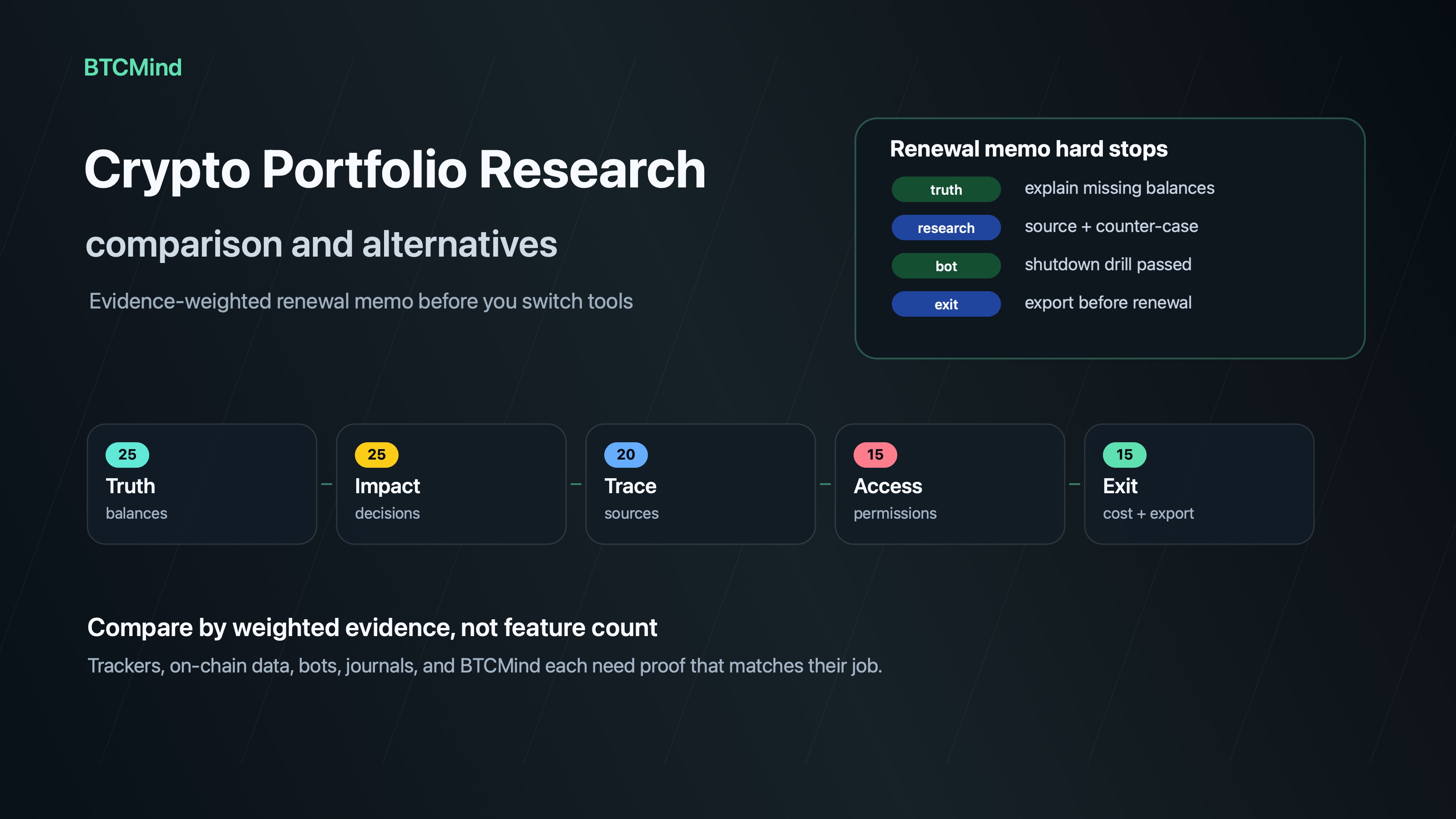
A renewal memo should not treat every tool output equally. A balance reconciliation error can matter more than ten attractive charts. A source-timestamp failure can matter more than a polished AI summary. A trading-bot shutdown drill can matter more than a backtest screenshot.
Use an evidence-weighted memo when two alternatives look similar on features. It gives more weight to the proof that protects actual decisions.
| Evidence category | Weight | What to inspect | Passing evidence | Failure signal |
|---|---|---|---|---|
| Portfolio truth | 25% | Holdings, venues, balances, duplicates, stale records | Reconciles against your source ledger with named exceptions | Unknown balances, duplicated wallets, or hidden stale data |
| Decision impact | 25% | Adopted decisions, rejected trades, no-action calls, risk changes | Three recent outputs changed or confirmed a real decision | Outputs were read but did not affect action or risk |
| Evidence traceability | 20% | Sources, timestamps, methodology, uncertainty, counter-case | Important claims can be inspected without guessing | Scores or summaries cannot be traced to evidence |
| Permission control | 15% | API scope, wallet permissions, trading access, revocation test | Least-privilege access and a successful disconnect drill | Broad permissions for a narrow research job |
| Exit readiness | 10% | Export, archive, decision history, alert configuration | You can leave without losing the operating record | Vendor lock-in traps the journal or configuration |
| Cost discipline | 5% | Subscription cost, time saved, duplicate tools removed | Cost per adopted decision is acceptable | Cost rises while utilization stays flat |
Multiply each category score from 0 to 3 by the weight. A tool should not renew on total score alone. Apply these hard stops:
- No portfolio-truth renewal if the tool is the system of record and cannot explain stale or missing balances.
- No research-layer renewal if important conclusions lack sources, timestamps, or counter-case handling.
- No execution-layer renewal if the bot or automation tool has not passed a shutdown and revocation drill.
- No full-stack replacement if exports, decision history, and permission rollback have not been tested.
The memo should end with one of five verbs:
| Verb | Use when | Next operating step |
|---|---|---|
| Keep | The tool owns one job and passes its weighted evidence test | Recheck quarterly |
| Change | The job is valid but configuration, permission, or handoff is weak | Fix one issue within 14 days |
| Downgrade | The tool is useful but over-scoped or overpriced | Reduce plan, data scope, or connected accounts |
| Replace | Another alternative performs the same job with stronger evidence | Run parallel mode before cutover |
| Remove | The output is unused, duplicated, or unsafe for its job | Export, revoke, archive, and update the ownership map |
Here is the practical test: if a tool cannot survive this memo, it probably should not survive the next invoice. Crypto portfolio research: comparison and alternatives is not a one-time buying exercise. It is a recurring proof exercise: every product in the stack must keep earning its job.
RFP checklist for replacing a crypto portfolio research tool
Use this checklist when the decision is no longer “Should I try another tool?” but “Can this alternative safely replace part of my current workflow?” It works for portfolio trackers, analytics platforms, bots, and AI research desks.
1. Scope and ownership
Write the job in one sentence:
This tool owns: ___________________________________________
It does not own: __________________________________________
The human approval step is: _______________________________
Reject any vendor or workflow that cannot fit inside those lines. A replacement should reduce ambiguity. If the tool claims to own tracking, research, execution, tax records, risk management, and final decision authority, split the claim into separate jobs and evaluate each one.
2. Data and source requirements
Ask for evidence that the product can handle your actual portfolio shape:
| Requirement | Question to ask | Acceptance test |
|---|---|---|
| Wallet and exchange coverage | Which venues, chains, and account types are supported today? | Sample holdings reconcile against your source ledger |
| Data freshness | What updates in real time, delayed, or manually? | Critical timestamps are visible in the output |
| Methodology | How are balances, P&L, metrics, scores, or brief conclusions calculated? | Important assumptions are inspectable |
| Missing-data behavior | What happens when an exchange, chain, metric, or source fails? | The workflow labels gaps instead of filling them silently |
| Exportability | Can you export holdings, alerts, notes, reports, and decision history? | A usable export is created before the trial ends |
This section matters because many crypto research failures start upstream. A polished conclusion built on stale balances or unexplained data should not pass.
3. Decision-quality requirements
A research replacement should improve at least one of these decision outputs:
| Output | Minimum standard |
|---|---|
| Thesis review | The tool records why a position still deserves capital |
| Evidence synthesis | The tool distinguishes price, on-chain, derivatives, news, and sentiment inputs |
| Counter-case | The tool explains what would prove the current view wrong |
| Invalidation | The tool names a price, data, event, or time trigger |
| Action clarity | The tool separates hold, investigate, reduce, add, hedge, exit, and no-action states |
| Review timing | The tool sets the next review date or event trigger |
For BTCMind, this is the intended research-layer fit: six specialized agents review technical, derivatives, tail-risk, bull, and bear evidence before a Portfolio Manager-style brief. That can help when the portfolio owner has enough data but not enough synthesis time. It does not replace custody, accounting, tax reporting, or personal responsibility for the decision.
4. Security and permission requirements
Apply least privilege before the trial starts.
| Permission type | Default rule |
|---|---|
| Public market data | Safe for research-only workflows |
| Read-only portfolio access | Use when holdings visibility is necessary |
| Trading permission | Use only when execution is the tool's explicit job |
| Withdrawal permission | Avoid for research and monitoring workflows |
| Webhooks and API exports | Document destination, owner, and revocation steps |
Run one revocation test during the trial. If nobody knows how to disconnect the tool quickly, the replacement is not production-ready.
5. Commercial and renewal requirements
Do not compare subscription price alone. Compare cost per adopted decision, time saved, errors prevented, and duplicate tools removed.
| Commercial question | Why it matters |
|---|---|
| Which existing tool will this replace? | Prevents paying twice for the same job |
| Which decisions will it improve each month? | Connects cost to actual use |
| What manual work remains? | Avoids buying a platform and keeping the old process anyway |
| What is the exit path? | Keeps the user from losing decision history if the tool is removed |
| What is the renewal trigger? | Forces a future keep/change/remove decision |
The best alternative is the one that earns ownership of a necessary job and stays removable. Lock-in without decision improvement is not a research advantage.
Quarterly governance: keep the tool stack from drifting
Crypto research stacks rarely fail all at once. They decay through duplicate subscriptions, stale API keys, forgotten alerts, unexplained methodology changes, and responsibilities that were never assigned. Run a 30-minute governance review every quarter.
1. Reconfirm the ownership map
Name one system for each job: holdings and reconciliation; thesis and assumption history; research evidence; recommendation or decision brief; human approval; execution; and the post-decision record.
If two systems own one job, define the tie-break rule. If no system owns a job, either assign it or remove the expectation.
2. Audit permissions and dormant connections
List every exchange key, wallet connection, webhook, automation credential, and export destination. Record whether it is read-only, trading-enabled, or withdrawal-capable. Remove dormant access and reduce permissions to the minimum required for the product’s job.
3. Review evidence quality
Sample ten recent outputs. Check whether each important claim has a timestamp, identifiable source, methodology, and uncertainty note. Record how often the workflow exposed conflicting evidence instead of compressing it into false certainty.
4. Measure utilization and duplication
For each paid tool, count active review sessions, adopted decisions, exports, alerts used, and hours saved. A subscription that appears in the stack diagram but does not change a decision is a removal candidate.
5. Run one failure drill
Choose one scenario: stale balances, unavailable market data, failed exchange connection, contradictory signals, duplicate alert, or rejected order. Verify that the workflow fails visibly and that the fallback is documented.
6. Record a keep, change, or remove decision
End the review with one line per tool:
- Keep: it owns a necessary job and meets its acceptance metrics.
- Change: the job is necessary, but permissions, configuration, cost, or handoffs need correction.
- Remove: another system owns the job or the output is not used.
This quarterly control matters because the best crypto portfolio research alternative is not just the product with the strongest demo. It is the system that remains understandable, inspectable, and operable after the initial setup enthusiasm disappears.
Final decision: comparison and alternatives
Choose the category that matches the failed layer:
- Use a spreadsheet for custom thesis memory and decision rules.
- Use a portfolio tracker for holdings, allocation, and reconciliation.
- Use specialist analytics for deep on-chain and market-structure investigation.
- Use a trading bot for repeatable execution of a tested rule.
- Use a multi-agent research desk for adversarial synthesis and recurring decision briefs.
For many users, the best architecture is a tracker for portfolio truth plus a research desk for interpretation. Add automation only after invalidation, sizing, permissions, and shutdown rules are explicit.
BTCMind is built for the research layer: six specialized AI agents analyze the market in parallel, challenge the bull and bear cases, and produce a structured brief for mobile review. Explore the BTCMind app if your search for crypto portfolio research: comparison and alternatives ends with the same gap: your current tool shows what you own but does not help you evaluate what the evidence means.
FAQ: crypto portfolio research: comparison and alternatives
What does crypto portfolio research: comparison and alternatives mean?
Crypto portfolio research: comparison and alternatives means comparing tools by the research decision they support, not just by features. A tracker, an on-chain dashboard, a trading bot, a spreadsheet, and a multi-agent research desk can all help a portfolio, but they do different jobs.
What is the best starting point for crypto portfolio research: comparison and alternatives?
The best starting point for crypto portfolio research: comparison and alternatives is the failed workflow layer. If balances are unreliable, start with tracking. If evidence is fragmented, add a synthesis layer. If execution rules drift, test automation only after the rule and risk limits are written.
Should crypto portfolio research alternatives replace a tracker?
Most crypto portfolio research alternatives should not replace a tracker unless they also solve portfolio truth. A tracker is usually the system of record for holdings and allocation. Research tools should explain what the evidence means after portfolio state is accurate.
When does a multi-agent AI desk fit crypto portfolio research: comparison and alternatives?
A multi-agent AI desk fits crypto portfolio research: comparison and alternatives when the bottleneck is synthesis. It is useful when technicals, derivatives, tail risk, sentiment, and conflicting directional evidence need to be compressed into one reviewable brief.
How should I test crypto portfolio research alternatives before switching?
Test crypto portfolio research alternatives with a 30-day process review. Track research time, reconciliation exceptions, evidence completeness, invalidation coverage, adopted decisions, permissions, and failures. Do not judge the tool only by whether the market moved in your favor during the trial.
What is the biggest mistake in crypto portfolio research: comparison and alternatives?
The biggest mistake in crypto portfolio research: comparison and alternatives is buying an execution or analytics product to solve a different problem. Do not buy a bot to fix weak research. Do not buy another data feed when the real issue is unclear judgment. Do not buy a research desk to replace custody, accounting, or tax records.
Sources and methodology
- BTCMind product overview
- CoinStats portfolio tracker overview
- Glassnode Studio product overview
- 3Commas platform functions
- Investor.gov: Asset allocation and diversification
- FINRA: Crypto asset risks
Product capabilities were checked against official public pages on August 11, 2026. Features, permissions, integrations, and availability can change. Verify current details before connecting accounts, relying on an output, or acting on a tool’s recommendation.