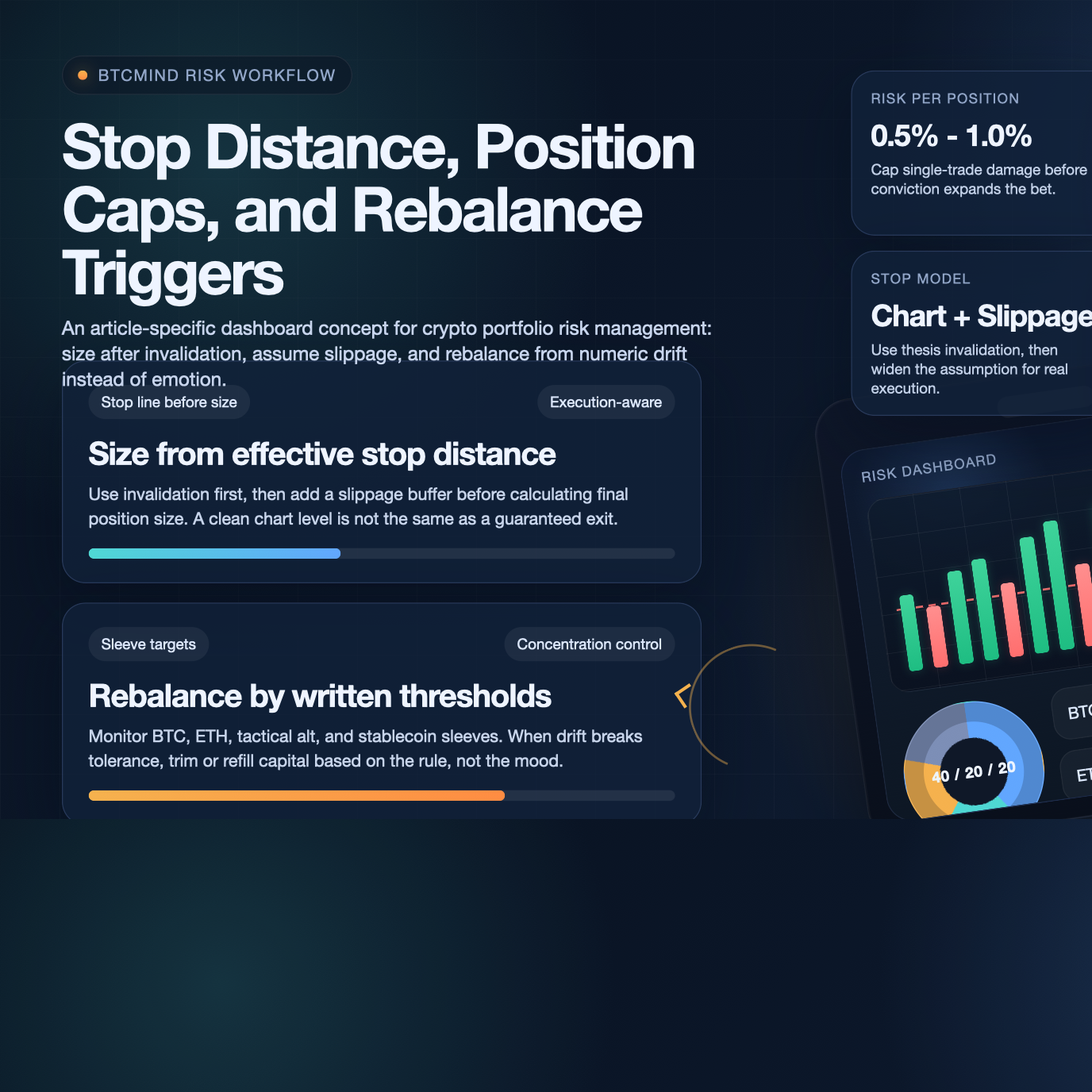
Crypto Portfolio Risk Management Rules for Stop Distance and Rebalancing Triggers
Crypto portfolio risk management gets harder after the entry, not before it. Many traders can explain why they bought a coin, but far fewer can explain how much of the portfolio they are willing to lose, how much slippage their stop plan assumes, or what level of drift should force a rebalance.
That is where crypto portfolio risk management stops being a slogan and starts becoming a process. You need rules that survive volatility, correlation, and the 24/7 nature of crypto markets.
This follow-up guide narrows the problem to three practical decisions:
- How wide should the stop be before you size the position?
- How much total portfolio risk should be live at the same time?
- What kind of drift should trigger a rebalance instead of a debate?
Risk note: This article is educational only. It is not investment advice. Crypto markets are volatile, and stop orders, rebalancing plans, and risk caps can still fail in thin or disorderly conditions.
Why crypto portfolio risk management needs portfolio rules, not trade-by-trade habits
The first article in this cluster focused on sizing, stop placement, and rebalancing basics. The next step is tighter rule design. Good crypto portfolio risk management does not end when one trade looks acceptable in isolation. It asks whether the full book still makes sense after you add that trade.
That matters because portfolio damage often comes from combinations:
- A reasonable stop on one coin plus three highly correlated positions
- A valid entry that becomes too large because the coin rallies and the rest of the book stays flat
- A stop order that triggers in a fast move and fills worse than planned
- A rebalance plan that exists in theory but never has a hard threshold
The CFTC's customer advisory on virtual currency trading warns that these markets carry significant risk, including volatility and the potential for large losses. In practice, that means crypto portfolio risk management has to assume imperfect execution, not ideal execution.
Start with a hard account-risk range before thinking about setup quality
Before you calculate position size, define two numbers:
- Per-trade risk cap
- Total open-risk cap
Per-trade risk cap limits the damage from one wrong idea. Total open-risk cap limits the damage from several wrong ideas at once.
A simple starter framework for crypto portfolio risk management looks like this:
| Rule | Conservative example | Why it helps |
|---|---|---|
| Risk per position | 0.5% to 1.0% of portfolio equity |
Prevents one mistake from doing outsized damage |
| Total open risk | 2% to 4% of portfolio equity |
Prevents stacking too many simultaneous bets |
| Max allocation to one coin | 20% to 50%, depending on strategy |
Controls concentration risk |
| Max allocation to illiquid alts | Lower than BTC or ETH sleeves | Reflects worse slippage and weaker depth |
The exact percentages are not universal. The point is to choose them before the market tests your discipline. If you skip the total open-risk cap, you can accidentally run six "small" positions that all depend on the same market regime.
Stop distance should come from invalidation, then be adjusted for execution reality
The clean rule is still the same:
- Define what would prove the trade thesis wrong.
- Place the stop beyond that invalidation level.
- Size the position from the distance to that stop.
But stronger crypto portfolio risk management adds one more step: stress the stop against the way crypto actually trades.
Ask four questions:
- Is the stop sitting where normal volatility often sweeps liquidity?
- Is the coin liquid enough that the stop can likely execute near the trigger?
- Is the trade running through an event window, weekend, or thin session?
- If the fill is worse than planned, does the position still fit the account-risk cap?
FINRA notes that a stop order becomes a market order once triggered, and the execution price can differ from the stop price during volatile conditions. That caveat matters even more in crypto because the market never closes and liquidity can change quickly across venues and hours.
For crypto portfolio risk management, the practical implication is simple: do not size from the trigger price alone. Size from a more conservative estimate that includes expected slippage.
A practical sizing formula that includes slippage
Basic sizing formulas are useful, but they are often too optimistic for crypto. A more realistic version is:
position size = dollar risk budget / effective stop distance
Where:
effective stop distance = chart stop distance + expected slippage buffer
Example:
- Portfolio equity:
$40,000 - Per-trade risk cap:
0.75% - Dollar risk budget:
$300 - Entry:
$125 - Thesis invalidation:
$115 - Chart stop distance:
8.0% - Slippage buffer:
1.5% - Effective stop distance:
9.5%
Position size:
$300 / 0.095 = $3,157.89
Without the slippage buffer, the position would have been larger. The extra buffer may feel conservative, but that is the point. Durable crypto portfolio risk management assumes the market will sometimes fill you worse than the clean chart suggests.
Use different stop-distance logic for majors and thin alts
One mistake in crypto portfolio risk management is pretending that every asset deserves the same stop style. BTC, ETH, and a thin altcoin do not trade the same way.
Use different expectations:
| Asset bucket | Typical issue | Risk implication |
|---|---|---|
| BTC / ETH | Deep liquidity but still sharp intraday volatility | Stops can be structure-based, but still need room |
| Large-cap alts | Higher beta and faster cascades | Position size usually needs to be smaller |
| Thin alts / low-liquidity pairs | Wider spreads, air pockets, harder fills | Smallest sizing, widest caution, or no trade |
If the required stop is so wide that the resulting size becomes trivial, that is not automatically a flaw. It may be the market telling you the trade does not deserve meaningful capital.
Build portfolio risk in sleeves so rebalancing decisions are obvious
Good crypto portfolio risk management works better when the portfolio is split into sleeves instead of one undifferentiated pool.
Example sleeve model:
- Core BTC sleeve
- Core ETH sleeve
- Tactical alt sleeve
- Stablecoin reserve sleeve
- Optional derivatives or high-conviction sleeve
This matters because rebalancing becomes easier to govern. You are not asking whether every single coin deserves trimming every day. You are asking whether a sleeve has drifted beyond the risk budget you assigned to it.
A simple target mix could look like:
| Sleeve | Target weight |
|---|---|
| BTC core | 40% |
| ETH core | 20% |
| Tactical alts | 20% |
| Stablecoins / cash reserve | 15% |
| Optional high-risk sleeve | 5% |
If the tactical alt sleeve doubles and becomes 34% of the whole portfolio, crypto portfolio risk management should treat that as a change in portfolio character, not just a nice gain.
Rebalancing triggers should be numeric, not emotional
Investor education on rebalancing defines the process as bringing a portfolio back toward its intended asset mix after market moves change the weights. In crypto, that process needs explicit triggers because drift happens faster.
Two trigger styles work well:
1. Absolute drift triggers
Example:
- Rebalance when any sleeve moves more than
5percentage points away from target
If BTC target is 40%, a move below 35% or above 45% triggers review or action.
2. Relative drift triggers
Example:
- Rebalance when a sleeve deviates more than
20%from its target weight
If ETH target is 20%, then 24% is a 20% relative overweight and 16% is a 20% relative underweight.
Absolute rules are easier to monitor. Relative rules adapt better across small and large sleeves. Many investors combine them, which is often the cleaner version of crypto portfolio risk management for mixed portfolios.
When not to rebalance immediately
Not every drift deserves action. Sound crypto portfolio risk management also defines when to hold off:
- The portfolio is near a scheduled review date anyway
- Trading costs or spreads make the rebalance inefficient
- Taxes matter and the drift is still inside tolerance
- A fresh deposit can repair the weights without selling
- A sleeve is within threshold, even if it feels large emotionally
This is why threshold rules matter. They stop you from trimming winners only because they make you nervous. Rebalancing should be a risk-control action, not a mood-control action.
A simple weekly dashboard for crypto portfolio risk management
If your process depends on memory, it will fail under stress. Track a small dashboard once a week:
| Check | Question | Action if breached |
|---|---|---|
| Risk per position | Is any position above the allowed account-risk cap? | Cut size or tighten exposure |
| Total open risk | If all stops hit badly, is total damage still acceptable? | Reduce overlapping trades |
| Concentration | Has one sleeve become too large? | Trim or rebalance |
| Correlation | Are multiple positions effectively the same bet? | Consolidate or lower total risk |
| Stable reserve | Do you still have dry powder or defensive capital? | Rebuild reserve if needed |
| Execution risk | Are stops sitting in illiquid or event-heavy conditions? | Widen assumptions or reduce size |
That dashboard is not complicated, but it is the kind of repetition that makes crypto portfolio risk management durable.
Correlation is the rebalancing problem most traders notice too late
Rebalancing is not just about weights. It is also about hidden overlap.
You can hold:
- BTC
- ETH
- A Solana beta trade
- A meme-coin basket
- A perpetual long on BTC
On paper, that may look like five exposures. In a fast risk-off move, it can behave like one leveraged thesis on crypto beta. That is why crypto portfolio risk management should review portfolio drift alongside correlation, not as separate topics.
If a strong BTC trend pulls every crypto sleeve higher at once, a rebalance may still be necessary even if each single position looks healthy on its own.
A follow-up rule set you can actually use
Here is a compact operating version of crypto portfolio risk management:
- Set a fixed risk cap per trade.
- Set a separate maximum for total open risk.
- Place stops at thesis invalidation, not at arbitrary round numbers.
- Add a slippage buffer before calculating final size.
- Run smaller sizing on thinner or more correlated assets.
- Divide the portfolio into sleeves with target weights.
- Rebalance by numeric drift thresholds on a preset review cadence.
- Treat concentration and correlation as part of the same risk check.
This is not about avoiding every drawdown. It is about making sure one market regime does not quietly rewrite your entire portfolio.
Where BTCMind fits
BTCMind is most useful before risk is committed and again before exposure is increased. A structured brief can help you test whether a setup has clean invalidation, whether multiple evidence streams agree, and whether the trade deserves capital at all. That still does not replace your own crypto portfolio risk management rules. It helps you apply them with less improvisation.
If you want the foundational version of this topic, read BTCMind's earlier guide on crypto portfolio risk management: sizing stops and rebalancing. If you want related allocation context, the stablecoin risk checklist for crypto allocation is a useful companion.
Final take
The strongest crypto portfolio risk management plans do three things well:
- They size from real stop distance, not from conviction.
- They cap total open risk, not just single-position risk.
- They rebalance from written thresholds, not from feelings.
That combination will not eliminate losses, and it will not guarantee clean fills in fast markets. It does something more important: it keeps one bad sequence from becoming a portfolio-level failure.
If you want a mobile workflow that helps you pressure-test invalidation, compare bull and bear cases, and review risk-aware research before you act, explore BTCMind's feature overview, review the AI agents, and use the download page to evaluate the app inside your own process.
FAQ
How wide should a crypto stop loss be?
A crypto stop should be wide enough to sit beyond the level that invalidates the thesis, while still allowing the position to fit your risk budget. Thin or volatile assets usually require wider assumptions and smaller sizing.
Should I size a crypto position before I know the stop distance?
No. In strong crypto portfolio risk management, stop distance helps determine size. If you size the trade first, you will usually force an unrealistic stop.
What is a good total open-risk cap for a crypto portfolio?
There is no universal number, but many self-directed traders use a total open-risk cap that is materially lower than the sum they might take if every idea were sized independently. The goal is to prevent overlapping positions from compounding losses.
How do I choose a rebalancing trigger for crypto?
A practical starting point is a calendar review, such as monthly, plus an absolute or relative drift threshold that forces action when a sleeve becomes too large or too small versus plan.
Can stop orders guarantee my crypto exit price?
No. FINRA notes that stop orders become market orders once triggered, which means the execution price can differ from the stop price during volatile conditions.
Sources
- CFTC, "Customer Advisory: Understand the Risks of Virtual Currency Trading"
- FINRA, "Stop Orders: Factors to Consider During Volatile Markets"
- SEC Investor.gov glossary, "Rebalancing"
- BTCMind, "Crypto Portfolio Risk Management: Sizing Stops and Rebalancing"