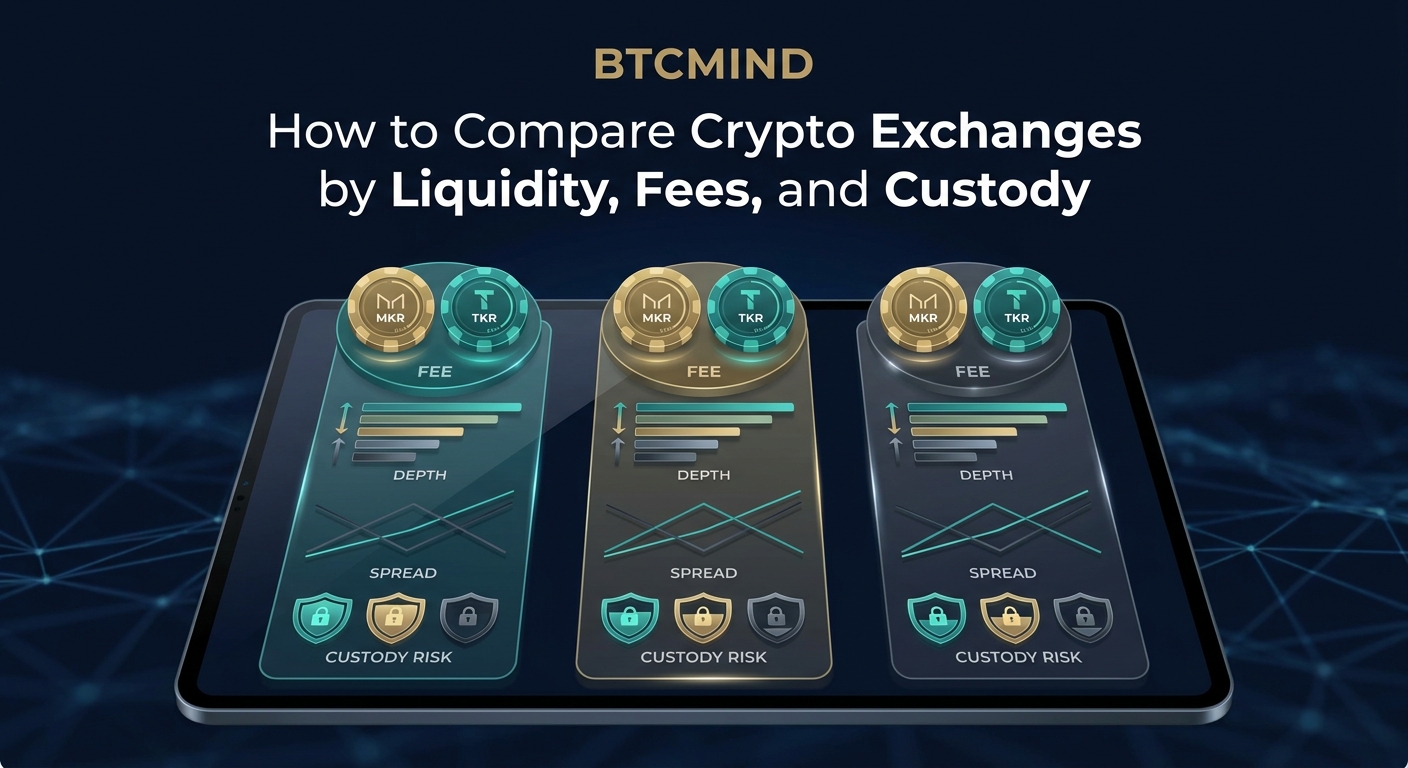
How to Compare Crypto Exchanges by Liquidity, Fees, and Custody
If you compare exchanges only by the visible trading fee, you can still choose the wrong venue.
Two platforms can both market themselves as low-cost while producing very different real outcomes once you include spread, slippage on your actual order size, withdrawal friction, and the way the platform holds customer assets. That is why how to compare crypto exchanges by liquidity, fees, and custody is a better decision framework than simply asking which exchange has the lowest taker fee.
As of Tuesday, July 21, 2026, the safest way to compare venues is to treat three variables as one system:
- Liquidity tells you whether you can actually trade near the quoted price.
- Fees tell you what the venue will charge you to trade, fund, move, and sometimes even store assets.
- Custody tells you who controls the keys, what protections exist, and what can go wrong if the venue freezes withdrawals, suffers a security event, or fails.
Risk note: This article is educational only. It is not investment, legal, tax, or custody advice. Exchange pricing, transfer fees, and custody disclosures can change quickly. Verify the current fee schedule, custody terms, and user agreement before moving funds.
The hidden-cost formula most exchange comparisons miss
The practical starting point for how to compare crypto exchanges by liquidity, fees, and custody is not a ranking table. It is this cost model:
real execution cost = trading fee + spread + slippage + funding cost + withdrawal friction + custody risk
That formula matters because the visible maker-taker line item is often only one part of what you actually pay.
Investor.gov's order-type guidance is useful here even though it is written for securities markets: a market order can prioritize execution speed without guaranteeing the final price. The same logic matters in crypto. If the book is thin, your execution can walk through multiple levels and become much more expensive than the headline fee suggests.
Coinbase's Advanced Trade order-type documentation makes the same point in product terms. Its market-order documentation explains that there is no guarantee a market order fills at the displayed buy or sell price. That is exactly why how to compare crypto exchanges by liquidity, fees, and custody should start with execution quality rather than branding.
Step 1: Compare liquidity on the pair and size you actually trade
Liquidity is not a general reputation score. It is whether a specific market can absorb your order with minimal spread and slippage.
Check the bid-ask spread first
The spread is the gap between the best available bid and ask. A narrow spread usually means lower immediate friction. A wider spread means you are already paying a hidden cost before the explicit fee even shows up.
For small recurring BTC buys, a slightly wider spread may not be decisive. For larger orders, smaller-cap pairs, or stressed market conditions, it matters a lot.
Check top-of-book depth, not only the last traded price
A venue can show a tight quote on tiny size while offering very little depth once you submit a meaningful order. That is why how to compare crypto exchanges by liquidity, fees, and custody should focus on order-book depth near the top of book, not only on the last traded price shown in the UI.
Gemini ActiveTrader's product page emphasizes order-book visibility, central limit order books, and price-time priority. Coinbase Advanced documents limit, post-only, stop-limit, bracket, and TWAP order controls. Those features matter because they help you reduce market impact instead of blindly crossing the spread.
Test your normal size, not a symbolic amount
Do not use a $50 test order if your real workflow is $5,000 or $25,000 clips.
The right question is:
What slippage do I get on my normal size for the exact pair I care about?
That answer may change sharply by asset:
- BTC and ETH may trade cleanly on multiple venues.
- A mid-cap alt may only trade well on one or two venues.
- Overnight or weekend conditions may look worse than peak U.S. trading hours.
Check for execution tools, not only low visible fees
The order controls themselves are part of the liquidity comparison.
Coinbase Advanced publicly documents:
- market orders
- limit orders
- post-only orders
- stop-limit orders
- bracket orders
- TWAP orders
If you trade size, these controls can save more money than a small difference in fee tier.
Compare by pair, not by homepage reputation
An exchange can be highly liquid in BTC/USD and far less robust in a smaller alt pair. Kraken's fee documentation also notes that certain stablecoin and FX-related trading can follow separate fee logic. That is another reason how to compare crypto exchanges by liquidity, fees, and custody must stay specific to the asset and workflow you actually use.
Step 2: Compare the full fee stack instead of one headline number
The second part of how to compare crypto exchanges by liquidity, fees, and custody is reading the fee schedule the way an operator would.
Trading fees
The official public fee pages reviewed on Tuesday, July 21, 2026 showed the following broad spot-fee clues:
- Coinbase Exchange: maker fees from
0.40%down to0.00%and taker fees from0.60%down to0.04%, based on trailing 30-day volume. - Kraken: volume-based maker-taker pricing, with public support examples showing spot tiers ranging from roughly maker
0.25%/ taker0.40%at the top retail end down to much lower levels for higher volume, including some0.00%maker cases. - Gemini ActiveTrader: base spot pricing at maker
0.60%/ taker1.20%, declining to maker0.00%/ taker0.03%and then0.02%at the highest tiers shown on the current public schedule.
Those numbers are useful, but they are not the whole answer. The relevant fee is the one your behavior actually lands on, not the most attractive number in the table.
Funding and withdrawal fees
This is where many low-fee comparisons fail.
Kraken separates trading fees from funding fees, margin fees, and crypto withdrawal fees in its support documentation. Gemini's transfer-fee schedule states that withdrawal fees are dynamic and reflect network conditions shown before confirmation. Gemini also discloses that moving crypto from Gemini Custody to Gemini Exchange costs $125 per withdrawal, while the transfer from Exchange to Custody is free.
So when you work through how to compare crypto exchanges by liquidity, fees, and custody, check:
- fiat deposit fees
- fiat withdrawal fees
- on-chain withdrawal fees
- spread on instant-buy workflows versus order-book workflows
- custody-to-exchange or exchange-to-custody transfer fees
Margin and financing costs
If you trade with leverage, the comparison changes again.
Kraken documents separate margin opening and rollover fees. Gemini publishes hourly margin-interest rates for supported assets. If you hold positions for days instead of minutes, financing costs can matter more than the spot trading fee.
A dated comparison snapshot from official public docs
This is not a universal ranking. It is a current-doc snapshot reviewed on Tuesday, July 21, 2026 from official public pages.
| Venue | Liquidity and execution clues | Published fee clues | Custody and transparency clues |
|---|---|---|---|
| Coinbase Exchange / Advanced | Market, limit, post-only, stop-limit, bracket, and TWAP support; market orders do not guarantee the displayed price | Maker 0.40%-0.00%, taker 0.60%-0.04% by 30-day volume |
Coinbase says Coinbase.com is a centralized exchange and maintains the private keys for hosted wallets; cash is held 1:1; crypto is not FDIC, NCUSIF, or SIPC insured |
| Kraken | Order-book maker-taker model; proof-of-reserves balance-verification process; separate funding and margin documentation | Public support pages show top-end retail spot around maker 0.25% / taker 0.40%, with lower tiers for higher volume and some 0.00% maker cases |
Kraken's proof-of-reserves process improves transparency, but users still need to review withdrawal rules, jurisdiction, and asset handling separately |
| Gemini ActiveTrader / Custody | Deep order-book visibility, price-time priority, API access, and central-limit-order-book positioning | Base spot maker 0.60% / taker 1.20%, falling to maker 0.00% / taker 0.03%-0.02% at higher tiers |
Gemini Custody says assets are stored offline, segregated to unique addresses, and backed by stated custody insurance for certain losses; transfer fees and custody-transfer costs still matter |
The right conclusion is not "pick the smallest visible fee." The right conclusion is "map your own trading and withdrawal behavior to the actual cost path."
Step 3: Compare custody like a risk manager, not a marketer
The SEC's Crypto Asset Custody Basics for Retail Investors bulletin is the best short public checklist here. It reminds investors to ask what happens if the custodian is hacked, becomes insolvent, delays withdrawals, commingles assets, or reuses deposited assets in ways the customer does not understand.
That is the core of how to compare crypto exchanges by liquidity, fees, and custody.
Ask who controls the keys
With exchange custody, the venue usually controls the private keys.
Coinbase's legal-policy documentation says Coinbase.com is a centralized exchange and that Coinbase maintains the private keys for the crypto in hosted exchange wallets. It separately distinguishes that model from Coinbase Wallet, which is self-custody.
That matters because:
- exchange custody is more convenient for active execution
- self-custody gives you direct control but full operational responsibility
Ask whether assets are segregated or commingled
Gemini Custody says customer crypto is stored offline and segregated by unique addresses that are independently auditable. That is more useful than vague "institutional grade" language because it tells you something concrete about asset handling.
If a venue does not clearly explain segregation, omnibus structure, or how customer balances are mapped internally, treat that as a diligence gap.
Ask what insurance actually covers
This is where many users overestimate protection.
Coinbase says crypto on the platform is not insured by FDIC, NCUSIF, or SIPC, though limited security-event insurance may apply in specific situations. Coinbase separately explains that customer cash may be held 1:1 in banks, credit unions, or short-duration liquid investments.
Gemini makes a similar distinction. It says U.S. dollar balances may be eligible for FDIC pass-through insurance in certain structures, while crypto custody has a different insurance framework. Gemini's custody-insurance documentation states $75 million of custody coverage against certain types of losses.
The practical lesson is simple: cash protection, exchange security coverage, and crypto recovery rights are not the same thing.
Ask whether the venue reuses assets or limits exit paths
The SEC bulletin explicitly tells investors to ask whether deposited crypto is commingled, lent out, or otherwise reused. That matters even if you do not personally use lending products.
You also need to know:
- whether withdrawals can be delayed
- what approval steps apply
- how network fees are calculated
- whether internal custody transfers carry their own fee
- whether your preferred withdrawal network is supported
This is especially important if your workflow is "research, execute, then move long-term holdings off-platform." If that sounds like you, BTCMind's guide to crypto portfolio risk management: sizing, stops, and rebalancing is the right companion because custody risk and position sizing belong in the same conversation.
A practical scorecard for how to compare crypto exchanges by liquidity, fees, and custody
If you want a repeatable checklist, score each venue on the lines below.
| Category | What to check | Why it matters |
|---|---|---|
| Bid-ask spread | Check the live spread on the exact pair you trade | Wide spreads are an immediate hidden cost |
| Depth and slippage | Look at your normal order size near the top of book | Thin books can erase any fee advantage |
| Order controls | Limit, post-only, stop-limit, TWAP, API support | Better tools reduce execution drag |
| Trading fee path | Base tier and the tier you will actually qualify for | The relevant fee is the one you will pay |
| Funding and withdrawal | Fiat rails, on-chain withdrawals, internal transfer charges | Moving capital often costs more than a single trade |
| Custody model | Hosted custody, segregation, omnibus structure, self-custody compatibility | This defines platform and operational risk |
| Insurance language | What is covered, what is excluded, and under what conditions | Many users overestimate platform protection |
| Transparency | Proof of reserves, attestations, status pages, public documentation quality | Better visibility lowers uncertainty, not risk to zero |
| Exit flexibility | Delay risk, network support, internal friction, withdrawal policy | A good venue should also be easy to leave |
The most important lines for most retail users are:
- spread and slippage on the pair they actually trade
- full fee stack for the way they fund and withdraw
- custody structure and withdrawal friction
Which users should weight what most heavily?
Different users should apply how to compare crypto exchanges by liquidity, fees, and custody differently.
Active spot traders
Prioritize:
- order-book depth
- maker-taker tiers
- API access
- order controls
- stable withdrawal rails
For this user, execution quality can matter more than a slightly stronger custody marketing story, though withdrawal reliability still matters.
Long-term holders who buy occasionally
Prioritize:
- custody clarity
- clean withdrawal pathways
- self-custody compatibility
- transparent cash and crypto handling
For this user, a venue with slightly higher visible trading cost but clearer custody and easier off-ramping can still be the better choice.
Users moving between research and execution every day
Prioritize:
- liquid BTC, ETH, and major-alt pairs
- low friction between analysis and action
- clear risk controls
- reliable exits
That is the workflow BTCMind is built around. The product is not an exchange-ranking site. It is a mobile AI crypto research desk that helps you test bull, bear, derivatives, and tail-risk views before you place the trade. If that wider workflow matters to you, review BTCMind's AI agents, feature overview, and download page.
The biggest mistakes people make
The most common failures in how to compare crypto exchanges by liquidity, fees, and custody are:
- comparing only the maker-taker table
- ignoring spread and slippage
- treating instant-buy pricing as the same as order-book pricing
- assuming cash insurance means crypto insurance
- skipping withdrawal-fee and transfer-fee checks
- ignoring who controls the private keys
- treating proof of reserves as a complete custody solution
Any one of those mistakes can make a low-fee venue more expensive or riskier than it looks.
Final take
The best answer to how to compare crypto exchanges by liquidity, fees, and custody is not a fixed winner list. It is a process.
Start with execution reality on your actual pair and trade size. Then map the full fee stack, including deposits, withdrawals, and any custody-transfer charges. Finally, study the custody model the same way you would study a counterparty: key control, segregation, insurance language, withdrawal conditions, and transparency.
On Tuesday, July 21, 2026, the official public pages from Coinbase, Kraken, Gemini, and the SEC still supported one clear conclusion: the cheapest-looking exchange is not always the lowest-cost or lowest-risk exchange once liquidity and custody are included.
That is why the real question is not "Which platform charges the lowest fee?" The real question is "Which venue fits my actual execution size, funding pattern, and custody risk tolerance?"
FAQ
What is the first thing to check when comparing crypto exchanges?
The first thing to check in how to compare crypto exchanges by liquidity, fees, and custody is the actual trading pair and order size you use. A low visible fee does not help if the spread and slippage are poor.
Why is liquidity more important than the visible fee?
Because spread and slippage can cost more than the explicit trading fee, especially on larger orders or thinner pairs.
Does proof of reserves solve custody risk?
No. Proof of reserves can improve transparency, but it does not remove withdrawal-policy risk, insolvency risk, operational risk, or legal-structure risk.
Are crypto balances on exchanges FDIC insured?
Not in the way many users assume. Official exchange documentation reviewed on Tuesday, July 21, 2026 still distinguished cash protections from crypto protections, and crypto itself was not described as FDIC insurance eligible.
Why should I care about custody-to-exchange transfer fees?
Because they can turn a venue that looks cheap on trading fees into a more expensive venue once you include the full workflow of storing, moving, and exiting assets.