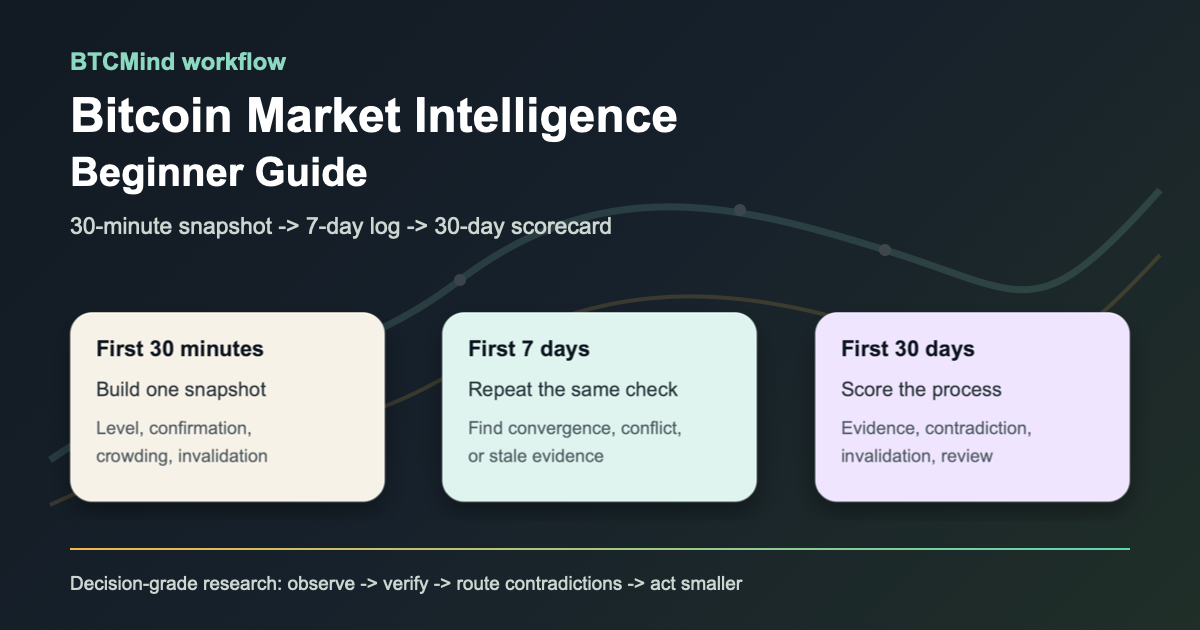
Bitcoin market intelligence is the habit of turning noisy Bitcoin data into one written decision: add, hold, reduce, wait, or do nothing. This Bitcoin market intelligence: beginner guide gives you a practical workflow for the first 30 minutes, the first seven days, and the first 30 days, so you can stop treating every chart, headline, and social post as equally important.
This is not a price prediction system. It is a decision-quality system. A beginner does not need 40 indicators, ten dashboards, or a stream of alerts. A beginner needs a repeatable way to ask: what changed, what is confirmed, what is contradicted, what would prove me wrong, and what action is small enough that one bad read cannot damage the account.
Crypto trading carries extreme risk. Nothing here is investment advice, and no research workflow can remove market risk. Use this as an operating manual for reading Bitcoin conditions more clearly before you act.
Bitcoin market intelligence: beginner guide in one page
Use five inputs and one output.
| Layer | Question | Beginner input | What to write down |
|---|---|---|---|
| Price structure | Where is Bitcoin trading relative to obvious levels? | Daily trend, support, resistance, failed breakout, failed breakdown | "Above / inside / below the level I care about" |
| Volume and liquidity | Did participation confirm the move? | Spot volume, candle range, liquidity sweep, thin weekend move | "Confirmed / weak / unclear" |
| Derivatives | Are leveraged traders crowded? | Funding rate direction, open interest, liquidation clusters | "Crowded long / crowded short / balanced" |
| On-chain and exchange flows | Is supply moving toward or away from trading venues? | Exchange reserve direction, large-transfer context, wallet concentration notes | "Supply pressure rising / falling / not useful today" |
| News and macro | Did a real event change the thesis? | Policy, ETF, exchange, custody, macro liquidity, security incident | "Material / noise / unverified" |
| Decision output | What do I do? | Your risk limit and invalidation rule | "Action, size, invalidation, review time" |
The table is intentionally plain. Bitcoin market intelligence for beginners should reduce decisions, not multiply them. If the inputs do not agree, the default output is not "guess harder." The default output is "wait, lower size, or ask for a stronger brief."
BTCMind is built around the same principle at a higher level: six AI specialists run technical, derivatives, tail-risk, historical, bull, and bear analysis in parallel, then a portfolio manager produces a structured brief with a verdict, key levels, action plan, invalidation, and confidence. That does not make the market safe. It makes the reasoning traceable.
The first 30 minutes: build your Bitcoin intelligence snapshot
Your first session should produce a one-page snapshot, not a trade.
Start with a 30-minute routine:
- Pick one Bitcoin decision you actually face: hold, add, trim, set an alert, or stay flat.
- Write the current price level that matters to you. Use a broad zone, not a single magic number.
- Mark whether price is above, inside, or below that zone.
- Check whether the move has obvious confirmation from volume or whether it happened in thin conditions.
- Check whether derivatives look crowded. If funding and open interest are both stretched, write that down before you get excited by price.
- Check one news source and one primary-source trail before treating a headline as material.
- Write one invalidation line: "My read is wrong if..."
A beginner-friendly Bitcoin market intelligence snapshot can be as simple as this:
| Field | Example note |
|---|---|
| Decision | Hold existing BTC; no new buy yet |
| Key zone | Prior support now being retested |
| Structure | Price inside zone, no clean reclaim |
| Confirmation | Volume not convincing |
| Derivatives | Leverage looks one-sided, risk of squeeze |
| News | No verified thesis-changing event |
| Invalidation | If daily close loses the zone, stop treating it as support |
| Action | Wait 24 hours; set alert; do not increase size |
This snapshot matters because it separates observation from action. Most beginner mistakes happen when those two are fused: "price moved, therefore I must respond." A written snapshot forces the decision to pass through evidence first.
The first seven days: run the same check at the same time
For the first week, do not keep changing your system. Run the same checklist once per day at roughly the same time. You are training consistency before sophistication.
Use a seven-day Bitcoin market intelligence log:
| Day | Price structure | Derivatives | News/macro | Contradiction | Decision |
|---|---|---|---|---|---|
| Day 1 | Range | Balanced | No material event | None | Hold |
| Day 2 | Tests resistance | Crowded long | No material event | Price strong, leverage crowded | Hold; no add |
| Day 3 | Failed breakout | Longs flushed | No material event | Derivatives cleaner, price weaker | Wait |
| Day 4 | Reclaims range | Balanced | ETF headline unverified | Source quality weak | Wait for confirmation |
| Day 5 | Holds reclaim | Balanced | Verified source | No conflict | Small add or alert |
| Day 6 | Choppy | Crowded short | No material event | Price flat, shorts crowded | Do nothing |
| Day 7 | Breaks range | OI rising | Macro catalyst ahead | Event risk | Reduce or stay flat |
The point is not to copy these entries. The point is to learn what the market keeps repeating. After seven days you will usually see one of three patterns:
| Pattern | What it means | Beginner response |
|---|---|---|
| Evidence converges | Most layers point in the same direction | You can define a small, bounded action |
| Evidence conflicts | Price, derivatives, and news disagree | Lower size or wait |
| Evidence is stale | You are using old screenshots, old levels, or recycled narratives | Refresh sources before acting |
The most useful beginner skill is recognizing conflict. If Bitcoin price looks bullish but leverage is crowded, that is not a green light. It is a contradiction. If news looks bullish but price fails to reclaim the level, that is a contradiction. If an influencer sounds certain but gives no invalidation level, that is not market intelligence. It is a claim without a failure test.
The first 30 days: score your process, not your profit
After 30 days, beginners usually want to ask: "Did I make money?" That question matters, but it is too narrow. A good outcome can come from a bad process, and a bad outcome can come from a disciplined process in a hostile market.
Score your Bitcoin market intelligence process across 20 points:
| Control | Points |
|---|---|
| I wrote a decision before checking social media | 2 |
| I separated observation from action | 2 |
| I used at least three evidence layers before acting | 2 |
| I recorded the source and timestamp for important claims | 2 |
| I wrote an invalidation rule for every active thesis | 2 |
| I reduced size when evidence conflicted | 2 |
| I avoided acting on unverified headlines | 2 |
| I reviewed losing decisions without changing the rules midstream | 2 |
| I kept a no-trade state available | 2 |
| I can explain my last decision in under 90 seconds | 2 |
Score 16-20 and your process is usable. Score 10-15 and you need fewer inputs, not more. Score below 10 and you should stop treating your notes as decision support; they are still raw observations.
This is where a Bitcoin market intelligence tool can help, but only if it improves the process. A tool that gives you more alerts without source trails, confidence, contradiction handling, and invalidation rules may increase noise. A useful tool should make the final decision easier to audit.
What beginners should track and what they should ignore
Beginners should track fewer things with more discipline.
Track these:
| Track | Why it matters | Beginner mistake |
|---|---|---|
| Key zones | They define whether your thesis is alive or dead | Treating a line as exact instead of a zone |
| Daily close | It filters some intraday noise | Reacting to every wick |
| Volume context | It helps confirm or question a move | Assuming price alone is proof |
| Funding and open interest direction | It warns when leverage may be crowded | Treating crowded positioning as guaranteed reversal |
| Material news | It can change the risk map | Acting before source verification |
| Your own decision history | It reveals whether your process is improving | Remembering only wins and dramatic losses |
Ignore these until your process is stable:
| Ignore for now | Why |
|---|---|
| Constant micro-timeframe flipping | It trains reaction, not judgment |
| Indicator stacking | Ten indicators can still measure the same trend |
| Anonymous screenshots | They are not a source trail |
| Certainty language | "Guaranteed," "obvious," and "easy" are risk signals |
| Profit screenshots | They hide size, risk, leverage, and survivorship bias |
If you want a deeper adjacent workflow, use BTCMind's guide to Bitcoin support and resistance for beginners for zones, the Bitcoin market cycle indicators dashboard for broader context, and the Bitcoin sentiment analysis workflow when social mood starts affecting your decisions.
A simple contradiction router for Bitcoin decisions
When the evidence conflicts, route the decision instead of arguing with the data.
| Conflict | What it means | Beginner route |
|---|---|---|
| Price bullish, leverage crowded long | Upside may continue, but liquidation risk is higher | Do not chase; wait for pullback or cleaner positioning |
| Price bearish, leverage crowded short | Breakdown may be real, but squeeze risk is higher | Avoid late shorts; wait for confirmation |
| News bullish, price weak | Market may have priced it in or doubts the impact | Wait for reclaim of the key zone |
| On-chain looks constructive, derivatives stressed | Long-term supply signal conflicts with short-term leverage | Separate timeframes; size short-term actions smaller |
| Tool says buy, your invalidation is unclear | The output is not actionable yet | Ask for invalidation or skip the trade |
This router is the core of the Bitcoin market intelligence: beginner guide approach. You are not trying to be right on every input. You are trying to avoid acting when the inputs are not strong enough for the risk you would take.
How BTCMind fits a beginner workflow
BTCMind should not replace your judgment. It should compress the research loop and make the reasoning easier to inspect.
For a beginner, the useful BTCMind pattern is:
- Ask for a Bitcoin brief on the decision you actually face.
- Read the verdict, key levels, action plan, invalidation, and confidence.
- Check whether the bull and bear arguments both cite evidence.
- Compare the brief against your own snapshot.
- If the brief exposes a contradiction you missed, reduce urgency.
- If the brief gives a concrete invalidation rule, copy that into your journal.
- If you cannot explain the decision after reading the brief, do not act.
The product's 3-layer pipeline exists for this reason. Layer 0 runs parallel analysis across technicals, derivatives, tail risk, and history. Layer 1 forces a bull and bear debate. Layer 2 turns that debate into a portfolio-manager-style output with action, size, and confidence. The important beginner benefit is not "AI says buy." The benefit is "I can see which evidence drove the call and what would make it wrong."
BTCMind also supports price alerts and mobile briefs, which matters because Bitcoin trades continuously. A mobile alert is useful when it points you back to a plan. It is dangerous when it becomes the plan.
Beginner source rules before you trust a signal
A Bitcoin market intelligence workflow is only as good as the sources behind it.
Use these source rules:
| Rule | Practical test |
|---|---|
| Prefer primary sources for event claims | Regulator, issuer, exchange, protocol, court, company, or official data page |
| Keep timestamps visible | If you cannot tell when evidence was created, do not treat it as fresh |
| Separate data from interpretation | "Funding rose" is data; "this must squeeze" is interpretation |
| Require source diversity | Do not let five social posts that cite each other count as five sources |
| Mark uncertainty directly | Use "unverified," "stale," "conflicted," or "not decision-grade" |
For general risk framing, keep official investor education close. Investor.gov's investment-product education and the CFTC's Learn & Protect materials are useful reminders that crypto assets can be volatile, lightly protected, and operationally risky. For AI-assisted processes, NIST's AI Risk Management Framework is a useful governance reference: it emphasizes mapping, measuring, managing, and governing AI risks rather than treating model output as automatically reliable.
These references will not tell you whether to buy Bitcoin today. They will help you avoid pretending a high-confidence output removes financial, operational, or model risk.
The beginner decision card
Before any Bitcoin action, fill this card:
| Field | Your answer |
|---|---|
| Decision | Add / hold / reduce / wait / set alert |
| Time horizon | Intraday / swing / multi-month / long-term |
| Key level or zone | |
| Evidence for | |
| Evidence against | |
| Crowding risk | Low / medium / high / unclear |
| Source quality | Primary / credible secondary / social / unverified |
| Invalidation | |
| Maximum size | |
| Review time |
If any of these fields are blank, the action is not ready. The fastest way to improve as a beginner is to preserve the no-action state. "No trade" is not a missed opportunity; it is a valid output when the evidence does not meet your threshold.
When to graduate from beginner Bitcoin market intelligence
You are ready for a more advanced workflow when four things are true:
| Graduation test | Pass condition |
|---|---|
| You keep a journal without being reminded | At least 20 written decisions |
| You can describe your evidence layers | Price, volume/liquidity, derivatives, on-chain, news/macro |
| You can name your invalidation before the outcome | No moving the line after price moves |
| You can reduce size under uncertainty | Conflict changes behavior, not just mood |
After that, deepen one layer at a time. Add more technical structure with support and resistance. Add cycle context with market-cycle indicators. Add source operations with a crypto news monitoring checklist. Add on-chain economics with an on-chain signal workflow ROI guide. Add AI signal hygiene with how to verify AI crypto trading signals.
Do not graduate by adding more noise. Graduate by making each decision easier to audit.
Final takeaway
This Bitcoin market intelligence: beginner guide is built around one rule: every Bitcoin decision needs evidence, contradiction handling, invalidation, and a review time. If a chart, post, dashboard, or AI output cannot help you fill those fields, it is not decision-grade yet.
BTCMind's role is to make that discipline faster: six AI analysts, adversarial bull/bear debate, tail-risk checks, and a structured mobile brief that shows the conclusion and the evidence trail. Use it to read the conclusion, inspect the reasoning, and skip the manual grind. Keep the final decision bounded, written, and reviewable.
Not investment advice. Crypto trading carries extreme risk. Past performance is not indicative of future results.
Sources and further reading
- BTCMind product source: Your AI crypto research desk
- BTCMind canonical reference: Bitcoin Market Intelligence: Beginner Guide for 2026
- Investor.gov: Investment Products
- CFTC: Learn & Protect
- NIST: AI Risk Management Framework