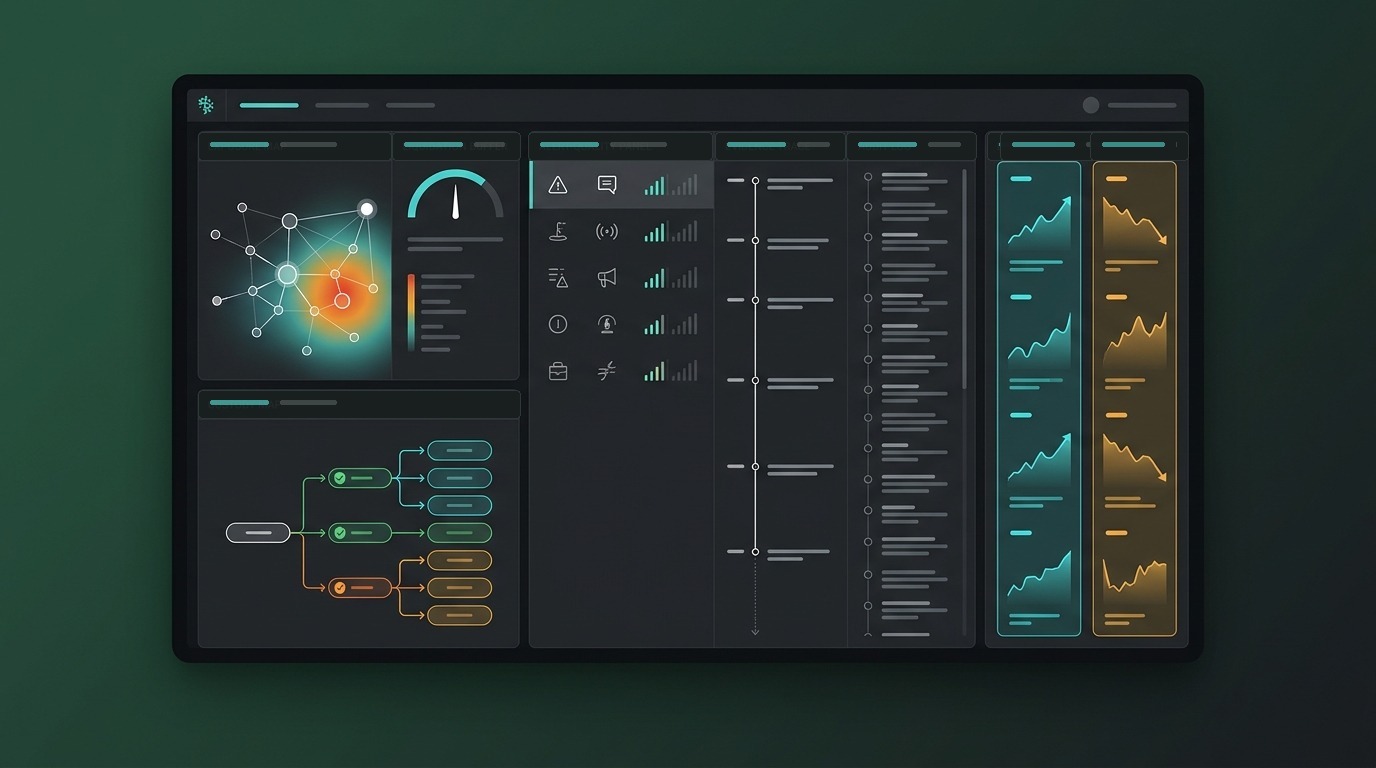
Crypto risk management tools are easy to buy and hard to trust.
Most dashboards can show balances, candles, alerts, and a risk score. That does not mean they improve decisions. A useful tool should tell you what changed, why it matters, how much capital is exposed, what action is now required, and which evidence supports the call.
This crypto risk management guide gives you a practical evaluation framework for crypto risk management tools. Use it before you renew a portfolio tracker, add an alerting product, connect an exchange API, test an AI research desk, or let any system influence live trading decisions.
This article is educational and not investment, tax, legal, or financial advice. Crypto assets can be volatile and operationally risky. A tool can improve process quality, but it cannot remove market, liquidity, custody, leverage, tax, or execution risk.
What Crypto Risk Management Tools Should Prove
Crypto risk management is not one feature. It is a decision system. A tool is useful only when it strengthens at least one part of that system:
- Exposure clarity: what you own, where it sits, how large it is, and which exposures are correlated.
- Loss control: how much a position, strategy, venue, or stablecoin can hurt the portfolio.
- Trigger discipline: which observable event causes a review, resize, hedge, pause, or exit.
- Evidence quality: whether alerts and conclusions trace back to reliable data.
- Action control: whether the tool can act, who approves the action, and what permissions it holds.
- Auditability: whether you can reconstruct the decision after the market has moved.
If a product cannot show where it fits, treat it as a data display, not a risk system. This matters because investor-education resources such as FINRA's crypto asset overview emphasize that crypto assets can carry substantial volatility, fraud, platform, and liquidity risk. A tool should make those risk categories easier to see, not compress them into one vague badge.
The 12-Point Evaluation Framework
Score each crypto risk management tool from 0 to 3 on each criterion:
- 0 = absent
- 1 = visible but manual
- 2 = usable with some setup
- 3 = reliable enough for repeated workflow use
For active traders, weight loss, leverage, alert, and permission controls more heavily. For long-term investors, weight exposure, custody, recordkeeping, and audit trail more heavily.
| Evaluation area | What to test | Pass condition |
|---|---|---|
| 1. Portfolio exposure map | Assets, venues, wallets, exchange balances, stablecoins, DeFi, open orders, leverage | One screen shows the real exposure that can lose money or become inaccessible |
| 2. Position sizing | Position size, invalidation distance, loss budget, concentration | Tool converts risk budget into size or flags oversize exposure |
| 3. Drawdown and stress tests | Portfolio drawdown, asset correlation, liquidity gap, stablecoin shock, exchange outage | You can model a bad day before it happens |
| 4. Leverage and liquidation controls | Margin mode, liquidation distance, funding, open interest, crowded positioning | Tool flags when liquidation risk or funding cost changes the decision |
| 5. Liquidity and exit capacity | Spreads, depth, route capacity, withdrawal path, staged exit | Exit size is checked against realistic liquidity, not only last price |
| 6. Custody and venue risk | Exchange caps, withdrawal test history, wallet split, API permissions | Tool separates market risk from platform or custody risk |
| 7. Alert quality | Price, volatility, funding, on-chain, news, exchange, wallet, and stablecoin alerts | Alerts are actionable, deduplicated, and tied to a preset decision rule |
| 8. Evidence trace | Source, timestamp, metric definition, calculation path, confidence | Every major alert or score can be traced to a source |
| 9. Contradiction handling | Bull case, bear case, technicals, derivatives, tail-risk, news context | Tool shows disagreement instead of hiding it inside one confidence number |
| 10. Action permissions | Read-only keys, trading keys, withdrawal access, order caps, human approval | The tool cannot create damage beyond your intended permission boundary |
| 11. Decision log | Thesis, trigger, action, source snapshot, owner, post-review | You can audit why a decision was made |
| 12. Operating fit | Setup time, daily routine, mobile access, export, failure modes | The tool fits the cadence you will actually maintain |
A tool that scores high on charts but low on permissions, traceability, and audit trail is not a strong crypto risk management tool. It is a charting product with risk labels.
Start With the Risk Job, Not the Tool Category
The market usually groups crypto risk management tools by product type:
- Portfolio trackers.
- Exchange dashboards.
- On-chain analytics tools.
- Alerting tools.
- Tax and recordkeeping tools.
- Derivatives dashboards.
- AI crypto research tools.
- Trading bots and execution tools.
That is useful for shopping, but weak for evaluation. A trader does not fail because a category was missing. A trader fails because a specific risk job was not handled.
Use this job map instead:
| Risk job | Tool capability needed | Example failure if missing |
|---|---|---|
| Know real exposure | Wallet, exchange, and DeFi aggregation | You think you hold 15% stablecoins, but 40% of liquid capital depends on one issuer or venue |
| Size decisions | Loss-budget and invalidation workflow | Conviction, not risk, determines position size |
| Avoid forced selling | Leverage, liquidation, funding, and margin alerts | A normal volatility spike becomes a liquidation event |
| Survive venue failure | Custody map, withdrawal tests, exchange caps | A good trade thesis is trapped on a bad venue |
| Prevent noisy alerts | Alert rules, deduplication, severity levels | Everything pings, so nothing gets reviewed |
| Verify signals | Source provenance and contradiction checks | A stale or one-sided signal gets treated as research |
| Keep records | Exportable decision, trade, transfer, and cost-basis logs | The decision cannot be explained later |
This is where many generic guides stop short. They ask whether a tool has alerts. The better question is: "Which decision does this alert change, and what evidence will I see before I act?"
The Tool Evaluation Scorecard
Use this scorecard during a trial. Do not score from a landing page alone. Test with your real workflow, read-only accounts, and a small set of representative positions.
| Criterion | Weight | 0 points | 1 point | 2 points | 3 points |
|---|---|---|---|---|---|
| Exposure coverage | 12% | Only manual balances | Exchange only | Exchange plus wallets | Exchange, wallets, DeFi, stablecoins, open orders, leverage |
| Loss budget workflow | 10% | None | Notes only | Manual calculator | Built into position review |
| Leverage risk | 10% | None | Shows liquidation only | Adds funding and margin alerts | Adds liquidation, funding, OI, crowded-trade context, and action triggers |
| Liquidity and exit capacity | 8% | Last price only | Volume view | Spread/depth visible | Size-aware exit route and staged-exit planning |
| Custody and permission safety | 10% | Encourages broad keys | Read/write unclear | Read-only supported | Scoped permissions, no withdrawal access, caps, and review prompts |
| Alert usefulness | 10% | Generic pings | Basic price alerts | Multi-signal alerts | Deduped, severity-ranked, tied to a decision rule |
| Evidence traceability | 10% | Black box | Source names only | Source plus timestamp | Source, method, timestamp, and replayable evidence |
| Contradiction handling | 8% | One score | Manual comparison | Shows multiple indicators | Explicit bull/bear/tail-risk disagreement |
| Decision log | 8% | None | Free-text notes | Exportable notes | Thesis, trigger, action, evidence, and review outcome |
| AI explainability | 6% | Unsupported recommendation | Generic explanation | Cites inputs | Separates claim, source, uncertainty, and invalidation |
| Reliability and fallback | 4% | No status visibility | Manual refresh | Source health visible | Fallback rules and source-health history |
| Daily operating fit | 4% | Too much setup | Works only on desktop | Usable routine | Fits a repeatable 10- to 15-minute review |
An acceptable trial score is not universal. A long-term BTC holder may accept weaker derivatives coverage. A perpetual-futures trader should not. The point is to make the tradeoff explicit before the tool becomes part of live decisions.
How to Evaluate AI Crypto Risk Management Tools
AI changes the evaluation standard. A normal dashboard can be wrong by omission. An AI tool can be wrong while sounding confident.
For AI crypto risk management tools, add five extra checks:
- Evidence before verdict: The tool should show the inputs behind the conclusion before asking you to trust the output.
- Uncertainty and invalidation: A serious brief should name what would make the view wrong.
- Adversarial review: Bullish and bearish evidence should be separated, not blended into one confident paragraph.
- Source freshness: The tool should make stale data visible.
- Permission boundary: The AI should not need withdrawal permission, and any execution ability should be capped and user-controlled.
The NIST AI Risk Management Framework emphasizes managing AI risks across governance, mapping, measurement, and management. For crypto traders, the practical translation is simple: do not evaluate only whether the output sounds smart. Evaluate whether the system can map its sources, measure uncertainty, and preserve human control.
BTCMind is built for this workflow: six AI specialists run technical, derivatives, tail-risk, bull, bear, and portfolio-manager analysis in a structured pipeline. The important buyer question is not "Can AI call the market?" It is "Can the tool show the evidence, disagreement, invalidation, and action boundary clearly enough for a trader to make a better decision?"
A 30-Day Trial Plan
Do not connect a crypto risk management tool to full live workflow on day one. Run a staged trial.
Days 1-3: Read-Only Setup
Use read-only connections where possible. Confirm:
- Balances match your exchange and wallet records.
- Stablecoins are separated by issuer and venue.
- Leverage, margin, and open orders are visible.
- API keys do not include withdrawal permission.
- Export works before you need it.
If setup requires broad permissions before proving value, stop the trial.
Days 4-10: Shadow Decisions
Pick five to ten decisions and write a one-line thesis for each:
Decision:
Reason:
Maximum loss:
Invalidation:
Tool alert expected:
Action if alert fires:
Then compare the tool against your manual process. The tool should catch relevant changes faster, explain them better, or reduce review time. If it only adds another screen, it has not earned workflow status.
Days 11-20: Alert Quality Test
Track every alert in a simple ledger:
| Alert | Was it timely? | Was it actionable? | Did it cite evidence? | Decision changed? | Notes |
|---|
Calculate two rough rates:
Actionable alert rate = useful alerts / total alerts
False urgency rate = alerts that felt urgent but changed no decision / total alerts
A tool that creates urgency without decision value weakens crypto risk management.
Days 21-30: Decision Audit
Review every decision influenced by the tool:
- What did the tool say?
- Which source or signal caused the change?
- Was the output available before the move, or only obvious after?
- Did the tool record the thesis and invalidation?
- Did it reduce loss, reduce time, improve evidence, or prevent a bad action?
End the trial with one of four decisions: keep, repair setup, downgrade to research-only, or remove.
Hard Stops Before You Trust a Tool
Some failures should end the evaluation immediately.
Stop or downgrade the tool if:
- It asks for withdrawal permission without a strict reason.
- It cannot explain how a risk score is calculated.
- Alerts repeatedly fire without source timestamps.
- It cannot export data or decision notes.
- It merges market, custody, leverage, and tax risk into one vague score.
- AI recommendations lack evidence, uncertainty, or invalidation.
- It pushes action without showing position size, loss budget, or permission limits.
- Public claims imply risk can be removed instead of managed.
Crypto risk management depends on humility. Any tool that sounds certain while hiding assumptions is adding risk.
Recordkeeping is another hard stop. The IRS digital assets guidance notes that taxpayers should keep records documenting digital asset purchases, receipts, sales, exchanges, dispositions, fair-market value, and basis. If a tool influences decisions but cannot export the evidence, trades, transfers, and notes needed for later review, keep it out of the core workflow.
Internal Workflow: Build a One-Page Risk Card
Before you buy, renew, or trust a tool, ask whether it can fill this one-page risk card:
| Field | Required answer |
|---|---|
| Position or portfolio segment | What exposure is being reviewed? |
| Thesis | Why does this exposure exist? |
| Maximum acceptable loss | What dollar and percentage loss triggers action? |
| Invalidation | What observable condition proves the thesis wrong? |
| Liquidity route | How can the exposure be reduced or exited? |
| Venue/custody map | Where is the asset and what can block access? |
| Signal stack | Which market, derivatives, on-chain, news, or portfolio signals matter? |
| Contradiction | What is the strongest opposite case? |
| Alert rule | What event creates a notification? |
| Permission boundary | What can the tool do without approval? |
| Evidence link | Where can the source data be reviewed? |
| Review outcome | Keep, reduce, hedge, pause, exit, or no action |
If a tool cannot help complete this card, its value is limited. It may still be useful for research or monitoring, but it should not control decisions.
Which Tool Type Fits Which Trader?
| Trader type | Primary risk | Tool emphasis |
|---|---|---|
| Long-term BTC holder | Custody, allocation drift, emotional adds, recordkeeping | Portfolio tracking, alerts, custody map, decision log |
| Active spot trader | Position size, liquidity, invalidation, news shocks | Risk-budget workflow, market alerts, source evidence |
| Perpetual-futures trader | Liquidation, funding, crowded positioning, execution speed | Leverage dashboard, liquidation buffer, derivatives alerts |
| Stablecoin allocator | Issuer, venue, redemption, depeg, concentration | Stablecoin risk checklist, issuer caps, venue split |
| AI-signal user | Stale signals, hidden assumptions, overconfidence | Evidence trace, contradiction handling, paper-test log |
| Research-heavy operator | Too many sources, poor prioritization, slow synthesis | AI research desk, source-health log, daily brief workflow |
BTCMind fits the last two rows best: traders who already know that one chart is not enough and need a structured brief that combines technicals, derivatives, tail-risk, and adversarial bull/bear review. For basic allocation tracking, pair BTCMind-style research with a clean portfolio tracker and a custody checklist.
How This Connects to a Broader Crypto Risk Management System
This framework sits between three adjacent workflows:
- Use a crypto portfolio risk budget to define how much loss a position, asset class, or narrative can create.
- Use a crypto exchange due diligence checklist before concentrating funds on one venue.
- Use an AI crypto trading signals trust audit before treating any AI-generated call as decision support.
If you need daily monitoring, the Bitcoin alerts checklist and Bitcoin portfolio tracking checklist give the operational layer. If you rely on on-chain analytics, the on-chain signal workflows cost and ROI guide helps audit data-tool spend and source reliability.
Final Rule: Buy the Workflow, Not the Dashboard
Crypto risk management tools should earn trust by making decisions clearer, smaller, better evidenced, and easier to audit.
Do not buy a tool because it has more charts. Buy it because it improves one of these outcomes:
- You know your real exposure faster.
- You size positions from loss budget instead of conviction.
- You catch leverage and custody risk before they become emergencies.
- You can trace alerts to sources.
- You can explain why a decision was made.
- You can keep human control over any automated action.
BTCMind's angle is the research layer: a mobile crypto research desk that forces technicals, derivatives, tail-risk, bull case, and bear case into one structured brief. That is useful only when it strengthens your crypto risk management process. The best crypto risk management process is the one you can still follow during volatility, not the one that only looks complete in a calm review. Use the framework above to test that claim before any tool becomes part of live decisions.