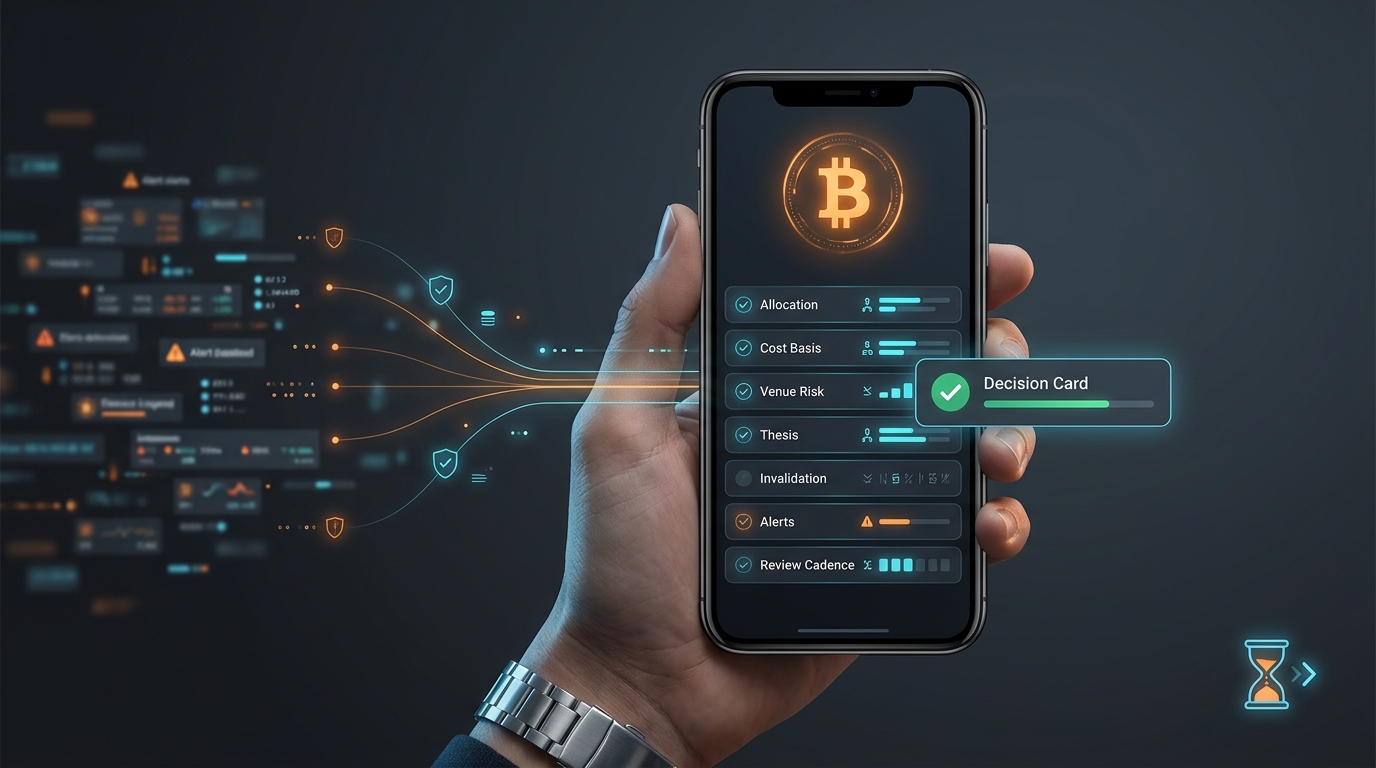
Bitcoin Portfolio Tracking Checklist for Faster Decisions
BTCMind Team
Aug 14, 2026
Bitcoin portfolio tracking should make your next decision faster, not just make your balances prettier.
That distinction matters. A dashboard can show account value, Bitcoin weight, deposits, withdrawals, and profit and loss. But when the market moves quickly, the useful question is different:
What changed, what matters, and what action is allowed by my plan?
This guide turns bitcoin portfolio tracking into a practical decision checklist. It is built for Bitcoin holders and active crypto traders who need a compact review process across wallets, exchanges, cost basis, alerts, thesis notes, and risk limits.
Important: This article is educational, not personalized financial, tax, or investment advice. Crypto assets can be volatile and expose users to market, custody, tax, operational, liquidity, and fraud risks. Use your own records and consult qualified professionals where needed.
The short answer
Good bitcoin portfolio tracking answers seven questions before you react:
- What do I own?
- Where is it held?
- What is my cost basis and realized history?
- How concentrated is the portfolio?
- What thesis does this Bitcoin position serve?
- What condition would change the plan?
- What alert or review cadence keeps the decision current?
If your tracker cannot support those answers, it may still be useful, but it is not enough for faster portfolio decisions.
What most bitcoin portfolio tracking tools get right
The current search results for bitcoin portfolio tracking tools usually point to three kinds of pages:
| Result type | What it usually helps with | What it often leaves to you |
|---|---|---|
| Portfolio tracker pages | Balances, allocation, performance, wallets, exchanges, and app-based monitoring | Thesis review, risk limits, counter-case, and decision rules |
| Spreadsheet templates | Custom fields, cost-basis notes, manual review, and full flexibility | Continuous price updates, wallet sync, alerts, and reconciliation |
| Tax or accounting tools | Transaction history, gains/losses, lots, exports, and reporting workflows | Market decision-making and portfolio risk judgment |
Those are real jobs. The mistake is treating them as the same job.
A bitcoin portfolio tracker should help you see the state of the portfolio. A research process should help you decide whether the state still fits your thesis. A risk process should define what you are allowed to do. Keep those layers separate and your decisions get cleaner.
For adjacent tool selection, use BTCMind's crypto portfolio research tools comparison. For the broader evidence layer, read the Bitcoin market intelligence beginner guide.
The bitcoin portfolio tracking checklist
Use this checklist once to set up your system, then repeat the short version during daily or weekly reviews.
| Check | Required field | Faster-decision question |
|---|---|---|
| Portfolio truth | Asset, amount, venue, wallet, sync status | Is the balance reliable enough to act on? |
| Cost basis | Entry date, entry amount, fees, transfer notes | Am I reacting to price or to actual exposure? |
| Venue and custody | Wallet, exchange, counterparty, permission scope | Can I access and move the Bitcoin if needed? |
| Allocation | Bitcoin weight, cash/stablecoin weight, non-BTC weight | Is the portfolio still inside its intended mix? |
| Concentration | Shared venue, stablecoin, chain, strategy, collateral | Does one failure mode control too much risk? |
| Thesis | Reason held, time horizon, expected evidence | Is the original reason still valid? |
| Decision trigger | Invalidation, trim, add, rebalance, or no-action rule | What exactly changes the plan? |
The goal is not to create a perfect dashboard. The goal is to remove avoidable hesitation when conditions change.
1. Confirm portfolio truth before analysis
Start every bitcoin portfolio tracking review with portfolio truth:
- current BTC amount;
- current fiat value;
- wallet or exchange location;
- pending transfers;
- stale connections;
- duplicate imports;
- unknown transactions;
- locked, borrowed, or collateralized balances.
Do not analyze an unreliable balance. If your wallet sync failed, an exchange export is missing, or a transfer is duplicated, the decision card should say:
Status: portfolio truth unresolved
Allowed action: reconcile only
Trading action: paused
That may feel slow, but it is faster than making a decision from the wrong account state.
Five-minute portfolio truth test
You should be able to answer these questions within five minutes:
| Question | Pass condition |
|---|---|
| How much BTC do I own? | One reconciled number with known exceptions |
| Where is it? | Wallets, exchanges, and custody locations are listed |
| What cannot move today? | Locked, pending, collateralized, or restricted balances are flagged |
| Which data is stale? | Broken syncs and old imports are visible |
| What changed since the last review? | Deposits, withdrawals, buys, sells, and transfers are separated |
If any answer is unclear, fix tracking before interpreting the market.
2. Separate cost basis from market opinion
Bitcoin price moves can trigger emotional decisions. Cost-basis records slow that down.
Your bitcoin portfolio tracking guide should include at least:
- acquisition date;
- acquisition amount;
- fees;
- transfer history;
- lot notes where relevant;
- realized gains/losses where available;
- tax-report export path;
- source of record.
The IRS digital assets page redirects to current digital asset filing guidance, so recordkeeping needs to be treated as a live compliance workflow, not an afterthought. A tracker can help organize data, but the user remains responsible for complete and accurate records.
For active users, add one practical field:
Decision basis: thesis / rebalance / liquidity need / tax record / error correctionThat field prevents every action from being explained afterward as "market conditions."
3. Map venue and custody risk
Bitcoin portfolio tracking is incomplete if it only shows asset value. The same BTC amount can carry different operational risk depending on where it sits.
Track each location:
| Location field | Why it matters |
|---|---|
| Wallet or exchange name | Shows custody and access dependency |
| Permission level | Separates read-only tracking from trading or withdrawal ability |
| Withdrawal status | Flags pending, paused, or restricted movement |
| Recovery method | Confirms whether access depends on one device, person, or credential |
| Counterparty exposure | Shows whether the portfolio depends on one venue |
Bitcoin.org's wallet security guidance emphasizes user responsibility for wallet backups and access practices. In portfolio terms, that means tracking is not just software. It is an operating process: know where the Bitcoin is, how it can move, and what would block access.
Use BTCMind's crypto exchange due-diligence framework for venue checks, and the stablecoin risk checklist if your Bitcoin plan depends on stablecoin liquidity.
4. Track allocation drift before it becomes a decision
Allocation drift is one of the fastest ways a calm portfolio becomes an emotional portfolio.
For each review, record:
- BTC weight;
- non-BTC crypto weight;
- cash or stablecoin weight;
- leveraged exposure;
- exchange-held percentage;
- cold-storage percentage;
- strategy buckets, such as long-term hold, tactical trade, reserve, or experimental.
Then define drift bands before the market tests them.
| Field | Example rule format |
|---|---|
| BTC target band | BTC should remain between X% and Y% of crypto portfolio value |
| Reserve band | Cash/stablecoin reserve should not fall below X% |
| Venue cap | No single exchange should hold more than X% |
| Tactical sleeve cap | Short-term trades cannot exceed X% |
| Rebalance trigger | Review when any band is breached for more than X hours/days |
These are templates, not recommendations. The actual limits must come from your own risk capacity, time horizon, and liquidity needs.
For a deeper worksheet, use BTCMind's crypto portfolio risk budget.
5. Attach every Bitcoin position to a thesis
Fast decisions require prewritten logic. Without a thesis, every price move invites a new story.
For each Bitcoin bucket, write a one-line thesis:
Bucket: long-term BTC
Thesis: multi-year savings allocation
Evidence expected: custody intact, monthly accumulation plan, macro thesis unchanged
Invalidation: personal liquidity need or thesis-level change, not a daily candle
Next review: monthly
For a tactical bucket, the thesis should be more specific:
Bucket: tactical BTC
Thesis: short-term continuation setup
Evidence expected: price structure, derivatives positioning, volume, sentiment, and risk level agree
Invalidation: failed level, funding stress, or contradictory evidence
Next review: daily or intraday
This is where bitcoin portfolio tracking connects to market intelligence. The tracker tells you the position exists. The thesis tells you why it exists. The decision trigger tells you what changes.
If you need a signal triage routine, use BTCMind's Bitcoin market intelligence signal triage.
6. Turn alerts into decisions, not noise
Most alert systems are too easy to create and too hard to govern. A useful alert should have an owner, condition, action, and expiration date.
Use this alert table:
| Alert | Source | Why it exists | Allowed response | Expires |
|---|---|---|---|---|
| BTC breaks a defined level | Price alert | Review thesis or stop condition | Open decision card, do not auto-react | Date/time |
| Portfolio weight breaches band | Tracker | Rebalance review | Compare with risk budget | Date/time |
| Exchange withdrawal issue | Venue status/manual check | Custody risk | Pause new exposure on venue | When resolved |
| Funding/open-interest shift | Derivatives source | Leverage regime change | Confirm with price and risk budget | Date/time |
| Sentiment extreme | Sentiment source | Crowd-risk context | Add to evidence, not standalone action | Date/time |
An alert without a planned response is not a decision tool. It is an interruption.
For source-health and alert discipline, see BTCMind's BTC sentiment analysis workflow playbook and on-chain signal workflows cost and ROI guide.
7. Use a one-page Bitcoin decision card
The fastest useful output from bitcoin portfolio tracking is a one-page decision card.
Date:
Portfolio truth: pass / fail
BTC amount:
BTC portfolio weight:
Venue/custody exceptions:
Cost-basis note:
Thesis:
Evidence supporting thesis:
Evidence against thesis:
Risk budget status:
Alert status:
Decision: hold / add / trim / rebalance / investigate / no action
Invalidation:
Next review:
The most important line is "evidence against thesis." It prevents tracking from becoming confirmation bias with nicer charts.
BTCMind is built around that synthesis layer: six AI specialists run parallel research, bull/bear debate, technical, derivatives, and tail-risk analysis, then a portfolio manager returns a structured mobile brief. That does not replace custody, tax records, or personal responsibility. It helps with the decision-synthesis bottleneck after portfolio state is known.
A 15-minute bitcoin portfolio tracking routine
Use this routine when you need speed without turning every review into a full research session.
| Minute | Step | Output |
|---|---|---|
| 0-2 | Check portfolio truth | Balances and venue exceptions |
| 2-4 | Check allocation drift | BTC weight, reserve weight, venue cap |
| 4-6 | Check cost-basis context | Action reason and tax-record flag |
| 6-9 | Check thesis evidence | Support, contradiction, missing data |
| 9-11 | Check alerts | Which alert needs a decision, which expires |
| 11-13 | Check risk budget | Position, cluster, and portfolio rule status |
| 13-15 | Write decision card | Hold, add, trim, rebalance, investigate, or no action |
Most sessions should end with "no action." That is not a failure. It means the tracking system did its job: it separated information from impulse.
Which tracking setup fits your situation?
| User situation | Minimum setup | Add when needed |
|---|---|---|
| Long-term Bitcoin-only holder | Wallet record, acquisition log, custody checklist, monthly review | Tracker if holdings span several wallets or venues |
| Bitcoin plus a few large-cap assets | Portfolio tracker, cost-basis export, allocation bands | Research journal and risk budget |
| Active BTC trader | Tracker, exchange records, alert rules, decision card | Market intelligence, sentiment workflow, on-chain/derivatives evidence |
| Multi-venue crypto user | Tracker, permission register, venue map, tax export path | Quarterly tool governance and incident log |
| Time-poor trader | Tracker for state plus synthesis tool for evidence | BTCMind-style structured brief and review cadence |
Do not add tools before assigning jobs. A simple stack with clear ownership beats a crowded stack where every app sends alerts and none owns the final decision.
Common bitcoin portfolio tracking mistakes
Mistake 1: tracking balances but not decisions
Balances show exposure. They do not explain why the exposure exists. Add thesis, invalidation, and next review fields.
Mistake 2: mixing transfers with performance
Deposits, withdrawals, buys, sells, fees, and transfers need separate labels. Otherwise performance becomes distorted and decisions become harder to audit.
Mistake 3: ignoring venue concentration
Holding Bitcoin across several strategies still creates a single failure point if everything depends on one exchange, device, or credential path.
Mistake 4: creating alerts without response rules
Every alert should answer: "If this fires, what do I do first?" If the answer is unclear, delete or rewrite the alert.
Mistake 5: treating one data source as the whole market
Price, on-chain data, derivatives positioning, sentiment, and news do different jobs. A useful tracker should not collapse them into an unexplained feeling.
When BTCMind belongs in the workflow
BTCMind is not a tax ledger, custody provider, or generic portfolio tracker. It is a mobile AI crypto research desk for the synthesis step after your portfolio state is known.
Use BTCMind when your bitcoin portfolio tracking process already shows what you own, but the decision still takes too long because evidence is scattered across charts, news, sentiment, derivatives, and risk notes.
The product's current positioning is a six-agent research process: technicals, derivatives, tail risk, reflection, bull case, bear case, and portfolio-manager synthesis. The useful handoff looks like this:
Tracker: What do I own?
Risk budget: What am I allowed to risk?
BTCMind: What does the evidence say, including the counter-case?
Decision card: What action, no-action, or review follows?
That workflow keeps responsibility with the user while reducing the research load.
Final takeaway
Bitcoin portfolio tracking is not finished when the dashboard loads. It is finished when you can answer, quickly and defensibly:
- what changed;
- what matters;
- what evidence supports or challenges the thesis;
- what action is allowed;
- and when the next review happens.
Track balances for accuracy. Track custody for access. Track cost basis for records. Track allocation for drift. Track thesis and invalidation for decisions.
That is how bitcoin portfolio tracking becomes faster decision-making instead of another screen to check.
FAQ
What is bitcoin portfolio tracking?
Bitcoin portfolio tracking is the process of recording BTC holdings, locations, transactions, cost basis, allocation, alerts, and decision notes so a user can understand exposure and review changes over time.
What should a bitcoin portfolio tracker include?
A practical bitcoin portfolio tracker should include holdings, wallet or exchange location, transaction history, cost-basis records, allocation, alerts, export options, sync status, and notes for thesis, invalidation, and next review.
Is a spreadsheet enough for bitcoin portfolio tracking?
A spreadsheet can be enough for a simple Bitcoin-only portfolio if the user updates it consistently and keeps reliable transaction records. A tracker becomes more useful when holdings span several wallets, exchanges, assets, or review cadences.
How often should I review a Bitcoin portfolio?
The cadence should match the portfolio's purpose. A long-term savings allocation may need a monthly review, while an active BTC trading sleeve may need daily or intraday checks. The key is to define the cadence before volatility forces a reaction.
Can BTCMind replace a portfolio tracker?
No. BTCMind is best used as a research and synthesis layer. Use a portfolio tracker or reliable records for account state, then use BTCMind-style briefs to evaluate evidence, counter-case, risk context, and the next decision.