If you treat Ethereum staking yield like a fixed savings rate, you will misunderstand what you are being paid for.
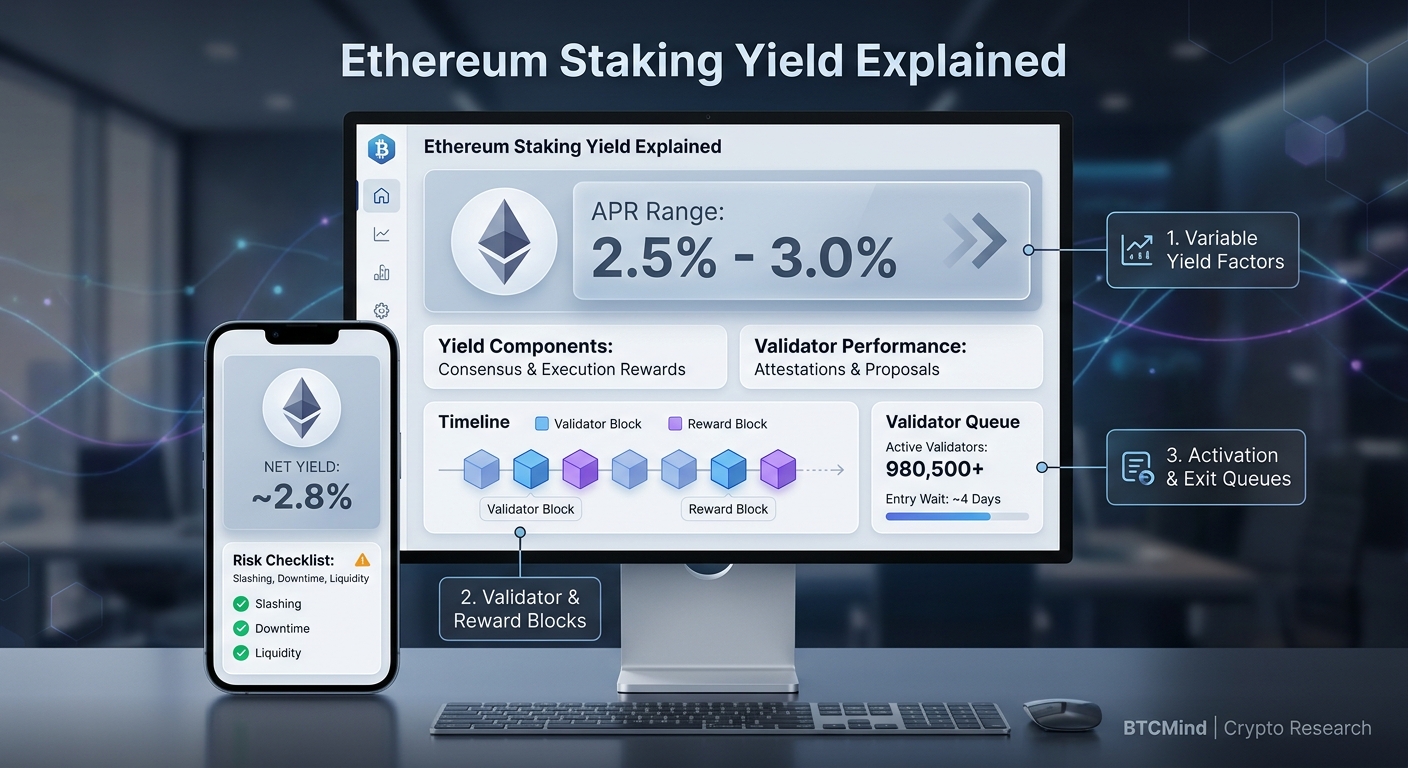
Ethereum staking yield is variable. It changes with how many validators are active, how much ETH is staked across the network, how well a validator performs its duties, how much execution-layer activity contributes tips and MEV, and how much an exchange, pool, or liquid staking provider keeps in fees before you see the net result.
As of Sunday, July 19, 2026, live public staking dashboards did not point to one single number. Validator Queue showed roughly 2.65% APR, while ETH.STORE showed about 3.003% p.a. That difference is not a contradiction. It is a reminder that Ethereum staking yield depends on measurement method, time window, and whether you are looking at gross network rewards or something closer to a blended realized rate.
Risk note: This article is educational only. It is not investment advice. Staked ETH can still lose value in USD terms, validator performance can reduce rewards, and third-party staking services add custody, smart-contract, fee, and operational risk.
What Ethereum staking yield actually means
At the simplest level, Ethereum staking yield is the reward earned for helping secure Ethereum's proof-of-stake network.
Validators are paid for doing work such as:
- proposing blocks when selected
- attesting to blocks proposed by other validators
- staying online and correctly synchronized
- following protocol rules consistently enough to avoid penalties
That makes Ethereum staking yield different from an advertised bank rate or bond coupon. The payout is not promised in advance. It is network-driven.
Ethereum's own staking documentation also makes the trade-off clear: staking rewards exist because validators lock capital, run infrastructure, and accept slashing and performance risk in exchange for helping consensus work.
Current Ethereum staking yield snapshot for Sunday, July 19, 2026
Here is the dated reference set used in this article.
| Metric | Source | Sunday, July 19, 2026 snapshot | Why it matters |
|---|---|---|---|
| Network staking APR | Validator Queue | 2.65% | A practical 7-day network reward snapshot |
| Active validators | Validator Queue | 882,437 | More validators generally compress per-validator rewards |
| Staked ETH | Validator Queue | 40.8M ETH | High participation means rewards are spread across more stake |
| Share of ETH supply staked | Validator Queue | 33.45% | Shows how large staking has become relative to total supply |
| Protocol reward rate reference | ETH.STORE | 3.003% p.a. | A second public benchmark with a different methodology |
The useful takeaway is not "the true number is exactly X." The useful takeaway is that Ethereum staking yield on Sunday, July 19, 2026 sat in roughly the high-2% to low-3% annualized range before you adjust for service fees, taxes, downtime, or strategy-specific drag.
Why different dashboards show different Ethereum staking yield numbers
This is one of the most important points to understand.
Two staking sites can show different Ethereum staking yield numbers because they may:
- use different lookback windows
- include or exclude execution-layer rewards differently
- annualize recent data in different ways
- show gross protocol rewards instead of user net rewards
- update on slightly different cadences
So when someone asks, "What is Ethereum staking yield right now?" the defensible answer is usually a range with a date, not one timeless figure.
That is also how you should compare staking products. If a provider advertises a higher number, the next question is not "Can I get it?" The next question is "What assumptions, fees, and risks sit behind it?"
Where Ethereum staking yield comes from
The easiest way to think about Ethereum staking yield is to split it into three layers.
1. Consensus rewards
These are the base rewards earned for proposing and attesting correctly.
They are the core of Ethereum staking yield because they come directly from validator participation in proof of stake. If a validator is online, properly configured, and doing its duties, this is the main reward engine.
2. Execution-layer rewards
Validators can also receive priority fees and MEV-related block rewards when they propose a block. These rewards are less smooth than consensus rewards. They depend more on network activity and block luck.
This matters because Ethereum staking yield is not always a smooth line. A validator can have periods where returns look slightly better or slightly weaker depending on proposal luck and activity conditions.
3. Compounding and withdrawal mechanics
Ethereum withdrawals changed the practical staking experience because rewards no longer need to stay trapped indefinitely. Partial withdrawals and balance sweeping can improve capital flexibility, but they do not turn Ethereum staking yield into a guaranteed coupon.
They simply make realized rewards easier to access and manage.
What pushes Ethereum staking yield lower
Most readers focus on upside. The more useful question is what drags net yield down.
More ETH staked across the network
When more validators join, protocol rewards are shared across a larger base. That usually compresses Ethereum staking yield per validator.
This is the most normal reason staking yield declines. It does not mean Ethereum is broken. It means participation is higher.
Missed duties or poor uptime
A validator that misses attestations or goes offline does not earn the same as a well-run validator. In practice, Ethereum staking yield is partly an operations problem.
If your validator setup is weak, your realized yield can trail the network.
Slashing and penalties
Serious validator mistakes can trigger slashing. That is a small-probability but high-consequence risk, especially for operators who do not understand infrastructure, key management, or failover design.
For that reason, Ethereum staking yield should always be discussed together with risk, not only with return.
Provider fees
If you stake through an exchange, staking pool, or liquid staking product, the provider usually takes a cut. That means your personal Ethereum staking yield can be meaningfully lower than the gross network rate.
This is why "network APR" and "what lands in my account" are not the same thing.
Solo staking, pooled staking, and liquid staking do not produce the same net result
Ethereum.org's staking documentation still distinguishes clearly between solo validators, staking pools, and liquid staking.
Here is the practical comparison:
| Staking path | What you usually get | What can reduce net yield |
|---|---|---|
| Solo staking | Maximum control and direct protocol exposure | Requires at least 32 ETH, operational skill, uptime discipline, and slashing risk |
| Pooled staking | Lower capital barrier and easier setup | Fees, provider dependency, and less direct control |
| Liquid staking | Transferable receipt token plus easier composability | Smart-contract risk, peg risk, protocol risk, and fee drag |
| Exchange staking | Simplicity and convenience | Custody risk, opaque fee structure, policy changes, and lower net payout |
This is why Ethereum staking yield cannot be compared honestly without specifying the route.
Two investors can both say they are "staking ETH" while receiving meaningfully different net outcomes because the structure around the staking is different.
Gross Ethereum staking yield is not your real yield
A clean rule is:
real yield to the user = protocol rewards - provider fees - operational drag - tax friction - avoidable mistakes
For example:
- a solo staker may keep more of the gross yield but accept more operating burden
- a pooled staker may accept lower yield for convenience
- a liquid staker may gain flexibility while taking extra smart-contract and token-structure risk
- an exchange staker may get the simplest experience but often the least transparent economics
If you ignore those layers, you will overestimate Ethereum staking yield in the real world.
How to evaluate Ethereum staking yield without fooling yourself
The best way to read Ethereum staking yield is as a decision framework, not as a headline metric.
1. Start with the current network range
Use a dated network benchmark first. On Sunday, July 19, 2026, a reasonable public reference range was roughly 2.65% to 3.003% annualized, depending on methodology.
That gives you a gross context.
2. Identify your staking route
Ask:
- am I solo staking?
- am I delegating to a pool?
- am I using a liquid staking token?
- am I using a centralized exchange?
Until that is clear, a quoted Ethereum staking yield number is incomplete.
3. Subtract the drag
Then review:
- provider commission
- withdrawal constraints
- smart-contract risk if applicable
- operational risk if solo
- extra token risk if liquid staking
This is how you turn Ethereum staking yield from marketing copy into a real expected-return estimate.
4. Separate ETH-denominated yield from portfolio return
A final trap is forgetting that Ethereum staking yield is paid in ETH terms, while most investors experience portfolio outcomes in fiat terms.
You can earn staking rewards and still lose money on the position if ETH itself falls sharply in dollar terms. That is why yield should never replace thesis, position sizing, or drawdown discipline.
If you already use BTCMind's crypto portfolio risk management guide or market cycle indicators framework, the same logic applies here: one return input should not overrule the broader risk process.
A practical Ethereum staking yield checklist
Before you commit capital based on a staking number, check these items:
- Record the quoted Ethereum staking yield with the exact date.
- Confirm whether the number is gross network APR or user net payout.
- Confirm the staking route: solo, pool, liquid staking, or exchange.
- Identify fees and commissions explicitly.
- Review slashing, uptime, custody, and smart-contract risk.
- Decide whether the position still fits your total portfolio allocation.
- Treat the yield as one input, not the full thesis.
That process is much safer than chasing the highest advertised number.
Where BTCMind fits
BTCMind is useful when you want to treat a crypto decision as a research workflow instead of a one-metric shortcut.
That matters here because Ethereum staking yield is easy to oversimplify. A clean staking review should still ask:
- what is the current market regime for ETH?
- what are the downside risks if ETH reprices lower?
- is the convenience of a third-party staking product worth the fee drag and extra risk?
- does the position size still make sense if the yield is only a small offset against volatility?
If you want that wider process, pair this article with BTCMind's AI crypto trading signals trust guide, the main feature overview, and the official download page.
Final take
Ethereum staking yield is best understood as a variable network reward, not a fixed interest rate.
On Sunday, July 19, 2026, public benchmarks suggested a gross annualized range around the high-2% to low-3% area, with Validator Queue showing 2.65% APR and ETH.STORE showing 3.003% p.a. That is useful context, but it is only the starting point.
The real decision is not "What is the headline yield?" The real decision is:
- what staking route am I using?
- what fees and risks sit on top of the network rate?
- what does the net yield look like after those frictions?
- does the ETH position still fit my portfolio and risk tolerance?
That is how Ethereum staking yield becomes something you can actually evaluate instead of just repeat.
FAQ
Is Ethereum staking yield fixed?
No. Ethereum staking yield changes with validator participation, network activity, execution-layer rewards, validator performance, and provider fees.
What was Ethereum staking yield on Sunday, July 19, 2026?
Public benchmarks on Sunday, July 19, 2026 pointed to roughly the high-2% to low-3% annualized range. Validator Queue showed about 2.65% APR, while ETH.STORE showed about 3.003% p.a..
Why do two Ethereum staking yield dashboards show different numbers?
Because they may use different methodologies, time windows, or reward components. A dated range is usually more reliable than one isolated figure.
Does higher Ethereum staking yield mean better portfolio return?
No. Ethereum staking yield is paid in ETH terms. If ETH falls sharply in fiat terms, the position can still lose value even while staking rewards accrue.
Is solo staking the highest-yield option?
Solo staking can preserve more gross rewards because there is no provider taking a fee, but it also carries operational burden, uptime requirements, and slashing risk. Net results depend on execution quality, not only on the headline rate.