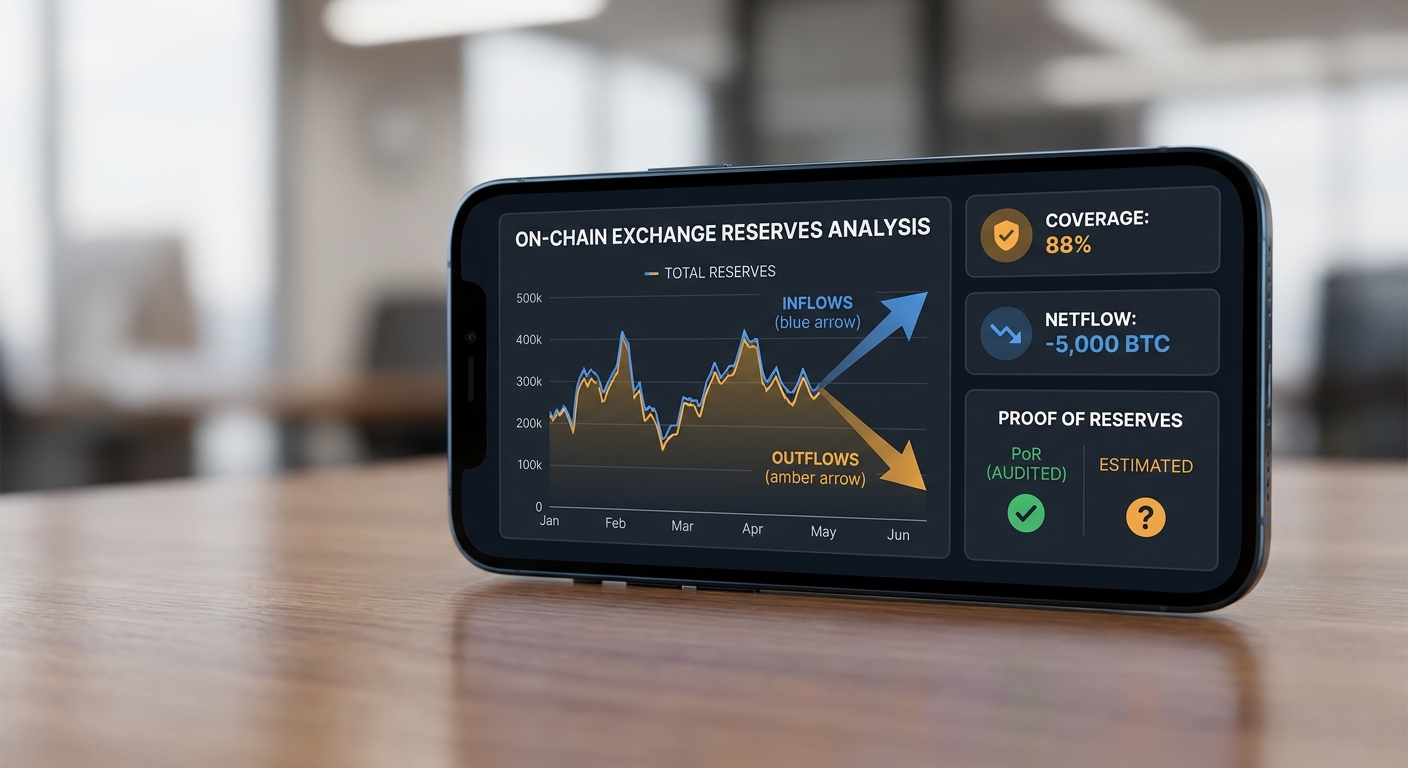
How to Read On-Chain Exchange Reserves
Most people look at on-chain exchange reserves because they want a quick answer to a hard question: are coins moving toward likely selling venues or away from them?
That instinct is reasonable, but the shortcut often fails.
On-chain exchange reserves can help you track supply behavior, exchange wallet concentration, and possible changes in market posture. They do not tell you, by themselves, whether a rally is safe, whether a dump is finished, or whether a reserve drop is automatically bullish.
The practical way to read this metric is to treat it as one layer inside a broader workflow:
- reserve direction
- exchange netflows
- stablecoin exchange balances
- price and market structure
- venue coverage and labeling caveats
Risk note: This article is educational only. It is not investment advice. On-chain metrics are estimates built from labeled wallet data and can change as providers improve attribution.
What on-chain exchange reserves actually measure
At the simplest level, the metric tracks the amount of a coin held in wallets that a data provider attributes to centralized exchanges.
CryptoQuant describes exchange reserve as the reserve of coins held in exchange wallets. Glassnode's exchange balance documentation describes the metric as the total amount of coins held on exchange addresses and explicitly notes that exchange metrics depend on labeled exchange data and can change over time as attribution improves.
That definition matters because these exchange-balance estimates are not:
- total market supply
- total coins available for immediate sale everywhere
- a full proof-of-reserves audit
- a guarantee that every tracked wallet label is final forever
The right mental model is narrower: this metric estimates how much tracked supply currently sits on exchange-linked addresses.
Why traders watch on-chain exchange reserves
People care about this metric because exchanges are where spot supply often becomes easier to sell, swap, lend, or use as collateral.
If exchange-linked balances rise, traders often interpret that as more supply moving closer to venues where it can be sold. If balances fall, traders often interpret that as supply moving off exchanges and potentially into longer-term custody.
That logic is useful, but it is incomplete.
Among the most practical reasons to watch exchange reserve data are:
- to see whether coins are concentrating on trading venues
- to compare current exchange supply with prior periods
- to check whether a move is being accompanied by obvious deposit behavior
- to pair reserve trends with netflows and market structure
This is why the metric belongs in a research dashboard, not as a standalone trade trigger.
How to interpret rising on-chain exchange reserves
Rising reserves usually mean more tracked coins are moving onto exchange-linked addresses over the measured period.
That can matter for several reasons:
- more holders may be preparing coins for sale
- market makers may be repositioning inventory
- arbitrage desks may be shifting balances between venues
- collateral usage may be changing during volatile periods
The common interpretation is "higher reserves can increase near-term sell-side availability." That is directionally fair, but it is still only a first read.
When reserves rise, ask better follow-up questions:
Is the move broad or exchange-specific?
A broad rise across large venues carries different information than a one-venue jump caused by internal reshuffling or operational wallet changes.
Is price actually weakening?
If reserves rise but price structure remains firm and absorption stays healthy, the market may be handling that supply without obvious damage.
Are netflows confirming the change?
Reserve growth without meaningful positive netflows can sometimes reflect attribution updates or internal wallet routing instead of fresh user deposits.
How to interpret falling on-chain exchange reserves
Falling reserves usually mean tracked balances on exchange-linked addresses are decreasing.
That often supports a more constructive narrative:
- coins may be leaving exchanges for self-custody
- longer-term holders may be reducing immediate sell access
- available exchange-side inventory may be tightening
This is why many traders treat falling exchange reserves as a potentially bullish backdrop.
But that read is still not automatic.
A reserve decline can happen while price continues lower. Coins can leave exchanges for many reasons that do not create immediate bullish pressure. Supply may move into custodians, OTC workflows, or other wallet structures that reduce the visibility of what is really happening next.
The better conclusion is narrower:
Falling on-chain exchange reserves can support a tightening-supply narrative, but only if other evidence agrees.
Why on-chain exchange reserves are not enough on their own
The biggest mistake with this metric is treating one directional move as a complete market verdict.
Reserve direction alone does not answer:
- who moved the coins
- why they moved them
- whether the change came from deposits, withdrawals, or relabeling
- whether stablecoin liquidity is increasing or decreasing at the same time
- whether price is accepting the shift or rejecting it
Glassnode also draws an important distinction between proof-of-reserve data and its broader exchange balance metrics. Proof-of-reserve coverage is not the same thing as exchange balance estimation. In other words, these reserve charts are useful market structure estimates, not a substitute for audited venue solvency.
That distinction helps prevent two bad habits:
- assuming exchange reserve charts are exact legal-accounting statements
- assuming reserve drops automatically mean a venue is healthier or users are safer
Combine on-chain exchange reserves with netflows first
If you only add one companion metric to exchange reserve analysis, make it netflows.
Reserve totals tell you the stock. Netflows help explain the change.
Use the pair like this:
| Metric | What it tells you | What it cannot tell you alone |
|---|---|---|
| Exchange reserves | How much tracked supply sits on exchange-linked addresses | Why the balance changed |
| Exchange netflows | Whether more coins are entering or leaving over a period | Whether the broader reserve trend is historically large or small |
This is the basic logic:
- rising reserves plus positive netflows can support a deposit-heavy reading
- falling reserves plus negative netflows can support a withdrawal-heavy reading
- reserve changes without clear netflow confirmation deserve more caution
That is the first serious use case for the metric: not prediction, but context.
Then check stablecoin exchange balances
The next useful layer is stablecoin exchange liquidity.
If BTC or ETH exchange reserves are falling while exchange-side stablecoin balances are rising, the market may be reducing coin supply on venue while increasing dry powder. That is not automatically bullish, but it is a more informative setup than a reserve chart alone.
If coin reserves are rising while stablecoin balances are falling, the picture can be less supportive. More coin inventory is appearing on venue while quote-side liquidity may not be improving.
This is one reason exchange reserve data should be read as a relative market structure input, not as a magic signal. Supply and buying capacity both matter.
Common false positives when reading on-chain exchange reserves
Many bad trade decisions start when traders over-read reserve charts and ignore the data hygiene issues around them.
False positive 1: exchange relabeling
Providers improve wallet attribution over time. Glassnode explicitly says exchange metrics are based on labeled exchange data and can fluctuate slightly as the dataset evolves. A sudden shift may reflect better labeling rather than fresh trading intent.
False positive 2: internal wallet reshuffling
Exchanges and related entities can move funds between hot wallets, cold wallets, and operational addresses. That can affect exchange reserve data without representing new user behavior.
False positive 3: one-venue distortion
An aggregate chart can hide the fact that one exchange changed materially while others did not. Broad confirmation is stronger than single-venue noise.
False positive 4: ignoring price structure
If reserves rise but the market keeps absorbing supply and holding key levels, the bearish interpretation may be weaker than it first appears.
False positive 5: confusing reserves with proof of reserves
Proof-of-reserves programs and exchange balance metrics are related to exchange visibility, but they are not the same dataset and should not be treated interchangeably.
A simple checklist for reading on-chain exchange reserves
If you want the metric to become useful instead of reactive, run this checklist:
- Confirm whether reserves are actually rising or falling over a meaningful window rather than one noisy print.
- Check whether exchange netflows support the same direction.
- Review whether the move looks broad or mostly isolated to one venue.
- Compare coin reserve behavior with exchange-side stablecoin balances.
- Check price structure, support and resistance, and whether the market is absorbing the shift.
- Ask whether the change could plausibly come from relabeling or internal wallet management.
This process will not make exchange reserve data perfect. It will make it harder to misuse.
What a stronger reserve read looks like
A stronger reserve read usually has confirmation across several layers.
More constructive example
- coin reserves trend lower
- netflows remain negative
- exchange stablecoin balances stay firm or improve
- price structure holds key support
- no obvious exchange-specific data distortion dominates the move
More cautionary example
- coin reserves trend higher
- netflows turn positive
- stablecoin balances fail to improve
- price structure weakens or loses support
- the move appears broad rather than isolated
Neither setup guarantees the next price move. But both are more defensible than reacting to reserve direction alone.
Where BTCMind fits
BTCMind is useful when you want to review crypto market structure through multiple evidence layers instead of relying on one favorite chart.
That fits this topic especially well, because exchange reserve data is easiest to misuse when traders force it to answer every question by itself. A better workflow is to compare reserves with flows, derivatives, sentiment, and risk conditions before turning the read into a decision.
If you want to build that broader context, pair this article with BTCMind's guides on how to compare crypto exchanges by liquidity, fees, and custody, crypto portfolio risk management, and crypto fear and greed index sentiment checks. You can also review BTCMind's feature overview and download page if you want a mobile workflow for comparing signals before acting.
Final take
The best way to use on-chain exchange reserves is to treat them as a supply-context tool, not a verdict machine.
They can help you answer useful questions:
- are more coins moving toward exchanges or away from them?
- is exchange-side inventory building or shrinking?
- do netflows confirm the reserve change?
- is stablecoin liquidity supporting or contradicting the read?
- does price structure agree with the on-chain story?
If you read reserve data together with netflows, stablecoin balances, and market structure, you will usually avoid the worst overreactions. That is more useful than pretending one chart can predict the next move by itself.
FAQ
What are on-chain exchange reserves?
On-chain exchange reserves estimate how much of a coin is held in wallet addresses that a data provider attributes to centralized exchanges.
Are falling on-chain exchange reserves bullish?
Falling exchange reserves can support a tighter-supply narrative, but they are not automatically bullish. Netflows, stablecoin balances, and price structure still matter.
Why can on-chain exchange reserves be misleading?
On-chain exchange reserves can be affected by attribution updates, internal wallet reshuffling, single-venue distortions, and incomplete context if you ignore netflows and market structure.
Are on-chain exchange reserves the same as proof of reserves?
No. On-chain exchange reserves are market-structure estimates based on tracked exchange-linked addresses. They are not the same thing as a venue's proof-of-reserves program or audit disclosure.